


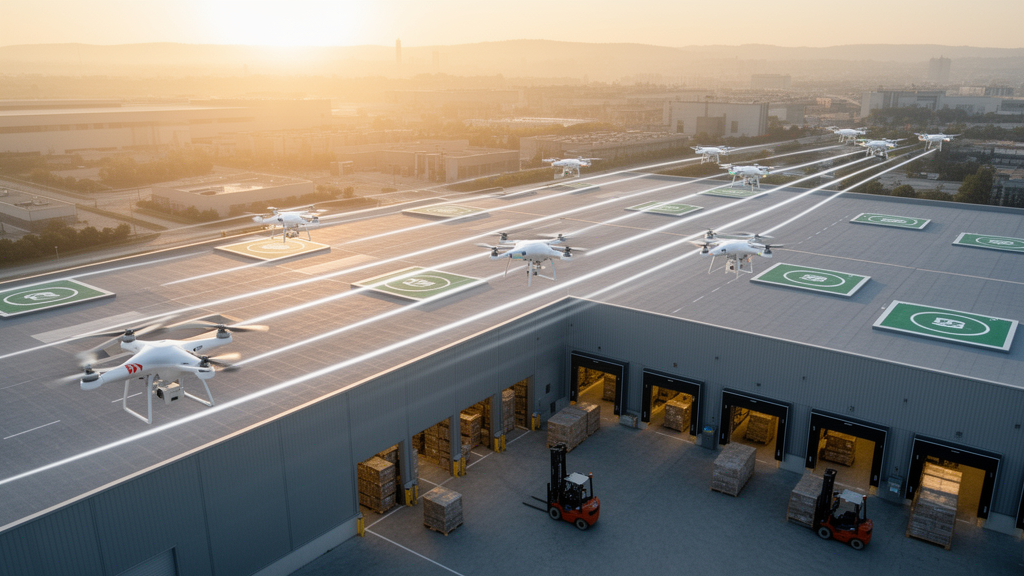
The low-altitude economy—the rapidly emerging sector of eVTOL aircraft, delivery drones, and urban air services operating below conventional aviation—has moved from vehicle prototypes to the difficult question of how thousands of aircraft will actually be coordinated over cities. A perspective paper published in Aerospace Systems on 23 October 2026 by researchers at the Technical University of Munich (TUM) and Shanghai Jiao Tong University (SJTU) argues that part of the answer already exists, on the ground. Led by Johannes Fottner, Felix Top, Tingyu Huang, Florian Holzapfel, and Haichao Hong, the authors propose systematically transferring control methods from industrial intralogistics—the discipline that runs automated warehouses, hospital transport networks, and distribution centers—to aerial logistics, but only through a structured filter they call Bounded Adaptation.
The paper’s central observation is topological. An automated 3D-shuttle warehouse, with its vertical layers, dynamically allocated slots, and conflict resolution at network nodes, shares a structural resemblance to a layered urban air corridor network. Both must manage slot contention, buffer allocation, priority override, and deadlock avoidance across a network of interconnected nodes. The authors treat the low-altitude economy as a high-frequency material flow system and propose Material Flow Control (MFC), the dispatching discipline of industrial intralogistics, as a complement to classical Air Traffic Management (ATM). Where ATM centers on the vehicle and its separation and safety, MFC centers on the cargo mission and its throughput, priority, and routing—both layers, the authors argue, are necessary for the sector to function at scale.
The Bounded Adaptation framework is the paper’s core methodological contribution. It assesses each potential transfer along five dimensions, comparing the intralogistics source method with the low-altitude target. If the deviation in a dimension stays within an acceptable adaptation window, the method is directly portable. If the deviation exceeds a defined threshold but a validated adaptation mechanism exists, the transfer is admissible after bounded modification. If no such mechanism exists, the transfer is ruled inadmissible. The authors stress that these thresholds are conceptual at this stage and require quantitative calibration through simulation and field data—an explicit reminder that the framework is a research proposal, not a tested operational system.
Two aviation-specific constraints dominate the analysis and appear throughout as hard conditions. The first is the Cannot-Stop Constraint: unlike an automated guided vehicle or a conveyor, an airborne vehicle has no energy-neutral safe-stop state at an arbitrary point in the network. Hovering, loitering, diversion, and emergency landing are possible but consume energy and require suitable airspace or infrastructure. The authors ground this constraint in published graph-theoretic results showing that node-disjoint trajectories without waiting at nodes are computable in polynomial time for certain topologies such as paths, grids, and meshes. The second constraint is contingency-aware routing: every route must be planned not only for nominal operation but for a defined set of degraded states, with pre-planned contingency corridors and safe-landing options at every point.
An illustrative example shows how the framework converts qualitative analogy into an auditable transfer decision. High-throughput dispatching logic validated in laboratory automation—specifically a Roche laboratory system—is a candidate for vertiport slot management. Along the stoppability dimension, however, the deviation is maximal: laboratory systems assume a safe halt is possible anywhere, whereas aerial operations require continuous motion with pre-planned contingency trajectories. In its unmodified form the transfer fails. The proposed adaptation embeds mandatory contingency slot reservations and fallback trajectory sets into the dispatching logic, preserving the core priority-based principle while satisfying the cannot-stop constraint. A parallel example transfers resilience mathematics from hospital intralogistics: Fault Tree Analysis and Monte Carlo simulation methods developed for double-failure and deadlock scenarios at Karolinska Hospital provide a domain-agnostic foundation for network resilience analysis, though aviation certification requirements demand significant adaptation.
Architecturally, the paper proposes a Comprehensive Digital Twin built on a bi-level coupling of two simulation worlds. The upper level is a Discrete-Event Simulation (DES) dispatching layer that assigns time slots to missions, sorting them by priority class—for instance, medical emergency traffic above express cargo above routine deliveries—and selecting slots to minimize weighted combinations of delay, energy, and conflict probability. The lower level is a continuous flight-dynamics simulation, drawn from published SJTU work on eVTOL trajectory optimization, controllability and maneuverability assessment, and energy-efficient control allocation, which verifies that proposed missions are physically feasible. The two levels are asynchronous by design: the upper level dispatches at minute-scale mission granularity, the lower level evaluates trajectories at second-scale granularity, and results propagate upward as constraint updates on the next dispatch cycle. Whether full bidirectional coupling under peak traffic loads remains within real-time bounds is identified as an open question.
Safety assessment forms the third pillar, aligned with SORA 2.5, the Specific Operations Risk Assessment methodology that became the operative European framework in September 2025 and introduces quantitative ground-risk assessment based on actual population density. Because safety-relevant events such as near-collisions are rare by regulatory design, standard Monte Carlo simulation cannot estimate their probabilities without prohibitive computational cost. The authors employ Rare Event Simulation and Subset Simulation using Markov Chain Monte Carlo sampling; a previously validated study of mid-air collision risk demonstrated that an importance-sampling variant can deliver risk estimates in under one second, compatible in principle with the dispatching layer. The framework additionally proposes sizing the SORA 2.5 Containment Volume to bound the 95th-percentile ground impact footprint rather than merely the expected trajectory deviation—a design choice of the authors, not a prescribed regulatory requirement. Because the containment volume physically narrows the usable corridor width, achievable throughput becomes a direct, spatially resolved function of population density.
The paper’s overarching research question—what operational capacity can be expected when SORA 2.5 requirements are fully met—remains deliberately unanswered. An illustrative order-of-magnitude scenario spectrum demonstrates the computability of this capacity-safety frontier, but the authors state plainly that it is not a SORA-compliant capacity calculation and not a validated result. Similarly, the NASA ATM-X Dallas/Fort Worth reference scenario, a seven-vertiport benchmark in which 694.63 minutes of total delay accumulated across 40 flights with 62.5 percent of aircraft affected absent active demand-capacity balancing, is adopted only as a candidate future validation baseline, not as evidence that the proposed Material Flow Control layer improves performance. The paper also documents prior work demonstrating that First-Come-First-Served allocation produces systematically inequitable outcomes, motivating priority-based dispatching as a research direction.
The institutional complementarity between the two universities shapes the proposed agenda. China has placed the low-altitude economy at the center of its economic strategy, with projected market volumes of 1.5 trillion yuan by 2025 and 3.5 trillion yuan by 2035, and mandatory national standards GB 46761-2025 and GB 46750-2025, in force since May 2026, establish digital identification with one-second position reporting over 5G-Advanced infrastructure. Shenzhen’s Smart Integrated Lower Airspace System (SILAS) provides a functioning urban-scale traffic management environment whose data streams could calibrate the digital twin. The authors argue that the genuinely European assets are methodological rather than regulatory: a Safety Mindset and structured probabilistic assessment methods that could complement China’s enforcement-first monitoring, while the dense Chinese position-reporting data stream could, in turn, supply exactly the calibration data that European Rare Event Simulation requires. On the European side, DLR’s VERTIFIED infrastructure at Cochstedt is identified as the emerging physical testing complement.
The authors are explicit about the limits of their claim and their evidence. The framework, the bi-level architecture, and the ten transfer parallels—each anchored in validated industrial projects of TUM’s fml laboratory but not yet demonstrated in low-altitude settings—are partially formalized constructs illustrated through reference scenarios. No large-scale simulation or field validation has been performed; the MFC dispatching layer has not been benchmarked against ATM-only baselines; the adaptation thresholds are argued from first principles and expert judgment; access arrangements to SILAS data are not yet formalized. Bounded Adaptation is framed as protection against overtransfer as much as an argument for transfer, with an explicitly non-empty class of inadmissible methods. The paper also anticipates adversarial behavior—operators gaming slot allocations or deviating from routes—and sketches three mechanism-design countermeasures, including commitment deposits and automatic priority downgrades driven by position-reporting compliance signals. Its honest framing of a long validation road is arguably what makes the paper a credible starting point: a structured research architecture from which benchmark studies, SILAS-connected experiments, and quantitative answers to the capacity-safety question are intended to follow in subsequent publications.
Subject of Research: A conceptual framework for transferring industrial intralogistics control methods to low-altitude aerial logistics operations
Article Title: Logistics architectures for the low-altitude economy: a bounded-adaptation framework for transferring intralogistics control methods
Article References: Fottner, J., Top, F., Huang, T., Holzapfel, F., & Hong, H. (2026). Logistics architectures for the low-altitude economy: a bounded-adaptation framework for transferring intralogistics control methods. Aerospace Systems. https://doi.org/10.1007/s42401-026-00562-2
Image Credits: AI Generated
DOI: 10.1007/s42401-026-00562-2
Keywords: low-altitude economy, intralogistics, eVTOL, Material Flow Control, air traffic management, SORA 2.5, digital twin, discrete-event simulation, rare event simulation, urban air mobility, vertiports, TUM SJTU collaboration
Cite Scienmag News
Denise Maddox. (October 23, 2026). Warehouse Logic for the Skies: Framework Maps Intralogistics Methods onto Low-Altitude Drone Economies. Scienmag. https://scienmag.com/warehouse-logic-for-the-skies-framework-maps-intralogistics-methods-onto-low-altitude-drone-economies/
Denise Maddox. "Warehouse Logic for the Skies: Framework Maps Intralogistics Methods onto Low-Altitude Drone Economies." Scienmag, 23 October 2026, https://scienmag.com/warehouse-logic-for-the-skies-framework-maps-intralogistics-methods-onto-low-altitude-drone-economies/. Accessed 23 October 2026.
Denise Maddox. "Warehouse Logic for the Skies: Framework Maps Intralogistics Methods onto Low-Altitude Drone Economies." Scienmag. October 23, 2026. https://scienmag.com/warehouse-logic-for-the-skies-framework-maps-intralogistics-methods-onto-low-altitude-drone-economies/


