


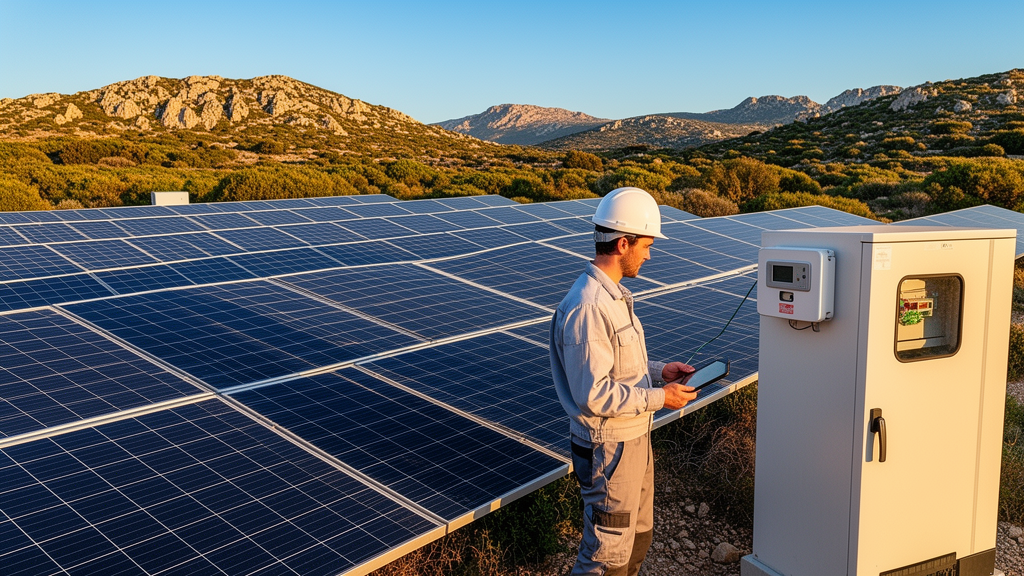
On a working farm in the small Sardinian town of Marrubiu, a 100-kilowatt-peak photovoltaic installation spent 177 days quietly proving that carbon credits can be minted automatically from rooftop sunshine. A research team spanning the Universities of Hohenheim, Camerino, Palermo and Cagliari, together with the Italian technology company SEEDS, deployed a four-layer blockchain and Internet of Things (IoT) system that measured the plant’s energy output, batched the readings, and wrote them to an immutable ledger. Between 1 November 2025 and 26 April 2026, the installation recorded 42,853.98 kilowatt-hours of exchanged energy and generated 11.87 tonnes of carbon dioxide equivalent (tCO2e) in blockchain-certified carbon credits, with the entire chain of evidence preserved on a Hyperledger Fabric network.
The significance of the pilot lies less in the headline numbers than in its status. Most published blockchain carbon-credit systems remain conceptual, demonstrated only through simulations or prototypes. A technology-readiness assessment of 39 blockchain projects for carbon markets found that most initiatives stall at the proof-of-concept stage, hampered by fragmented measurement, reporting and verification (MRV) data and unresolved legal recognition rather than by any limitation of ledger technology itself. A systematic review of IoT and blockchain approaches to carbon-credit generation from energy saving, covering 14 studies between 2013 and 2024, reached a blunter conclusion: no study had reported a real-world deployment with actual stakeholders. The Sardinian installation provides the empirical counterpart to that literature, reporting live production data, field failures and their fixes rather than architectural drawings.
The architecture follows the four layers the team had previously proposed in a design-stage paper that explicitly left field validation as future work. At the bottom, eight Shelly Pro 3 EM three-phase smart meters monitor 24 electrical phases across the plant, sampling active power, voltage, current, power factor, frequency and apparent power every one to two seconds. Each meter measures line current through split-core current transformers clamped on the alternating-current side of the conductors between the inverters and the grid connection point, and publishes readings over the local network using the lightweight MQTT messaging protocol, whose configurable quality-of-service levels support reliable delivery during brief connectivity loss.
The data collection layer consists of two Raspberry Pi units, Collector A and Collector B, each listening to the MQTT topics of its assigned group of four meters. A subscriber service holds the most recent measurement of every phase in memory and writes synchronised CSV records exactly at the zero-second boundary of each minute, yielding 1,440 records per day per phase. Enforcing minute-boundary writes on both collectors eliminates timestamp skew and keeps all 24 phases aligned. A freshness threshold of 120 seconds guards against false zero-power readings: if a meter’s last reading arrived within the window, the most recent value is logged; otherwise the write is skipped and a monitoring warning is raised.
A third edge-computing node forms the aggregation layer, reading the collectors’ files over the network, computing plant-wide totals, and batching minute-level data into five-minute intervals. This reduces potential blockchain submissions from 1,440 per day to a theoretical maximum of 288. The blockchain and certification layer then runs on Hyperledger Fabric, a permissioned platform chosen over public alternatives for four documented reasons: near-zero transaction costs, contrasted with an estimated 500 to 2,500 euros per year for Ethereum; privacy through private channels compatible with the General Data Protection Regulation; performance of up to 3,500 transactions per second with two to three second latency, against Ethereum’s roughly 30 transactions per second and 20 second latency; and low energy consumption, reported at about 0.5 kilowatt-hours, consistent with the sustainability goals of the project itself.
Inside the network, three cooperating smart contracts written in TypeScript chaincode govern the certification logic. SensorContract stores aggregated measurements submitted by the aggregation node, discarding negative power values that would represent grid import rather than production. ControllerContract periodically retrieves stored measurements and converts them into carbon credits using a reference emission factor of 0.4368 tCO2 per megawatt-hour, the Italian gross thermo-electricity production factor for reference year 2022 as published in ISPRA Reports 404/2024 by the Italian Institute for Environmental Protection and Research. The choice assumes that photovoltaic generation displaces an equivalent amount of thermo-electric generation on the Italian grid. Measurements exceeding a configured reference value of 110,000 watts are excluded as implausible and stored on-chain as anomaly records, preserving an auditable trace of their rejection. AccountContract then mints credits into per-identity balances, with minting and burning restricted to the controller identity.
Certificates are generated on demand from a dashboard. Each certificate identifier is the Fabric transaction identifier associated with issuance, which links the human-readable document to a unique, immutable ledger entry. An auditor can search the identifier in the Fabric Explorer and compare the corresponding ledger transaction directly with the certificate data, providing a verification path from document to blockchain record without requiring access to raw sensor data. Each block carries a cryptographic hash linking it to its predecessor, making the full historical record tamper-evident. As of 9 August 2026, the ledger contained 70,620 blocks and 73,575 application transactions: 49,642 measurement writes, 23,913 credit-calculation executions, 11 certificate issuances and 9 configuration transactions. During normal operation the ledger grew at a combined design rate of 384 blocks per day, 288 from data collection and 96 from the controller’s 15-minute scheduling loop.
The deployment also demonstrated anomaly handling in production. The system implements two distinct mechanisms: readings above the power threshold are rejected as invalid, and missing five-minute readings caused by connectivity loss are detected, logged and recovered through retransmission. From the first logged event on 17 November 2025 through the end of the pilot, the system recorded 8,048 retransmission events, roughly 30.5 percent of the 26,392 valid measurements recorded. Retransmission values ranged from 0.00 kilowatt-hours in pre-dawn intervals to 5.44 kilowatt-hours at midday peaks. An apparent spike of 2,247.73 kilowatt-hours attributed to 30 March 2026 turned out to be a connectivity outage followed by bulk retransmission, which the dashboard credited to the recovery date. Notably, retransmitted readings whose original timestamps predate the controller’s latest-read key are stored on-chain but not re-evaluated for crediting: hence the gap between the dashboard total of 42,853.98 kilowatt-hours and the approximately 27,180 kilowatt-hours that actually entered the carbon credit calculation.
Early operation surfaced three field challenges that the theoretical design had not anticipated. The electrical panel enclosure was too small to house all the meters, forcing a mixed installation with some devices mounted directly on the inverters. Wi-Fi signal instability inside the enclosures caused intermittent transmission, resolved by repositioning the inverters for a stable signal. And a synchronization flaw allowed 539 five-minute windows to be submitted more than once before the fix on 13 November 2025, producing 567 extra ledger entries that inflated the raw on-chain totals by 682.08 kilowatt-hours and 0.298 tCO2e, about 2.51 percent of certified credits; deduplicated totals are approximately 42,172 kilowatt-hours and 11.57 tCO2e, and the raw figures were not retrospectively corrected. Eleven pilot days were lost entirely to a collector malfunction, leaving measurement data for 166 of the 177 days.
The authors are careful about what the ledger does and does not prove. Blockchain certifies the provenance of what was recorded, not the accuracy of the underlying measurements; independent validation of meter calibration, firmware and electromagnetic conditions remains an open requirement before these credits can enter formal voluntary market verification workflows. The aggregation node also concentrates a single point of failure between sensing and ledger, and the certification gap left by late retransmissions suggests the need for recovery-aware crediting mechanisms. Regulatory context matters too: photovoltaic-based credits fall outside the EU Emissions Trading System and the new EU carbon-removal certification framework, so voluntary carbon markets such as Verra and Gold Standard are the viable pathway, where the system directly supports measurability, verification and uniqueness while additionality and permanence remain the operator’s responsibility. With results from a single site and no cost-benefit analysis yet performed, the team’s stated next steps are replication at more SME sites, integration with accredited verification bodies, and anchoring the permissioned records onto a public blockchain for public verifiability without exposing sensitive production data.
Subject of Research: Empirical field deployment of a blockchain–IoT framework for automated carbon credit certification at an agricultural solar SME
Article Title: Deployment and empirical validation of a blockchain–IoT framework for carbon credit certification in renewable energy SMEs
Article References: Vaccargiu, M., Ullah, A., Gallo, P., Capizzi, G., Cannizzaro, F. S., Lunesu, M. I., & Tonelli, R. (2026). Deployment and empirical validation of a blockchain–IoT framework for carbon credit certification in renewable energy SMEs. Frontiers in Blockchain, 9, 1947901. https://doi.org/10.3389/fbloc.2026.1947901
Image Credits: AI Generated
DOI: 10.3389/fbloc.2026.1947901
Keywords: blockchain, carbon credits, IoT, Hyperledger Fabric, renewable energy, SME, photovoltaic, smart meters, carbon certification, Sardinia, smart contracts, MRV
Cite Scienmag News
Alan Morgan. (October 23, 2026). Blockchain and smart meters certify carbon credits on a Sardinian solar farm. Scienmag. https://scienmag.com/blockchain-and-smart-meters-certify-carbon-credits-on-a-sardinian-solar-farm/
Alan Morgan. "Blockchain and smart meters certify carbon credits on a Sardinian solar farm." Scienmag, 23 October 2026, https://scienmag.com/blockchain-and-smart-meters-certify-carbon-credits-on-a-sardinian-solar-farm/. Accessed 23 October 2026.
Alan Morgan. "Blockchain and smart meters certify carbon credits on a Sardinian solar farm." Scienmag. October 23, 2026. https://scienmag.com/blockchain-and-smart-meters-certify-carbon-credits-on-a-sardinian-solar-farm/


