


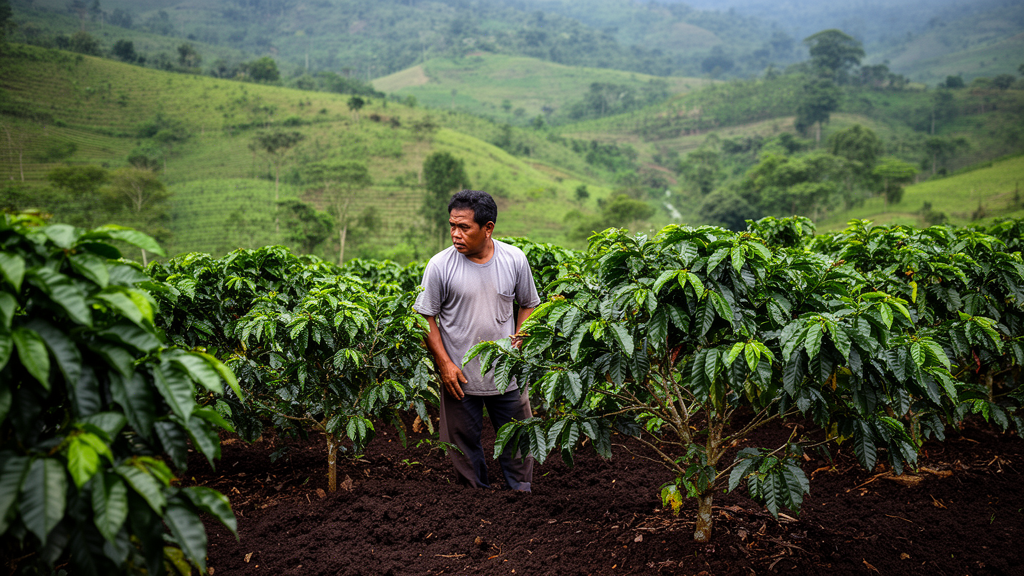
The future of Kapeng Barako, the distinctive Liberica coffee grown around Lipa City in the Philippine province of Batangas, is being squeezed from two directions at once: the farms themselves are shrinking, and the farmers who remain say they cannot count on stable prices when they sell. Those are the central impressions emerging from a mixed-method descriptive study of the city’s traditional coffee sector, published in Frontiers in Environmental Economics by researchers at Batangas State University. The study surveyed 100 purposively selected coffee farmers and two local coffee-industry owners between January and March 2021, supplementing the questionnaire with key-informant interviews and focus-group discussions. Its authors are careful to frame the results as a picture of what participating stakeholders perceive and experience, not as a measurement of how price swings or trading conditions actually change farmer income.
The production profile that emerged is unmistakably smallholder. Forty-one percent of the surveyed farmers cultivated half a hectare or less, 48 percent farmed between one and five hectares, and only 11 percent worked more than five hectares; not a single respondent fell in the narrow band between half a hectare and one hectare. Three-quarters of the farmers owned the land they cultivated, while a quarter rented. Liberica, the variety behind the Barako name, was reported by 49 percent of respondents, followed by Robusta at 30 percent, Excelsa at 19 percent, and a marginal 2 percent growing Arabica. Farming was overwhelmingly traditional or natural, reported by 91 percent, and processing was dominated by the dry method at 95 percent, with only 5 percent using wet processing.
Production volumes were modest across the board. Thirty-eight percent of farmers harvested less than 50 kilograms of coffee per year, 20 percent produced between 50 and 100 kilograms, 31 percent fell in the 101-to-500-kilogram range, and only 4 percent and 7 percent reached the 501-to-1,000-kilogram and above-1,000-kilogram categories respectively. Marketing was equally localized: 80 percent of farmers sold primarily to local markets, 18 percent sold through traders, and 2 percent kept their harvest for household consumption. Some respondents described less favorable terms when dealing with traders, particularly when coffee was sold soon after harvest or before drying and quality were complete. Because the study collected no transaction-level farmgate prices or price differentials, the researchers treat these statements as reported market experiences rather than verified price effects.
When farmers rated a list of constraints on a four-point agreement scale, one production concern rose above everything else: shrinkage of coffee plantations, with a weighted mean of 3.74, interpreted as Strongly Agree. In the market and profitability domain, the standout item was ineffective regulation and instability of market prices and coffee-cherry trading, rated at a weighted mean of 3.14, or Agree. Notably, the composite mean for that entire domain was only 1.76, in the Disagree range, which means the price-and-trading item stood out within the domain rather than reflecting uniformly high concern across all profitability questions. Competition from imported and instant coffee, for instance, was rated at just 2.29, and items on low demand or failure to maintain quality processing scored as low as 1.26.
Farm continuity emerged as the other cluster of strongly endorsed concerns. Non-participation of the young generation in farming received a weighted mean of 3.71, also in the Strongly Agree range, followed by the long duration before coffee can be harvested at 3.48 and delayed profit and returns at 3.36, both rated Agree. Lack of assistance for other coffee income-generating projects scored 3.00. Yet the financial-capacity items told a different story: lack of funds for sustaining coffee trees and soil health, and lack of capital for seed selection and growing, were both rated Disagree, at 1.93 and 1.88 respectively. The composite mean for the whole domain was 2.42. This pattern matters because it suggests the pressure farmers described concerned the timing of returns rather than an outright shortage of money.
The qualitative strand of the study, drawn from eight key-informant interviews and two focus groups of eight farmers each, produced four recurring themes. The first, shrinking farm area and continuity, confirmed the two most strongly endorsed survey items and expanded on them: participants attributed farm-area reductions to land conversion, the burden of maintenance, decisions to sell portions of agricultural land to meet immediate financial needs, and younger household members pursuing non-farm careers. The second theme, cash-flow-driven selling, described farmers selling dried or newly harvested coffee quickly for immediate cash and relying on intercropping or other activities while waiting for the next harvest. Neither strand, the researchers note, measured the actual extent or rate of farm-area change, and because the timing of sale and prices received were never recorded, the income consequences of early selling could not be assessed.
The third theme, processing and quality upgrading, revealed the study’s most interesting divergence. Farmers and industry participants alike described a need for improved drying, processing, and farming methods, and the leadership of the Samahan ng Magkakape farmer association emphasized the importance of processing quality in relation to pricing. The two industry owners confirmed this in their ratings, scoring inability to upgrade processing methods at 3.00 and inability to upgrade farming methods such as rejuvenation and clonal grafting at 2.50, both Agree. The farmer survey, however, was discordant: failure to maintain quality processing from harvest to finished product was rated Strongly Disagree at 1.26. The authors suggest this gap may reflect the difference between maintaining current quality and upgrading methods, or simply the different vantage points of producers and processors. Because quality grades and associated prices were never measured, the link between processing quality and price remains a participant perspective rather than an established relationship.
The fourth theme pointed toward stronger market coordination. Participants repeatedly linked their concerns about price setting and trading to the need for better farmer organization, market coordination, and public-sector support. The survey confirmed the salience of the concern while also sharpening its location: farmers did not report lacking knowledge of the factors affecting coffee prices, at 1.69, or of trading and marketing, at 2.12, both Disagree. That suggests their anxiety was directed at market-level price setting and coordination rather than at their own understanding. The two owners rated government regulation of coffee trading at 2.50, Agree, but did not rate price-risk mitigation as a business challenge, at 1.00. With only two owners, the researchers caution, no meaningful comparison with farmers is possible.
The study’s limitations are laid out with unusual candor. The population figure of roughly 200 to 250 farmers came from association membership records rather than a complete census, and some active coffee farmers in Lipa do not belong to organized groups. Purposive sampling, while useful for identifying information-rich participants in the absence of a full sampling frame, can introduce selection bias, so the results describe the surveyed stakeholders and cannot be generalized to all Lipa coffee producers. The industry-owner component rested on just two respondents. The surviving qualitative files lack a complete coding matrix, saturation record, and speaker-attributed verbatim transcripts, so no direct quotations were reconstructed, and the qualitative evidence is limited to paraphrased, group-attributed accounts. The questionnaire showed acceptable internal consistency with an overall Cronbach’s alpha of 0.87, but domain-specific coefficients were not reported.
What the study ultimately delivers is a prioritized map for future measurement rather than proof of economic harm. Because no inferential, causal, or econometric analyses were conducted, the findings cannot establish whether perceived price instability, trading conditions, delayed returns, or processing constraints actually affect farmer income or profitability, or whether perceptions differ systematically across farm-size, tenure, or marketing-channel groups. The authors propose locally testable steps instead of presumed solutions: the Lipa City Agriculture Office and farmer organizations could document and disseminate quality-specific farmgate prices and trading conditions, while public agencies, the university, farmer groups, and coffee enterprises could pilot farm rehabilitation, shared drying or processing facilities, and youth-oriented enterprise activities, measuring changes in quality, cost, price received, and producer margin before any scale-up. For a coffee tradition as culturally loaded as Barako, the message is that saving it will require not just sentiment but systematic data on what farmers actually receive at the farmgate.
Subject of Research: Perceived production, marketing, and continuity constraints among Kapeng Barako Liberica coffee farmers in Lipa City, Philippines
Article Title: Production characteristics, marketing channels, and stakeholder-perceived constraints in Lipa City's Kapeng Barako sector: a mixed-method descriptive study
Article References: Extra, S. S., Malaluan, N. E., Austria, L. A., & Lumbera, M. L. (2026). Production characteristics, marketing channels, and stakeholder-perceived constraints in Lipa City's Kapeng Barako sector: a mixed-method descriptive study. Frontiers in Environmental Economics, 5, Article 1957600. https://doi.org/10.3389/frevc.2026.1957600
Image Credits: AI Generated
DOI: 10.3389/frevc.2026.1957600
Keywords: Kapeng Barako, Liberica coffee, Lipa City, Philippines, smallholder farmers, mixed methods, coffee value chain, price instability, farm continuity, youth participation, dry processing, marketing channels
Cite Scienmag News
Violet Maxwell. (October 23, 2026). Philippine Barako Coffee Farmers Flag Shrinking Farms and Price Instability in New Survey. Scienmag. https://scienmag.com/philippine-barako-coffee-farmers-flag-shrinking-farms-and-price-instability-in-new-survey/
Violet Maxwell. "Philippine Barako Coffee Farmers Flag Shrinking Farms and Price Instability in New Survey." Scienmag, 23 October 2026, https://scienmag.com/philippine-barako-coffee-farmers-flag-shrinking-farms-and-price-instability-in-new-survey/. Accessed 23 October 2026.
Violet Maxwell. "Philippine Barako Coffee Farmers Flag Shrinking Farms and Price Instability in New Survey." Scienmag. October 23, 2026. https://scienmag.com/philippine-barako-coffee-farmers-flag-shrinking-farms-and-price-instability-in-new-survey/


