


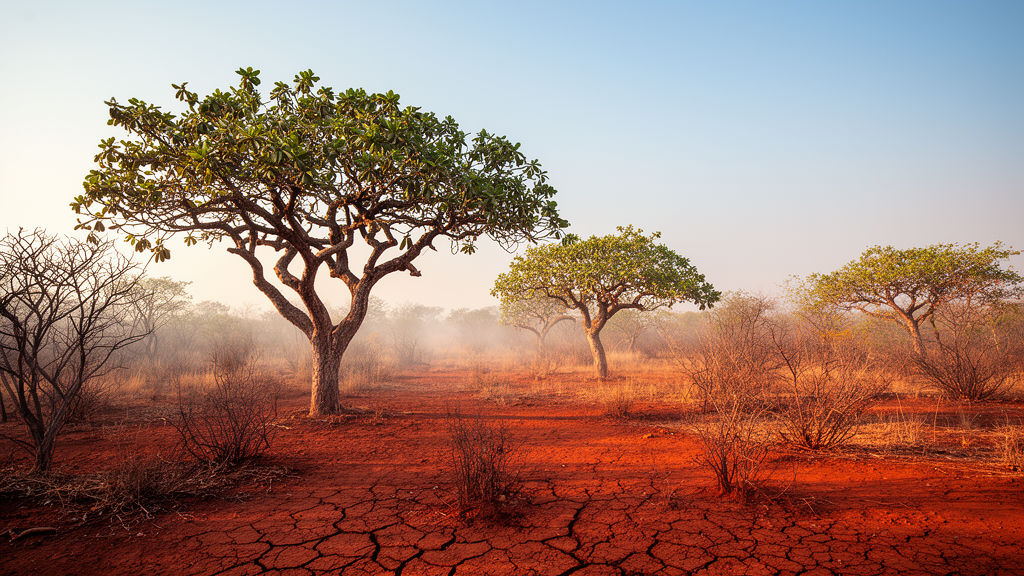
Cashew, one of the most economically and socially important perennial crops of Brazil’s semiarid backlands, could lose the majority of its environmentally suitable habitat within decades, according to a new modeling study published in Frontiers in Earth Science. Using species distribution modeling coupled with state-of-the-art climate projections, researchers found that under a high-emissions scenario the area of the Caatinga biome suitable for the cashew tree (Anacardium occidentale) could shrink by between 68 and 76 percent across the projected horizons of 2050 and 2070, with the species’ niche retreating toward coastal and sub-humid refugia that correspond to its historical origins.
The study, led by Luciana Vieira Cristina de Sousa Vieira of the University of São Paulo together with colleagues at Brazil’s National Institute for Space Research (INPE), Embrapa and partner institutions, addressed a question with direct consequences for rural livelihoods: how shifting temperature and rainfall regimes may reshape the environmental suitability of a native dryland species that supports extractive economies across the Brazilian semiarid region. Because the cashew is both a cultivated crop and a naturally adapted component of tropical dry ecosystems, its projected fate has implications for conservation planning and sustainable land use in the biome.
To build the models, the team compiled occurrence records for the species from three major biodiversity databases: the Global Biodiversity Information Facility (GBIF), SpeciesLink, and Embrapa’s own collections. The records were then refined through ecological filtering and pedoclimatic zoning before being used to train the model.
The modeling itself relied on MaxEnt, version 3.4.4, a maximum-entropy approach that estimates the probability of species presence from occurrence localities and a set of environmental predictors. Here the predictors were bioclimatic variables derived from two Earth System Models contributing to the CMIP6 intercomparison: EC-Earth3-Veg and MIROC6. The team ran projections under two shared socioeconomic pathways, SSP2-4.5 representing intermediate emissions and SSP5-8.5 representing a high-emissions future, for two future time horizons, 2050 and 2070, alongside a baseline period describing current conditions.
The baseline model performed strongly, achieving an area under the curve (AUC) of approximately 0.88, a value generally considered indicative of high predictive discrimination. Under present-day conditions, roughly a quarter of the Caatinga, about 25 percent of the biome, was classified as highly suitable for cashew, defined as suitability of 0.5 or higher on the model’s continuous scale. That suitable core is concentrated mainly in the northern portion of the biome, an area where moisture and habitat conditions currently align with the species’ requirements.
Which environmental variables mattered most proved especially informative. Suitability patterns were driven primarily by precipitation seasonality, total annual rainfall, elevation, and vegetation cover. In other words, the cashew’s footprint in the Caatinga is fundamentally gated by water: not just how much rain falls in a year, but how reliably it is distributed across seasons. The importance of vegetation cover points to a dependence on habitat structure, suggesting that the species thrives where moisture availability and intact plant communities coincide.
The future projections tell a starker story. Under the high-emissions SSP5-8.5 scenario, suitable area contracted dramatically, with modeled losses of 68 percent in the EC-Earth3-Veg projections and 76 percent in those from MIROC6. Importantly, both climate models independently pointed in the same direction: rising temperatures combined with reduced seasonal precipitation are projected to intensify aridification across the interior of the biome, pushing conditions beyond the cashew’s tolerance and driving a spatial retreat of the species’ climatic niche toward coastal and sub-humid zones. Those refugia, the authors note, coincide with the historical origin of the species and its current strongholds, meaning the tree would in effect be pushed back toward the margins of its ancestral range.
The researchers frame these findings as evidence of high vulnerability for Anacardium occidentale under continued climate change, and they emphasize two practical implications. First, conserving coastal and sub-humid microrefugia becomes a priority, since these areas are projected to remain suitable and may serve as reservoirs for the species and its associated extractive systems. Second, climate-adaptive management strategies will be needed to sustain the rural livelihoods that depend on cashew production in the semiarid interior.
As a modeling study, the work projects potential distributions rather than observed population changes, and its conclusions are bounded by the assumptions of the emission scenarios and the two climate models used. Nevertheless, the consistent agreement between independent Earth System Models lends weight to the central warning that the heart of Brazil’s cashew country faces a hotter, drier, and considerably less hospitable future.
Subject of Research: Projected contraction of suitable habitat for the cashew tree in the Caatinga biome under CMIP6 climate change scenarios
Article Title: Potential distribution of the cashew tree (Anacardium occidentale) in the Caatinga under CMIP6 climate projections from EC-Earth3-Veg and MIROC6
Article References: Vieira, L. C. D. S., Brandão, D. O., Serrano, L. A. L., Martins, M., Castro, A. A. D., Von Randow, C., Von Randow, R. D. C. S., Santos, D. J., & Nobre, C. A. (2026). Potential distribution of the cashew tree (Anacardium occidentale) in the Caatinga under CMIP6 climate projections from EC-Earth3-Veg and MIROC6. Frontiers in Earth Science, 14, Article 1751554. https://doi.org/10.3389/feart.2026.1751554
Image Credits: AI Generated
DOI: 10.3389/feart.2026.1751554
Keywords: cashew, Anacardium occidentale, Caatinga, CMIP6, MaxEnt, species distribution modeling, aridification, Brazil semiarid, SSP5-8.5, climate refugia, precipitation seasonality, Frontiers in Earth Science
Cite Scienmag News
Sloane Callahan. (October 23, 2026). Climate Change Could Wipe Out Most Suitable Cashew Habitat in Brazil’s Caatinga. Scienmag. https://scienmag.com/climate-change-could-wipe-out-most-suitable-cashew-habitat-in-brazils-caatinga/
Sloane Callahan. "Climate Change Could Wipe Out Most Suitable Cashew Habitat in Brazil’s Caatinga." Scienmag, 23 October 2026, https://scienmag.com/climate-change-could-wipe-out-most-suitable-cashew-habitat-in-brazils-caatinga/. Accessed 23 October 2026.
Sloane Callahan. "Climate Change Could Wipe Out Most Suitable Cashew Habitat in Brazil’s Caatinga." Scienmag. October 23, 2026. https://scienmag.com/climate-change-could-wipe-out-most-suitable-cashew-habitat-in-brazils-caatinga/


