

Friday, October 23, 2026
Science
No Result
View All Result
  • Login
  • HOME
  • SCIENCE NEWS
  • CONTACT US
  • HOME
  • SCIENCE NEWS
  • CONTACT US
No Result
View All Result
Scienmag
No Result
View All Result
Home Science News Technology and Engineering

Simulations reveal why copper-aluminum cable welds fail at the edges

October 23, 2026
in Technology and Engineering
Denise Maddox
By Denise Maddox Scienmag Editorial Profile - Mechanical Engineering
Reading Time: 2 mins read
0
Simulations reveal why copper-aluminum cable welds fail at the edges

Simulations reveal why copper-aluminum cable welds fail at the edges

65
SHARES
587
VIEWS
Share on FacebookShare on Twitter
ADVERTISEMENT

Engineers who join copper and aluminum cables with ultrasonic welding now have a clearer picture of what weakens the resulting joints, thanks to a finite element study published in Scientific Reports. A research team led by X. M. Cheng developed a thermomechanical coupling model of the process using Abaqus software, and used it to pinpoint where stress builds up inside a welded connection and how the tiny gaps left between wires shape the joint’s final strength.

Ultrasonic welding bonds metals through high-frequency vibration under pressure, generating frictional heat and intense plastic deformation at the interface. Capturing that interplay in a simulation is difficult, because the materials soften both from heating and from the ultrasonic vibrations themselves. The model therefore incorporated ultrasonic softening and thermal softening effects on the yield strength of the copper and aluminum cables, alongside a heat flux representing frictional heat generation and the heat produced by plastic deformation at the weld interface.

The team checked the model against reality by comparing its predictions with temperature measurements and morphological analysis of actual welded joints, reporting that the simulation proved both efficient and accurate. That validation matters, because the model’s conclusions about joint quality rest on whether it reproduces the real thermal and mechanical conditions inside a weld.

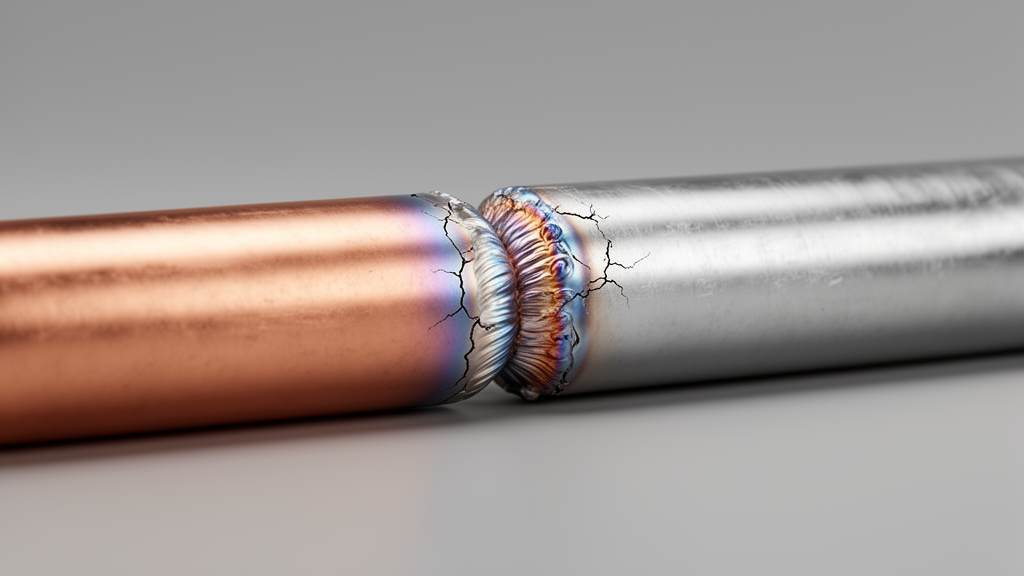
The simulation results point to a specific culprit for joint degradation: stress concentration at the edges of the aluminum wires. According to the study, this edge concentration reduces the effective load-bearing area of the joint, which the researchers identify as the primary cause of weakened connections. In practical terms, the parts of the joint that should carry mechanical load are instead undermined by localized stress at wire boundaries.

The study also examined the gaps that remain within the joint after welding. The analysis indicated that joint quality is optimal when the total gap volume is approximately 2.36 cubic millimeters, a condition under which the tensile strength reached 398.6 newtons at a welding energy of 300 joules. Because the work is a simulation study validated against measured temperatures and joint morphology, its conclusions describe modeled behavior supported by those comparisons rather than direct observations of every welding scenario.

Subject of Research: Finite element modeling of ultrasonic welding of copper/aluminum cables and joint gap characteristics

Article Title: Ultrasonic welding of Cu/Al cables: a study on the finite element model and characteristics of the gaps

Article References: Cheng, X. M., Liu, F. Y., Pan, X. T., & Yang, K. (2026). Ultrasonic welding of Cu/Al cables: a study on the finite element model and characteristics of the gaps. Scientific Reports. https://doi.org/10.1038/s41598-026-77425-5

Image Credits: AI Generated

DOI: 10.1038/s41598-026-77425-5

Keywords: ultrasonic welding, copper-aluminum cables, finite element model, thermomechanical coupling, Abaqus, stress concentration, joint gaps, tensile strength, weld interface, Scientific Reports, Ultrasonic, welding

Cite Scienmag News

Denise Maddox. (October 23, 2026). Simulations reveal why copper-aluminum cable welds fail at the edges. Scienmag. https://scienmag.com/simulations-reveal-why-copper-aluminum-cable-welds-fail-at-the-edges/

Denise Maddox. "Simulations reveal why copper-aluminum cable welds fail at the edges." Scienmag, 23 October 2026, https://scienmag.com/simulations-reveal-why-copper-aluminum-cable-welds-fail-at-the-edges/. Accessed 23 October 2026.

Denise Maddox. "Simulations reveal why copper-aluminum cable welds fail at the edges." Scienmag. October 23, 2026. https://scienmag.com/simulations-reveal-why-copper-aluminum-cable-welds-fail-at-the-edges/


Tags: ABAQUSAbaqus software for welding simulationCopper-aluminum cable ultrasonic weldingcopper-aluminum cablesfinite element analysis of weld failurefinite element modelheat flux in ultrasonic weldingjoint gapsjoint strength prediction in dissimilar metalsmicroscopic analysis of welded aluminum and coppermodeling of metal softening during weldingplastic deformation at weld interfacesScientific Reportsstress concentrationstress distribution in welded jointstensile strengththermal effects on metal welding integritythermomechanical couplingthermomechanical coupling in weldingultrasonicultrasonic softening effects in metalsultrasonic weldingweld interfacewelding
Share26Tweet16
Previous Post

Nine New Fungal Species Uncovered in China as Genomes Reshape Gnomoniopsis Family Tree

Next Post

Hungarian Tower Captures Ten Years of Carbon Monoxide Exchange Between Land and Air

Related Posts

Borrowed from medicine, a statistical fix for icy droplet data
Athmospheric

Borrowed from medicine, a statistical fix for icy droplet data

October 23, 2026
Green Roof Model Overhaul Slashes Heat Flux Errors by More Than 75 Percent
Earth Science

Green Roof Model Overhaul Slashes Heat Flux Errors by More Than 75 Percent

October 23, 2026
Spreadsheet-Powered Web Tools Cap Four Decades of Ocean Core Description Aboard the JOIDES Resolution
Earth Science

Spreadsheet-Powered Web Tools Cap Four Decades of Ocean Core Description Aboard the JOIDES Resolution

October 23, 2026
When Is a Shapiro Step Really There? Reanalysis Shows YBCO Detector Maxima Can Deceive
Technology and Engineering

When Is a Shapiro Step Really There? Reanalysis Shows YBCO Detector Maxima Can Deceive

October 23, 2026
Feed-forward neural basis model delivers most accurate held-out temperature predictions for Schottky diode curves
Technology and Engineering

Feed-forward neural basis model delivers most accurate held-out temperature predictions for Schottky diode curves

October 23, 2026
New zero-knowledge protocol lets users prove attributes without revealing identity
Technology and Engineering

New zero-knowledge protocol lets users prove attributes without revealing identity

October 23, 2026
Next Post
Hungarian Tower Captures Ten Years of Carbon Monoxide Exchange Between Land and Air

Hungarian Tower Captures Ten Years of Carbon Monoxide Exchange Between Land and Air

  • Mothers who receive childcare support from maternal grandparents show more optimized

    Mothers who receive childcare support from maternal grandparents show more parental warmth, finds NTU Singapore study

    27656 shares
    Share 11059 Tweet 6912
  • University of Seville Breaks 120-Year-Old Mystery, Revises a Key Einstein Concept

    1061 shares
    Share 424 Tweet 265
  • Bee body mass, pathogens and local climate influence heat tolerance

    682 shares
    Share 273 Tweet 171
  • Researchers record first-ever images and data of a shark experiencing a boat strike

    546 shares
    Share 218 Tweet 137
  • Groundbreaking Clinical Trial Reveals Lubiprostone Enhances Kidney Function

    531 shares
    Share 212 Tweet 133
Science

Embark on a thrilling journey of discovery with Scienmag.com—your ultimate source for cutting-edge breakthroughs. Immerse yourself in a world where curiosity knows no limits and tomorrow’s possibilities become today’s reality!

RECENT NEWS

  • Hungarian Tower Captures Ten Years of Carbon Monoxide Exchange Between Land and Air
  • Simulations reveal why copper-aluminum cable welds fail at the edges
  • Nine New Fungal Species Uncovered in China as Genomes Reshape Gnomoniopsis Family Tree
  • Botanists untangle a 200-year-old naming mystery of a rare Iberian plant

Categories

  • Agriculture
  • Anthropology
  • Archaeology
  • Athmospheric
  • Biology
  • Biotechnology
  • Blog
  • Bussines
  • Cancer
  • Chemistry
  • Climate
  • Earth Science
  • Editorial Policy
  • Marine
  • Mathematics
  • Medicine
  • Pediatry
  • Policy
  • Psychology & Psychiatry
  • Science Education
  • Science News
  • Social Science
  • Space
  • Technology and Engineering

Subscribe to Blog via Email

Enter your email address to subscribe to this blog and receive notifications of new posts by email.

Join 5,151 other subscribers

© 2025 Scienmag - Science Magazine

Welcome Back!

Login to your account below

Forgotten Password?

Retrieve your password

Please enter your username or email address to reset your password.

Log In
No Result
View All Result
  • HOME
  • SCIENCE NEWS
  • CONTACT US

© 2025 Scienmag - Science Magazine

Discover more from Science

Subscribe now to keep reading and get access to the full archive.

Continue reading