

Friday, October 23, 2026
Science
No Result
View All Result
  • Login
  • HOME
  • SCIENCE NEWS
  • CONTACT US
  • HOME
  • SCIENCE NEWS
  • CONTACT US
No Result
View All Result
Scienmag
No Result
View All Result
Home Science News Medicine

Model maps cheapest routes to end sleeping sickness transmission in DRC

October 23, 2026
in Medicine
Ophelia Keating
By Ophelia Keating Scienmag Editorial Profile - Health Services Research
Reading Time: 3 mins read
0
Model maps cheapest routes to end sleeping sickness transmission in DRC

Model maps cheapest routes to end sleeping sickness transmission in DRC

65
SHARES
587
VIEWS
Share on FacebookShare on Twitter
ADVERTISEMENT

Gambiense human African trypanosomiasis, or gHAT, is a deadly vector-borne disease targeted for elimination of transmission by 2030. New modelling work has examined how best to reach that goal across the Democratic Republic of Congo, the country carrying the highest burden, and concludes that current tools could drive transmission down in most affected health zones, provided funding is rapidly scaled.

The study modelled transmission dynamics, health outcomes and economic costs across 165 health zones for the period 2026 to 2040. Six strategies were compared, including continued status quo control and more ambitious elimination strategies that cease activities once reported cases reach zero. Uncertainty was assessed within a net monetary framework, expressing outcomes as costs per disability-adjusted life-year averted and identifying optimal strategies across different willingness-to-pay values for each health zone and for the country as a whole.

The results show a steep trade-off between cost and speed. Status quo strategies, cost-effective strategies at a willingness-to-pay of 500 dollars, and strategies prioritising a high probability of elimination by 2030 are predicted to achieve elimination of transmission by 2030 in 118, 123 and 134 health zones respectively. By 2040, these approaches would cost 67.8 million dollars, 93.3 million dollars and 185 million dollars, with prediction intervals spanning 36.7 to 113 million, 51.6 to 153 million and 111 to 309 million dollars.

Relaxing the timeline shifts the picture considerably. A more lenient target of elimination by 2040 would bring elimination to 152 health zones at a predicted cost of 158 million dollars, leaving 13 health zones short of the goal even then.

The timing of spending matters as much as the total. In 2026 alone, status quo strategies would cost 8.75 million dollars, with a prediction interval of 7.01 to 11.2 million, whereas elimination strategies would require 27.0 million dollars, ranging from 21.0 to 35.2 million. Investment in the 2030 goal therefore has to be front-loaded, concentrating resources early in the period covered by the model.

The health gains of acting early are substantial. Pursuing elimination by 2030 is predicted to reduce gHAT deaths by 68 percent compared with continuing current strategies. Under the status quo, the model projects 7,979 deaths, with a wide prediction interval of 770 to 27,868, while the elimination strategy reduces this to 2,576 deaths, with a prediction interval of 255 to 9,133.

The analysis assessed the optimal strategy separately for each health zone, weighing where intensified efforts pay off and where moderate approaches suffice. The authors present findings by health zone, by coordination level and nationally, allowing planners to see which strategies are predicted to perform best in different parts of the country.

Overall, the study supports the conclusion that existing diagnostic and treatment tools could make considerable progress toward the 2030 elimination target across much of the DRC. However, in select health zones facing a low probability of elimination even under the most ambitious strategies, the models suggest novel tools would help close the remaining gap. As with any modelling projection, the results are presented as ranges with stated prediction intervals rather than precise forecasts.

Subject of Research: Cost-effectiveness modelling of elimination strategies for Gambiense human African trypanosomiasis in the Democratic Republic of Congo

Article Title: Cost-effectiveness of end-game strategies against sleeping sickness across the Democratic Republic of Congo

Article References: Antillon, M., Huang, C.-I., Sutherland, S. A., Crump, R. E., Brown, P. E., Bessell, P. R., Crowley, E. H., Snijders, R., Hope, A., Tirados, I., Dunkley, S., Verle, P., Lebuki, J., Shampa, C., Miaka, E. M., Tediosi, F., & Rock, K. S. (2026). Cost-effectiveness of end-game strategies against sleeping sickness across the Democratic Republic of Congo. PLOS Neglected Tropical Diseases, 20(10), e0014777. https://doi.org/10.1371/journal.pntd.0014777

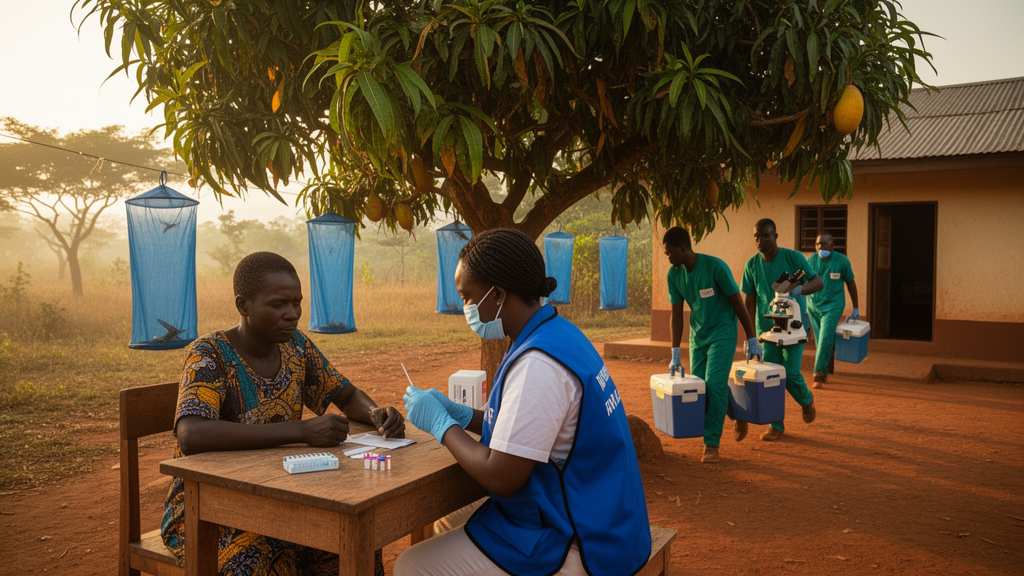
Image Credits: AI Generated

DOI: 10.1371/journal.pntd.0014777

Keywords: sleeping sickness, gHAT, elimination of transmission, cost-effectiveness, Democratic Republic of Congo, mathematical modelling, DALYs averted, willingness to pay, neglected tropical diseases, health economics, end-game strategies, end-game

Cite Scienmag News

Ophelia Keating. (October 23, 2026). Model maps cheapest routes to end sleeping sickness transmission in DRC. Scienmag. https://scienmag.com/model-maps-cheapest-routes-to-end-sleeping-sickness-transmission-in-drc/

Ophelia Keating. "Model maps cheapest routes to end sleeping sickness transmission in DRC." Scienmag, 23 October 2026, https://scienmag.com/model-maps-cheapest-routes-to-end-sleeping-sickness-transmission-in-drc/. Accessed 23 October 2026.

Ophelia Keating. "Model maps cheapest routes to end sleeping sickness transmission in DRC." Scienmag. October 23, 2026. https://scienmag.com/model-maps-cheapest-routes-to-end-sleeping-sickness-transmission-in-drc/


Tags: Cost-effectivenesscost-effectiveness of sleeping sickness controlDALYs avertedDemocratic Republic of Congoeconomic analysis of disease eliminationelimination of transmissionend-gameend-game strategiesGambiense human African trypanosomiasis elimination strategies in DRCgHAThealth economicshealth outcomes and costs of sleeping sickness interventionshealth zone-specific intervention planning in Democratic Republic of Congoimpact of funding on sleeping sickness eradicationmathematical modellingmodeling transmission dynamics of gHATmodeling uncertainty in disease elimination planningneglected tropical diseasesoptimal resource allocation for gHAT controlprioritizing health zones for sleepingsleeping sicknessstrategies to reduce sleeping sickness transmission by 2030willingness to pay
Share26Tweet16
Previous Post

Open-Source 3D-Printed Air-Cooling Conveyor Slashes Hot Filament Temperatures by Half

Next Post

Ten Rules for Keeping AI Honest in Computational Biology

Related Posts

Gallbladder Fossa Depth on CT May Predict Catheter Path in Drainage Procedure
Medicine

Gallbladder Fossa Depth on CT May Predict Catheter Path in Drainage Procedure

October 23, 2026
Screening Young Hearts: How ECGs and AI Could Curb Sudden Cardiac Death
Medicine

Screening Young Hearts: How ECGs and AI Could Curb Sudden Cardiac Death

October 23, 2026
AI Decision Aid for Juvenile Arthritis Scores Well on Safety but Diverges on Treatment Choices
Medicine

AI Decision Aid for Juvenile Arthritis Scores Well on Safety but Diverges on Treatment Choices

October 23, 2026
Data-driven subtypes reveal hidden diversity in chronic inflammatory demyelinating polyneuropathy
Medicine

Data-driven subtypes reveal hidden diversity in chronic inflammatory demyelinating polyneuropathy

October 23, 2026
Canada and Europe Build a Shared Shield Against Emerging Infections Across the North Atlantic
Medicine

Canada and Europe Build a Shared Shield Against Emerging Infections Across the North Atlantic

October 23, 2026
Decade-long Chinese surveillance shows falling MRSA and ESBL resistance, but carbapenem-resistant Klebsiella persists
Medicine

Decade-long Chinese surveillance shows falling MRSA and ESBL resistance, but carbapenem-resistant Klebsiella persists

October 23, 2026
Next Post
Ten Rules for Keeping AI Honest in Computational Biology

Ten Rules for Keeping AI Honest in Computational Biology

  • Mothers who receive childcare support from maternal grandparents show more optimized

    Mothers who receive childcare support from maternal grandparents show more parental warmth, finds NTU Singapore study

    27656 shares
    Share 11059 Tweet 6912
  • University of Seville Breaks 120-Year-Old Mystery, Revises a Key Einstein Concept

    1061 shares
    Share 424 Tweet 265
  • Bee body mass, pathogens and local climate influence heat tolerance

    682 shares
    Share 273 Tweet 171
  • Researchers record first-ever images and data of a shark experiencing a boat strike

    546 shares
    Share 218 Tweet 137
  • Groundbreaking Clinical Trial Reveals Lubiprostone Enhances Kidney Function

    531 shares
    Share 212 Tweet 133
Science

Embark on a thrilling journey of discovery with Scienmag.com—your ultimate source for cutting-edge breakthroughs. Immerse yourself in a world where curiosity knows no limits and tomorrow’s possibilities become today’s reality!

RECENT NEWS

  • Ten Rules for Keeping AI Honest in Computational Biology
  • Model maps cheapest routes to end sleeping sickness transmission in DRC
  • Open-Source 3D-Printed Air-Cooling Conveyor Slashes Hot Filament Temperatures by Half
  • Gallbladder Fossa Depth on CT May Predict Catheter Path in Drainage Procedure

Categories

  • Agriculture
  • Anthropology
  • Archaeology
  • Athmospheric
  • Biology
  • Biotechnology
  • Blog
  • Bussines
  • Cancer
  • Chemistry
  • Climate
  • Earth Science
  • Editorial Policy
  • Marine
  • Mathematics
  • Medicine
  • Pediatry
  • Policy
  • Psychology & Psychiatry
  • Science Education
  • Science News
  • Social Science
  • Space
  • Technology and Engineering

Subscribe to Blog via Email

Enter your email address to subscribe to this blog and receive notifications of new posts by email.

Join 5,151 other subscribers

© 2025 Scienmag - Science Magazine

Welcome Back!

Login to your account below

Forgotten Password?

Retrieve your password

Please enter your username or email address to reset your password.

Log In
No Result
View All Result
  • HOME
  • SCIENCE NEWS
  • CONTACT US

© 2025 Scienmag - Science Magazine

Discover more from Science

Subscribe now to keep reading and get access to the full archive.

Continue reading