


Sudden cardiac death in people under 35 is most often caused by rare inherited and congenital heart conditions that produce few or no symptoms until catastrophe strikes. A new perspective article published in PLOS Medicine argues that the case for systematically screening young people for these silent conditions is strengthening, and that artificial intelligence may soon transform how such screening is done. Writing from the Cardiovascular and Genomics Research Institute at City St. George’s, University of London, Daniel Tardo and Sanjay Sharma synthesize decades of international evidence and conclude that the outstanding question is no longer whether cardiac screening in the young is justified, but how such a programme should best be delivered alongside emergency preparedness.
The scale of the problem is difficult to overstate. Cardiovascular disease is a major cause of death in individuals aged under 35, with an estimated global mortality rate of 10 to 25 deaths per 100,000 person-years. In this age group, sudden cardiac arrest and sudden cardiac death are overwhelmingly driven by rare inherited and congenital cardiac conditions, such as cardiomyopathies and channelopathies, which are frequently clinically silent. Most existing data come from athletic cohorts, supplemented by studies of the general population. In the United Kingdom, sudden cardiac death among adolescent football players occurs at an incidence of 1 in 14,794 person-years, whereas Office for National Statistics data estimate roughly 1 in 55,000 person-years across the young general population. Recent work by the London group suggests that official figures significantly underestimate the true burden, calculating an incidence of 1 in 31,250 person-years, rising to 1 in 17,901 when survived sudden cardiac arrests are included.
Denmark offers one of the most instructive natural experiments. A 20-year nationwide study of individuals aged 1 to 35 years reported an overall sudden cardiac death incidence of 2.2 per 100,000 person-years, approximately 1 in 45,500, with a 49 percent decline between 2000 and 2019. That decline coincided with a tenfold increase in the diagnosis of inherited cardiac conditions, a doubling in implantation rates of implantable cardioverter-defibrillators, and improved survival following out-of-hospital cardiac arrest, largely driven by increased bystander cardiopulmonary resuscitation and defibrillation. The Danish data suggest that earlier detection, better treatment and faster emergency response can move the needle, even though sudden cardiac arrest and death in the young remain a significant public health issue requiring proactive primary prevention.
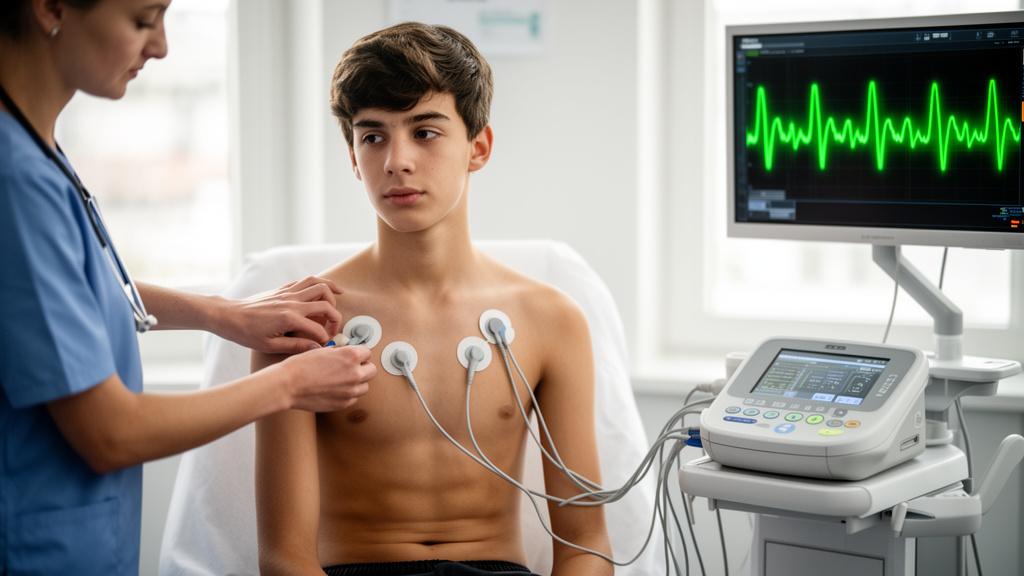
Cardiac screening, as conventionally structured, combines a focused health questionnaire covering cardiac symptoms and family history of premature cardiovascular disease or death, a physical examination, a 12-lead electrocardiogram, and, where resources allow, an echocardiogram. International practice varies primarily in whether the electrocardiogram is used. This matters because the ECG is the diagnostic test of choice for electrical disorders of the heart and can raise suspicion of structural disease, including the cardiomyopathies that predispose young people to sudden cardiac arrest. Targeted screening of higher-risk individuals is widely implemented in the United Kingdom, but population-based screening of asymptomatic people has long been controversial among health policymakers.
The divergence between guideline bodies is stark. The European Society of Cardiology and the American Heart Association both support pre-participation screening in young athletes, and many sporting organisations mandate screening of elite competitors. The UK National Screening Committee, by contrast, concluded in 2019 that a national cardiac screening programme did not meet its criteria, citing uncertainty regarding sudden cardiac death incidence, the absence of an accurate and validated screening test, and limited evidence supporting treatment of inherited cardiac conditions. Tardo and Sharma contend that the landscape has shifted since then: incidence and diagnostic yield have been further characterised, and international guidelines now provide evidence-based treatment strategies for the conditions that screening detects.
The strongest evidence in favour of screening comes from Italy, which has mandated screening of competitive athletes by federal law since 1982. Over 25 years, sudden cardiac death incidence among screened athletes fell by almost 90 percent, while remaining unchanged in unscreened non-athletes, a finding attributed to the diagnosis of cardiomyopathies and subsequent disqualification from competitive sport. The concurrent comparator group of unscreened non-athletes is the study’s principal strength, but important caveats remain. The data derive from the Veneto region alone, covering just 9 percent of the national population; arrhythmogenic right ventricular cardiomyopathy was being characterised as the main cause of exercise-related sudden cardiac death over the same interval; and the elevated baseline incidence raises the possibility of regression to the mean. Improving disease recognition and expanding defibrillator access, the authors note, cannot be fully disentangled from the intervention of cardiac screening itself.
Other national experiences complicate the picture further. Israel introduced comparable legislation in 1997 but found sudden cardiac death incidence essentially unchanged, at 2.54 versus 2.66 per 100,000 person-years. This null result argues against a very large screening effect, although newspaper-based case ascertainment in the Israeli study likely underestimated event numbers, and a pre-programme cluster of cases means the lower subsequent rates may equally reflect regression to the mean rather than a genuine downward trend over time. Japan, meanwhile, has screened all schoolchildren in the first, seventh and tenth grades since 1973, irrespective of sport participation. This general population programme supports the sensitivity of the ECG, with 2.7 percent of those screened requiring secondary evaluation and a prevalence of 0.024 percent for conditions associated with sudden cardiac death.
Perhaps the most consequential new data come from the United Kingdom, where the charity Cardiac Risk in the Young has voluntarily screened individuals aged 14 to 35 for more than 30 years using a mobile service combining a health questionnaire, an ECG interpreted under international guidelines, selective echocardiography and cardiology consultation. A recent analysis of 104,369 individuals screened between 2008 and 2018, with outcomes ascertained through national datasets, participant surveys and direct reporting, found that among the 2.5 percent referred after initial evaluation, 280 individuals, or 0.27 percent of the whole cohort, were diagnosed with a condition associated with sudden cardiac arrest or death, of whom 41 percent received risk-modifying interventions. Sensitivity was 32.5 percent for the questionnaire and 75.4 percent for the ECG, underscoring that the electrical tracing carries most of the diagnostic power. Over a follow-up period of six years, only 0.08 percent of individuals initially cleared were subsequently diagnosed with such a condition, with 86 of the 101,750 cleared individuals diagnosed at a mean of four years, including 29 cases of sudden cardiac arrest or death.
The remaining false negatives and false positives define the frontier for improvement. False negatives arise in concealed channelopathies and cardiomyopathies, and some causes of sudden death, including sudden arrhythmic death syndrome, coronary anomalies and idiopathic left ventricular hypertrophy, may only be diagnosed at post-mortem examination. Because a single evaluation misses conditions that have not yet declared themselves, age-related penetrance argues for repeat screening: in an Italian cohort of 22,300 children followed over 11 years, repeat evaluation increased diagnostic yield by 60 percent. On the false positive side, ECG interpretation depends on expertise and is prone to inter-observer variability, but the International Criteria for ECG Interpretation in Athletes have improved both specificity and sensitivity relative to earlier iterations by distinguishing physiological adaptation from genuine pathology, and their applicability to general population screening has been demonstrated within the CRY programme.
Artificial intelligence may push accuracy further. AI-enabled electrocardiography applies machine learning and deep neural networks to interpret large volumes of ECGs, autonomously identifying complex diagnostic features and offering the potential for personalised risk assessment. In older populations, such models already permit risk stratification for overall and cardiovascular mortality, heart failure and arrhythmias. In one striking application, deep learning was applied to a population-wide Swedish cohort of ECGs linked to death certificates, identifying a high-risk group with a 7 percent annual sudden cardiac death rate, exceeding that of individuals with reduced left ventricular ejection fraction who would be considered eligible for defibrillators. Crucially, 86.1 percent of the high-risk cases would not have been identified by ejection fraction alone, and the model revealed a previously undescribed ECG biomarker. Applying these tools to the young, however, poses distinct challenges: the rarity of events limits positive predictive value, the underlying disease substrate is inherited rather than acquired, athlete’s heart patterns must not be misread as pathology, and models must be calibrated for sex, gender and ethnicity. These limitations, alongside unresolved questions of cost-effectiveness and access, mean validation in young cohorts is still required. But the direction of travel is clear, and the authors call for sustained engagement with funders and policymakers so that preventing sudden cardiac death in the young becomes a matter of public health policy rather than solely a charitable endeavour.
Subject of Research: Cardiac screening of young people for detecting inherited cardiovascular disease and preventing sudden cardiac death
Article Title: Cardiac screening in the young for the detection of cardiovascular disease and prevention of sudden cardiac death
Article References: Tardo, D. T., & Sharma, S. (2026). Cardiac screening in the young for the detection of cardiovascular disease and prevention of sudden cardiac death. PLOS Medicine, 23(10), e1005278. https://doi.org/10.1371/journal.pmed.1005278
Image Credits: AI Generated
DOI: 10.1371/journal.pmed.1005278
Keywords: sudden cardiac death, cardiac screening, electrocardiogram, inherited cardiac conditions, cardiomyopathy, artificial intelligence, ECG interpretation, young athletes, implantable cardioverter-defibrillator, public health screening, Cardiac Risk in the Young, AI-ECG
Cite Scienmag News
Ophelia Keating. (October 23, 2026). Screening Young Hearts: How ECGs and AI Could Curb Sudden Cardiac Death. Scienmag. https://scienmag.com/screening-young-hearts-how-ecgs-and-ai-could-curb-sudden-cardiac-death/
Ophelia Keating. "Screening Young Hearts: How ECGs and AI Could Curb Sudden Cardiac Death." Scienmag, 23 October 2026, https://scienmag.com/screening-young-hearts-how-ecgs-and-ai-could-curb-sudden-cardiac-death/. Accessed 23 October 2026.
Ophelia Keating. "Screening Young Hearts: How ECGs and AI Could Curb Sudden Cardiac Death." Scienmag. October 23, 2026. https://scienmag.com/screening-young-hearts-how-ecgs-and-ai-could-curb-sudden-cardiac-death/


