


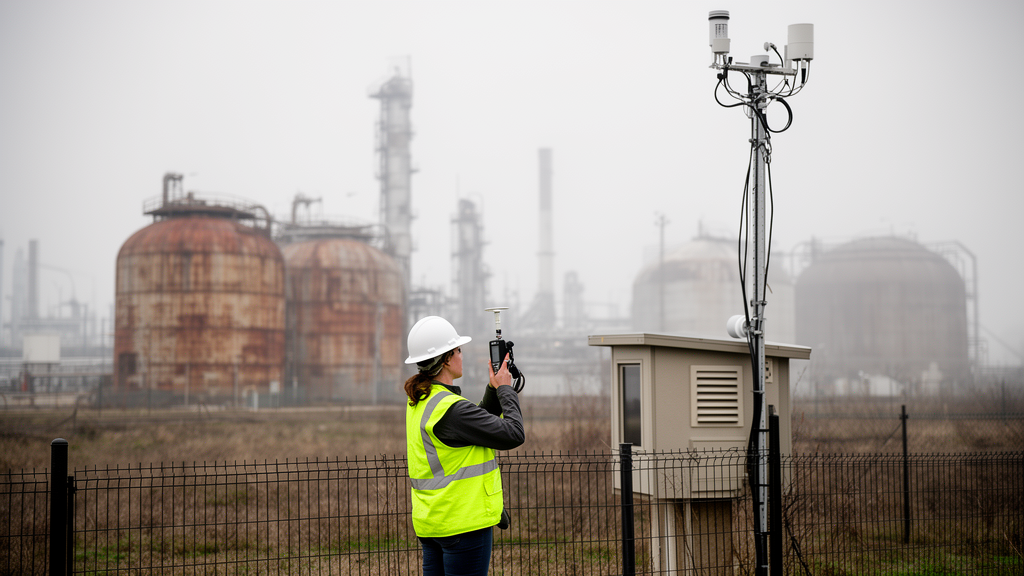
A year-long air monitoring study in a Philadelphia fenceline community has documented where hazardous volatile organic compounds vary across a neighborhood living beside a former refinery, and it did so with residents helping to shape the research from the start. The work, discussed in the Journal of Exposure Science & Environmental Epidemiology, detected 38 different VOCs using passive sampling tubes deployed over twelve months, revealing spatial variation in benzene and other hazardous compounds across the monitoring area, including among sites located at different distances from the former refinery.
Fenceline communities are neighborhoods that sit directly adjacent to industrial pollution sources, where residents may be exposed to air toxics emitted by nearby facilities. In the United States, these burdens fall unevenly: polluting industries are more likely to be located in low-income communities of color, and national data show that Black and Latinx populations live disproportionately close to industrial facilities. That uneven geography is part of what motivates detailed, locally informed measurement efforts like this one.
What distinguished the study was its design process. Rather than arriving with predetermined sampling points, the researchers worked in collaboration with the local community through an iterative process that included site-selection meetings and the sharing of interim findings. Community priorities informed both where monitors were placed and which potential emission sources the team examined.
Technically, the monitoring relied on passive thermal desorption tubes, a low-cost, field-friendly sampling method suited to exposure and environmental justice research. Deployed across a full year, the tubes enabled the detection of 38 VOCs and supported spatial, seasonal, and source apportionment analyses, allowing the team to study a broader suite of compounds than many routine networks capture.
To trace those compounds back to their origins, the team applied positive matrix factorization, a statistical receptor model that groups measured compounds into factors reflecting shared sources. The analysis identified traffic as a primary VOC source, the former refinery site as a source of gasoline and petroleum evaporative emissions, and industrial solvent use as an additional contributor. The method has limits: vehicle-related and refinery-related evaporative emissions can exhibit similar VOC profiles, making it difficult to fully separate their respective contributions.
Notably, benzene concentrations were low overall, an important measured observation rather than an assumption. Yet the study still documented spatial variation in benzene and other hazardous VOCs across the monitoring area, including among sites at different distances from the former refinery. Characterizing that heterogeneity is what long-term, spatially distributed passive sampling is designed to support during industrial land-use transitions, when contamination sources may be changing.
The analysis points to several priorities for future research. Future studies could combine integrated weekly monitoring with online gas chromatography-mass spectrometry instruments that deliver speciated VOC measurements at high temporal resolution, helping to characterize short-term concentration changes and sharpen the interpretation of source apportionment results. Low-cost sensors measuring total VOCs, particulate matter, and nitrogen oxides could add temporal detail, though the researchers caution that such sensors require co-location and calibration with reference monitors to account for cross-sensitivity, humidity effects, and sensor drift.
A second priority extends beyond outdoor air. Because people spend most of their time indoors, outdoor monitors alone capture only part of actual exposure. Paired outdoor, indoor, and personal measurements collected alongside time-activity data would allow researchers to evaluate pollutant infiltration into homes, indoor emission sources, and variability from one person to the next. Third, the analysis suggests applying compound-specific toxicity information and cumulative risk assessment methods to the measured VOC mixtures, moving from concentration data toward better-characterized potential health risks.
Alongside the technical agenda, the study argues for deepening community involvement well beyond choosing sampling sites. Future work could involve residents as community scientists in field deployments, quality assurance, interpretation, and communication of results. Timely, accessible report-back strategies and environmental health literacy frameworks can help residents understand what the data mean and support informed actions to reduce exposure in fenceline communities.
The authors frame the results as characterizing exposure patterns and potential sources rather than demonstrating health effects. But by turning community priorities into sampling locations and returning interim findings to the people who live near the results, the Philadelphia study illustrates how exposure science and environmental justice concerns can be addressed within the same measurement campaign.
Subject of Research: Community-engaged air toxics monitoring and VOC source apportionment in a Philadelphia fenceline community
Article Title: Integrating community engagement into air toxics research in fenceline communities
Article References: Yao, Y. (2026). Integrating community engagement into air toxics research in fenceline communities. Journal of Exposure Science & Environmental Epidemiology. https://doi.org/10.1038/s41370-026-00996-y
Image Credits: AI Generated
DOI: 10.1038/s41370-026-00996-y
Keywords: air toxics, volatile organic compounds, fenceline communities, environmental justice, community engagement, passive sampling, positive matrix factorization, benzene, Philadelphia refinery, exposure science, source apportionment, industrial land-use transition
Cite Scienmag News
Ophelia Keating. (October 23, 2026). Year-Long Monitoring Maps VOC Variation Near Former Philadelphia Refinery. Scienmag. https://scienmag.com/year-long-monitoring-maps-voc-variation-near-former-philadelphia-refinery/
Ophelia Keating. "Year-Long Monitoring Maps VOC Variation Near Former Philadelphia Refinery." Scienmag, 23 October 2026, https://scienmag.com/year-long-monitoring-maps-voc-variation-near-former-philadelphia-refinery/. Accessed 23 October 2026.
Ophelia Keating. "Year-Long Monitoring Maps VOC Variation Near Former Philadelphia Refinery." Scienmag. October 23, 2026. https://scienmag.com/year-long-monitoring-maps-voc-variation-near-former-philadelphia-refinery/


