

Thursday, October 22, 2026
Science
No Result
View All Result
  • Login
  • HOME
  • SCIENCE NEWS
  • CONTACT US
  • HOME
  • SCIENCE NEWS
  • CONTACT US
No Result
View All Result
Scienmag
No Result
View All Result
Home Science News Psychology & Psychiatry

Flanker study finds distance-dependent attention differences in deaf and hard of hearing children

October 22, 2026
in Psychology & Psychiatry
Glenn Wilkins
By Glenn Wilkins Scienmag Editorial Profile - Clinical Psychology
Reading Time: 2 mins read
0
Flanker study finds distance-dependent attention differences in deaf and hard of hearing children

Flanker study finds distance-dependent attention differences in deaf and hard of hearing children

65
SHARES
587
VIEWS
Share on FacebookShare on Twitter
ADVERTISEMENT

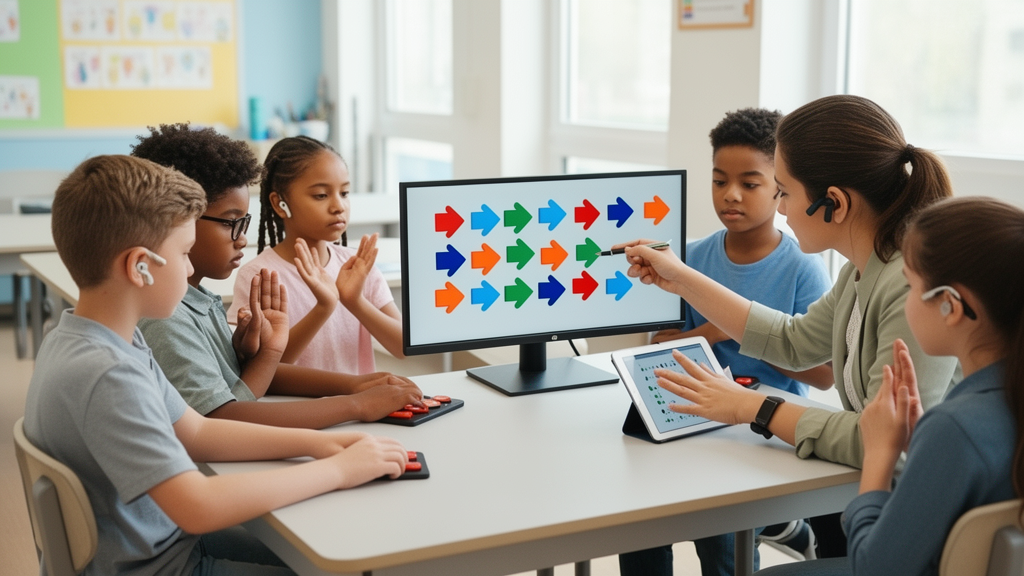
Deaf and hard of hearing children suppressed visual distractors about as well as typically hearing children overall, but the groups differed in how interference changed with the distance between a target and a competing stimulus. In a study of 42 deaf and hard of hearing children and 180 typically hearing children aged 6 to 13, researchers found a hearing-condition-by-distance interaction in response time: at the nearest target–flanker separation, typically hearing children showed a greater interference effect than deaf and hard of hearing children. The study, published in Current Psychology in 2026, was an experimental comparison of executive attention rather than a longitudinal study of its development.

Participants completed a flanker task in which a target appeared with another stimulus, while researchers manipulated the target–flanker distance. Interference effects were evaluated separately for accuracy and response time as differences in performance between incongruent and congruent trials. The analysis found no significant difference between deaf and hard of hearing children and typically hearing children in the overall interference effect for either measure. The findings therefore indicate comparable overall interference suppression under the tested conditions, while also showing that this aggregate similarity concealed a distance-dependent difference in response time.

The principal group difference appeared at the closest spatial separation. There, the difference in performance between incongruent and congruent trials was greater among typically hearing children than among deaf and hard of hearing children. The supplied study abstract does not establish that the groups differed in the same direction at every tested distance or provide the complete pattern across all separations. It also reports the finding in response time, not accuracy, so the result should not be presented as a general advantage in performance across tasks or measures.

Age was related to interference differently across distance conditions in the typically hearing group, whereas no corresponding age-related pattern was found among deaf and hard of hearing children. These associations suggest that executive attention may develop differently during childhood in the two groups, but the study does not establish hearing status as the cause. The comparison also does not show how long each child had experienced auditory deprivation, and the available evidence does not identify the mechanisms behind the observed differences. With 42 deaf and hard of hearing participants, the group was smaller than the 180 typically hearing participants, limiting how broadly the results can be generalized. Overall, the study provides evidence of a specific spatial pattern in response-time interference, alongside similar overall interference suppression in the two groups.

Subject of Research: Executive attention and spatial distractor interference in deaf and hard of hearing children

Article Title: Changes in spatial allocation of executive attention in deaf and hard of hearing children

Article References: Gioiosa Maurno, N., Phillips-Silver, J., & Daza González, M. T. (2026). Changes in spatial allocation of executive attention in deaf and hard of hearing children. Current Psychology, 45(21), Article 1643. https://doi.org/10.1007/s12144-026-10192-8

Image Credits: AI Generated

DOI: 10.1007/s12144-026-10192-8

Keywords: deaf children, hard of hearing children, executive attention, spatial attention, distractor interference, flanker task, child development, response time, auditory deprivation, Changes, spatial, allocation

Cite Scienmag News

Glenn Wilkins. (October 22, 2026). Flanker study finds distance-dependent attention differences in deaf and hard of hearing children. Scienmag. https://scienmag.com/flanker-study-finds-distance-dependent-attention-differences-in-deaf-and-hard-of-hearing-children/


Glenn Wilkins. "Flanker study finds distance-dependent attention differences in deaf and hard of hearing children." Scienmag, 22 October 2026, https://scienmag.com/flanker-study-finds-distance-dependent-attention-differences-in-deaf-and-hard-of-hearing-children/. Accessed 22 October 2026.

Glenn Wilkins. "Flanker study finds distance-dependent attention differences in deaf and hard of hearing children." Scienmag. October 22, 2026. https://scienmag.com/flanker-study-finds-distance-dependent-attention-differences-in-deaf-and-hard-of-hearing-children/

Tags: allocationattention control in hearing-impaired childrenauditory deprivationauditory impairment and visual attention performancechangeschild developmentdeaf and hard of hearing children visual distractor suppressiondeaf childrendistance-dependent attention in childrendistractor interferenceearly childhood cognitive developmentexecutive attentionexecutive attention in deaf childrenexperimental study of visual distraction suppressionflanker taskflanker task in auditory impairmentshard of hearing childrenimpact of stimulus distance on attentioninterference effects in visual attentionpsychological assessment of attention in hearing lossresponse timeresponse time differences in attention tasksSpatialspatial attention
Share26Tweet16
Previous Post

ERC Grant Funds Research on Solidarity and Shared Agency

Next Post

Cross-sectional study links three correlates to anxiety in moderate-to-profound intellectual disability

Related Posts

Pandemic Study Links Personality, Support and Interpersonal Estrangement
Psychology & Psychiatry

Pandemic Study Links Personality, Support and Interpersonal Estrangement

October 22, 2026
Qualitative study maps pandemic grief coping among 17 rural South African youths
Psychology & Psychiatry

Qualitative study maps pandemic grief coping among 17 rural South African youths

October 22, 2026
Reflexive model maps how researchers shape psychobiographical knowledge
Psychology & Psychiatry

Reflexive model maps how researchers shape psychobiographical knowledge

October 22, 2026
Brief Instruction Reduced Immediate Self-Reported Lesbian and Gay Prejudice in Trial
Psychology & Psychiatry

Brief Instruction Reduced Immediate Self-Reported Lesbian and Gay Prejudice in Trial

October 22, 2026
Research report: Perspectives on intervention strategies for influencing physical activity and sedentary behavior among Ethiopian office workers: a qualitative study
Psychology & Psychiatry

Research report: Perspectives on intervention strategies for influencing physical activity and sedentary behavior among Ethiopian office workers: a qualitative study

October 22, 2026
Diabetes subtypes linked to younger death in Jiangsu schizophrenia cohort
Psychology & Psychiatry

Diabetes subtypes linked to younger death in Jiangsu schizophrenia cohort

October 22, 2026
Next Post
Cross-sectional study links three correlates to anxiety in moderate-to-profound intellectual disability

Cross-sectional study links three correlates to anxiety in moderate-to-profound intellectual disability

  • Mothers who receive childcare support from maternal grandparents show more optimized

    Mothers who receive childcare support from maternal grandparents show more parental warmth, finds NTU Singapore study

    27656 shares
    Share 11059 Tweet 6912
  • University of Seville Breaks 120-Year-Old Mystery, Revises a Key Einstein Concept

    1061 shares
    Share 424 Tweet 265
  • Bee body mass, pathogens and local climate influence heat tolerance

    682 shares
    Share 273 Tweet 171
  • Researchers record first-ever images and data of a shark experiencing a boat strike

    546 shares
    Share 218 Tweet 137
  • Groundbreaking Clinical Trial Reveals Lubiprostone Enhances Kidney Function

    531 shares
    Share 212 Tweet 133
Science

Embark on a thrilling journey of discovery with Scienmag.com—your ultimate source for cutting-edge breakthroughs. Immerse yourself in a world where curiosity knows no limits and tomorrow’s possibilities become today’s reality!

RECENT NEWS

  • Cretaceous stick insects had enlarged defensive hind legs
  • Cross-sectional study links three correlates to anxiety in moderate-to-profound intellectual disability
  • Flanker study finds distance-dependent attention differences in deaf and hard of hearing children
  • ERC Grant Funds Research on Solidarity and Shared Agency

Categories

  • Agriculture
  • Anthropology
  • Archaeology
  • Athmospheric
  • Biology
  • Biotechnology
  • Blog
  • Bussines
  • Cancer
  • Chemistry
  • Climate
  • Earth Science
  • Editorial Policy
  • Marine
  • Mathematics
  • Medicine
  • Pediatry
  • Policy
  • Psychology & Psychiatry
  • Science Education
  • Science News
  • Social Science
  • Space
  • Technology and Engineering

Subscribe to Blog via Email

Enter your email address to subscribe to this blog and receive notifications of new posts by email.

Join 5,151 other subscribers

© 2025 Scienmag - Science Magazine

Welcome Back!

Login to your account below

Forgotten Password?

Retrieve your password

Please enter your username or email address to reset your password.

Log In
No Result
View All Result
  • HOME
  • SCIENCE NEWS
  • CONTACT US

© 2025 Scienmag - Science Magazine

Discover more from Science

Subscribe now to keep reading and get access to the full archive.

Continue reading