

Thursday, October 22, 2026
Science
No Result
View All Result
  • Login
  • HOME
  • SCIENCE NEWS
  • CONTACT US
  • HOME
  • SCIENCE NEWS
  • CONTACT US
No Result
View All Result
Scienmag
No Result
View All Result
Home Science News Technology and Engineering

Natural agents and stem cells alter healing in rat skin wounds

October 22, 2026
in Technology and Engineering
Denise Maddox
By Denise Maddox Scienmag Editorial Profile - Mechanical Engineering
Reading Time: 3 mins read
0
Natural agents and stem cells alter healing in rat skin wounds

Natural agents and stem cells alter healing in rat skin wounds

65
SHARES
587
VIEWS
Share on FacebookShare on Twitter
ADVERTISEMENT

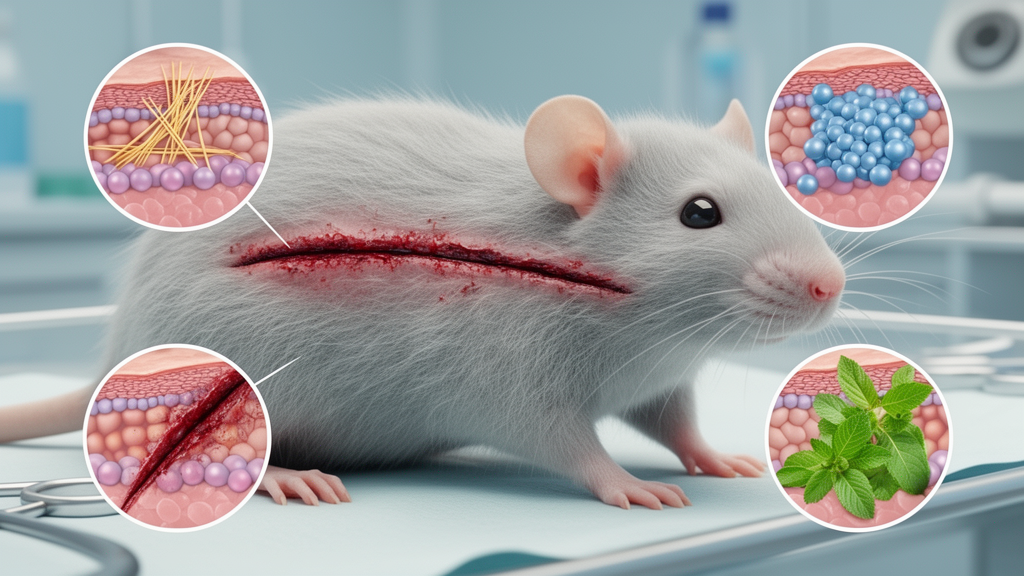
A controlled experiment in 70 male rats found that stem-cell treatment produced the greatest measured wound contraction on days 3 and 7, while chitosan had the strongest contraction result by day 14. The study compared four treatments for circular skin wounds: Aloe vera gel, stem cells, chitosan and hyaluronic acid. The fifth group received no treatment.

The researchers divided the animals equally among the five groups and followed wound diameters on the third, seventh and fourteenth days after wounding. The timing was important because the leading treatment changed during the observation period. Stem-cell-treated wounds had the highest contraction rates at the two early assessments, followed by the chitosan-treated group, with no significant difference reported between them at those points.

By day 14, the chitosan-treated group had the highest wound-contraction rate and outperformed the other experimental groups. This result does not mean that chitosan led at every measurement. The observed pattern was an early advantage for stem cells followed by a stronger final contraction result for chitosan.

The investigators combined wound-diameter measurements with histopathology, immunohistochemistry and photomicrographs. These methods were used to examine pathological alterations in the fixed tissue and to assess selected tissue-growth and immune markers. On day 14, the chitosan-treated group had the highest recorded values for the evaluated markers, with the stem-cell-treated group next.

The marker and microscopic findings therefore accompanied, but were not identical to, the contraction measurements. The report presents the interventions within a single preclinical model of experimentally created circular skin wounds. Stem cells contributed most strongly to early contraction, whereas chitosan led at the final measurement and in the day-14 marker assessments.

The findings show measurable differences among the treatments rather than a uniform advantage for one intervention throughout healing. Consequently, the available evidence does not support a detailed assessment of reproducibility or the biological mechanisms behind the reported differences. Because all animals were male rats and the wounds were experimentally induced, the study cannot establish that any of these treatments would improve healing in human clinical wounds.

Nor does it demonstrate that the observed marker changes caused the differences in wound contraction. The supported conclusion is limited to the comparative healing-related outcomes measured in this rat model under the study’s conditions. The article was published in Scientific Reports on October 22, 2026, in an early-access version identified as an accepted manuscript subject to further editing and later replacement by the version of record.

Its results provide a preclinical comparison of natural agents and a cell-based intervention, with the clearest distinction appearing in the timing of contraction and the day-14 histopathological and marker assessments. Any assessment of human safety, effectiveness or clinical use would require separate evidence beyond this experiment.

Subject of Research: Comparative effects of natural agents and stem cells on skin-wound healing in male rats

Article Title: Complementary and alternative natural medicinal agents accelerate skin wound healing effectively through modulating the pathological outcomes in rat model

Article References: Mowafy, R. E., Helal, Z. F., Bader, Y., El-Gendy, E. I. S., & Meghawry, A. (2026). Complementary and alternative natural medicinal agents accelerate skin wound healing effectively through modulating the pathological outcomes in rat model. Scientific Reports, 16(1), Article 33412. https://doi.org/10.1038/s41598-026-72849-5

Image Credits: AI Generated

DOI: 10.1038/s41598-026-72849-5

Keywords: skin wounds, wound healing, rat model, chitosan, Aloe vera, hyaluronic acid, stem cells, wound contraction, histopathology, immunohistochemistry, Complementary, alternative

Cite Scienmag News

Denise Maddox. (October 22, 2026). Natural agents and stem cells alter healing in rat skin wounds. Scienmag. https://scienmag.com/natural-agents-and-stem-cells-alter-healing-in-rat-skin-wounds/

Denise Maddox. "Natural agents and stem cells alter healing in rat skin wounds." Scienmag, 22 October 2026, https://scienmag.com/natural-agents-and-stem-cells-alter-healing-in-rat-skin-wounds/. Accessed 22 October 2026.

Denise Maddox. "Natural agents and stem cells alter healing in rat skin wounds." Scienmag. October 22, 2026. https://scienmag.com/natural-agents-and-stem-cells-alter-healing-in-rat-skin-wounds/


Tags: Aloe veraAloe vera gel effects on skin repairalternativechitosanchitosan skin wound contractioncomparative study of natural wound treatmentsComplementaryearly vs. late wound healing mechanismseffects of natural agents on wound histologyhistopathological analysis of skin woundshistopathologyhyaluronic acidhyaluronic acid in wound healingimmunohistochemistryimmunohistochemistry in wound assessmentnatural agents for skin regenerationrat modelskin woundsstem cellsstem-cell wound healing in ratstissue-growth and immune markers in skin repairwound contractionwound contraction timeline in ratswound healing
Share26Tweet16
Previous Post

Observational meta-analysis links beverages to gout and hyperuricemia risk

Next Post

Accelerated FDA approval for dostarlimab in biomarker-defined locally advanced rectal cancer

Related Posts

Researchers scale heat-resistant silicon carbide transistors to 6-inch wafers
Technology and Engineering

Researchers scale heat-resistant silicon carbide transistors to 6-inch wafers

October 22, 2026
Perceived usefulness linked to acceptance of Malang adolescent health app
Technology and Engineering

Perceived usefulness linked to acceptance of Malang adolescent health app

October 22, 2026
Advanced crosslinking strategies in Pluronic F127-based hydrogels
Technology and Engineering

Advanced crosslinking strategies in Pluronic F127-based hydrogels

October 22, 2026
Designed proteins enable enantioselective artificial photocatalysts
Medicine

Designed proteins enable enantioselective artificial photocatalysts

October 22, 2026
Gold nanorod suspensions show tunable heating under resonance-matched pulsed lasers
Technology and Engineering

Gold nanorod suspensions show tunable heating under resonance-matched pulsed lasers

October 22, 2026
Review positions crosslinking as a multidimensional regulator of regenerative biomaterials
Science News

Review positions crosslinking as a multidimensional regulator of regenerative biomaterials

October 22, 2026
Next Post
Accelerated FDA approval for dostarlimab in biomarker-defined locally advanced rectal cancer

Accelerated FDA approval for dostarlimab in biomarker-defined locally advanced rectal cancer

  • Mothers who receive childcare support from maternal grandparents show more optimized

    Mothers who receive childcare support from maternal grandparents show more parental warmth, finds NTU Singapore study

    27656 shares
    Share 11059 Tweet 6912
  • University of Seville Breaks 120-Year-Old Mystery, Revises a Key Einstein Concept

    1061 shares
    Share 424 Tweet 265
  • Bee body mass, pathogens and local climate influence heat tolerance

    682 shares
    Share 273 Tweet 171
  • Researchers record first-ever images and data of a shark experiencing a boat strike

    546 shares
    Share 218 Tweet 137
  • Groundbreaking Clinical Trial Reveals Lubiprostone Enhances Kidney Function

    531 shares
    Share 212 Tweet 133
Science

Embark on a thrilling journey of discovery with Scienmag.com—your ultimate source for cutting-edge breakthroughs. Immerse yourself in a world where curiosity knows no limits and tomorrow’s possibilities become today’s reality!

RECENT NEWS

  • Accelerated FDA approval for dostarlimab in biomarker-defined locally advanced rectal cancer
  • Natural agents and stem cells alter healing in rat skin wounds
  • Observational meta-analysis links beverages to gout and hyperuricemia risk
  • Researchers scale heat-resistant silicon carbide transistors to 6-inch wafers

Categories

  • Agriculture
  • Anthropology
  • Archaeology
  • Athmospheric
  • Biology
  • Biotechnology
  • Blog
  • Bussines
  • Cancer
  • Chemistry
  • Climate
  • Earth Science
  • Editorial Policy
  • Marine
  • Mathematics
  • Medicine
  • Pediatry
  • Policy
  • Psychology & Psychiatry
  • Science Education
  • Science News
  • Social Science
  • Space
  • Technology and Engineering

Subscribe to Blog via Email

Enter your email address to subscribe to this blog and receive notifications of new posts by email.

Join 5,151 other subscribers

© 2025 Scienmag - Science Magazine

Welcome Back!

Login to your account below

Forgotten Password?

Retrieve your password

Please enter your username or email address to reset your password.

Log In
No Result
View All Result
  • HOME
  • SCIENCE NEWS
  • CONTACT US

© 2025 Scienmag - Science Magazine

Discover more from Science

Subscribe now to keep reading and get access to the full archive.

Continue reading