


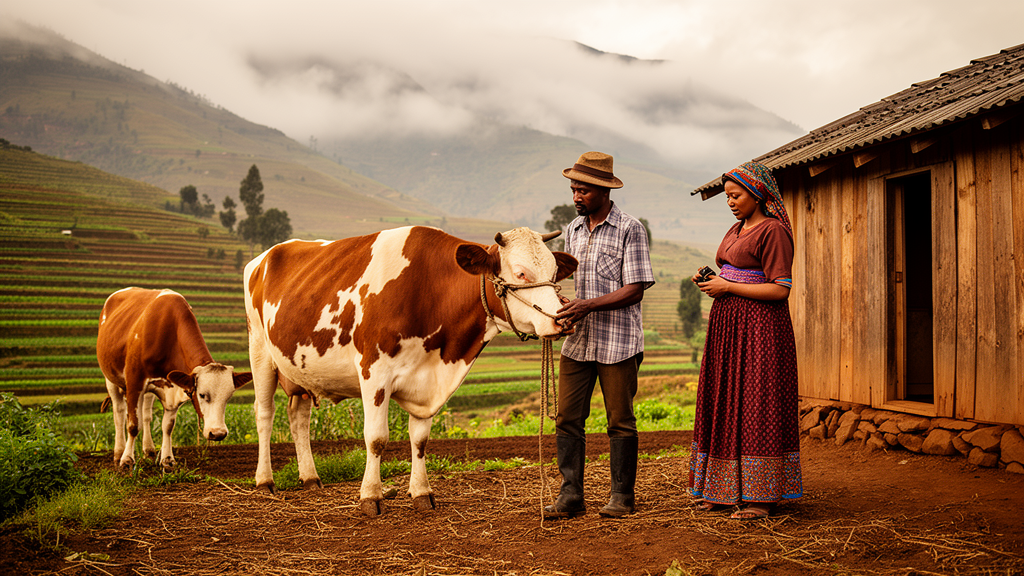
Smallholder cattle farmers in northwest Ethiopia prioritized body size in a discrete choice experiment, while market prices similarly reflected body condition and live weight, according to a study that combined farmers’ stated preferences with 200 recorded cattle transactions. Traits that were important to households but difficult to observe at sale—including milk yield, docility, disease tolerance, libido, calving interval and calf vigor—received little or no detectable price premium, showing that market signals alone may miss traits central to farmers’ livelihoods.
Researchers collected data from January through April 2024 in three districts: Farta, where 91 farmers participated; Simada, where 133 participated; and Lay Gayint, where 160 participated. Their stated preferences were measured through a discrete choice experiment, in which farmers evaluated alternative cattle traits. The researchers analyzed these responses with a mixed logit model. Separately, they used a log-linear ordinary least squares regression to examine prices in 200 cattle transactions recorded at the Debre Tabor, Simada and Nefas Mewucha marketplaces.
The two methods produced both agreement and divergence. Farmers showed a strong stated preference for large body size, a result significant at p < 0.001. In the market analysis, body condition and live body weight also had significant positive effects on price, each with p < 0.001. This convergence suggests that farmers’ assessments and commercial transactions identify the same broad preference for larger, better-conditioned animals. However, the market model did not capture the high stated value placed on several traits that are not readily visible when cattle are sold. Milk yield, docility, disease tolerance, libido, calving interval and calf vigor were valued by farmers but were not reflected in market prices, an outcome the authors associated with observability constraints and information asymmetry.
Market data also revealed structural influences absent from the stated-preference results. Traders paid higher prices, and animals sold for slaughter attracted premiums in the hedonic pricing model. These findings indicate that transaction prices do not simply measure the traits farmers say they want. They are shaped by commercial factors, buyer behavior and end use, while excluding information buyers cannot readily observe. Conversely, the discrete choice experiment made non-market traits explicit but did not reproduce the same pricing structure found in real transactions.
The study was limited to surveyed farmers in three northwest Ethiopian districts and transactions from three marketplaces, with the two datasets analyzed separately before comparison. Its authors said combining stated and revealed preferences provides a broader evidence base for defining breeding objectives: the former captures livelihood-critical traits that markets may undervalue, and the latter identifies the attributes and market dynamics that influence actual prices. The priorities identified could support later estimation of genetic parameters and economic weights, but the study itself did not estimate those quantities or test the effects of a breeding program. For now, the results point to a practical design challenge: a cattle improvement program aimed at smallholders may need to track more than the traits that visibly command a market premium.
Subject of Research: Combining stated and revealed cattle trait preferences to inform smallholder breeding objectives in northwest Ethiopia.
Article Title: Combining stated and revealed preferences to define smallholder cattle breeding objectives in northwest Ethiopia: Evidence for breeding program design
Article References: Abebe, A. S., Yazie, B., & Menale, M. (2026). Combining stated and revealed preferences to define smallholder cattle breeding objectives in northwest Ethiopia: Evidence for breeding program design. PLOS One, 21(10), e0359944. https://doi.org/10.1371/journal.pone.0359944
Image Credits: AI Generated
DOI: 10.1371/journal.pone.0359944
Keywords: cattle breeding, smallholder farmers, northwest Ethiopia, discrete choice experiment, hedonic pricing, market preferences, livestock traits, body weight, milk yield, breeding objectives, Combining, stated
Cite Scienmag News
William Thompson. (October 22, 2026). Ethiopian cattle farmers value traits markets overlook. Scienmag. https://scienmag.com/ethiopian-cattle-farmers-value-traits-markets-overlook/
William Thompson. "Ethiopian cattle farmers value traits markets overlook." Scienmag, 22 October 2026, https://scienmag.com/ethiopian-cattle-farmers-value-traits-markets-overlook/. Accessed 22 October 2026.
William Thompson. "Ethiopian cattle farmers value traits markets overlook." Scienmag. October 22, 2026. https://scienmag.com/ethiopian-cattle-farmers-value-traits-markets-overlook/


