


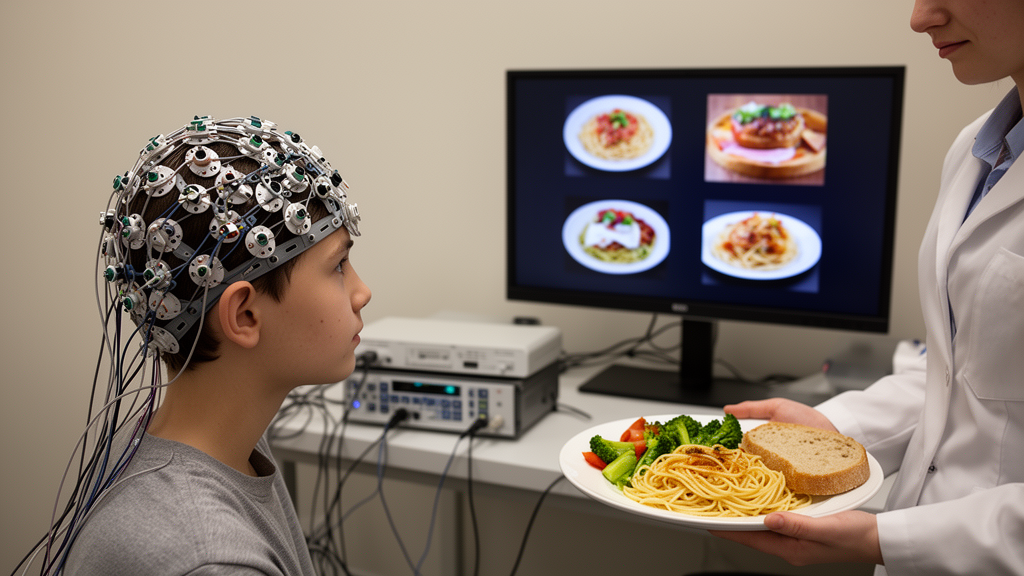
Adolescents with anorexia nervosa showed altered attention toward food images that changed over time, according to an event-related potential study comparing 33 female adolescents with the disorder with 36 age-matched healthy controls. Behavioral measurements indicated greater attentional engagement with food among the anorexia nervosa group, while an attentional-blink task revealed no impairment in disengaging from food stimuli. The brain responses were more complex: high-calorie food distractors produced reduced early electrocortical processing but enhanced later processing in participants with anorexia nervosa.
The research combines event-related potentials, or ERPs, with a behavioral attentional-blink measure in a rapid serial visual presentation task. This approach allowed the investigators to distinguish different temporal stages involved in food-related attentional bias. The participants were female adolescents, a population in which anorexia nervosa typically emerges and in which the disorder can carry substantial psychological and physical consequences. The study therefore focused not merely on whether food attracted attention, but on how that attention unfolded during and after food images appeared.
At the behavioral level, the results showed increased attentional engagement with food among adolescents with anorexia nervosa. That finding is important because cognitive models of eating disorders have emphasized the role of attentional biases in processing food stimuli, although relatively few studies have examined their temporal dynamics in adolescents with the disorder. At the same time, the lack of an observed impairment in attentional disengagement means the findings do not indicate a uniform deficit in shifting attention away from food. Instead, the group difference was selective, appearing in the engagement and temporal-processing measures rather than across every aspect of attention.
The ERP results added a finer temporal picture. When high-calorie food images served as distractors, participants with anorexia nervosa displayed reduced early electrocortical processing followed by enhanced later processing. In other words, the measured response to these images was not consistently heightened at every stage. The initial response was weaker than that of controls, while later processing was stronger. This pattern suggests that food-related attentional bias in adolescent anorexia nervosa is temporally dynamic rather than a single, fixed mechanism operating identically from first exposure onward.
The attentional-blink results further indicated that the bias was not entirely autonomous. When the task became more demanding and required greater concentration, the anorexia nervosa–specific differences in food attention were no longer evident. The authors interpret this as evidence that allocation of attention to food depends on the attentional resources available at a given moment. Under greater cognitive demand, the observed group differences disappeared, suggesting that they arise under particular conditions of attention rather than independently of the person’s current mental capacity.
Overall, the study points to a more nuanced account of how adolescents with anorexia nervosa process food-related visual information. It does not show that altered attention to food causes the disorder, and it does not establish that the measured pattern is specific to anorexia nervosa beyond the population studied. As an ERP comparison with a limited sample of female adolescents, it identifies measurable differences in temporal attention allocation rather than demonstrating a treatment effect or clinical outcome. Nevertheless, its findings offer a mechanism-level account of how food stimuli can be attended to differently across time and across levels of task demand, with implications for future research into processes that may help maintain the disorder.
Subject of Research: Temporal food-related attentional bias in female adolescents with anorexia nervosa
Article Title: Temporal attentional bias to food stimuli in adolescent anorexia nervosa – an ERP study
Article References: Nannt, J., Wolz, I., Vagedes, J., & Svaldi, J. (2026). Temporal attentional bias to food stimuli in adolescent anorexia nervosa – an ERP study. Journal of Eating Disorders. https://doi.org/10.1186/s40337-026-01800-w
Image Credits: AI Generated
DOI: 10.1186/s40337-026-01800-w
Keywords: anorexia nervosa, adolescent health, food attention, event-related potentials, attentional blink, electroencephalography, eating disorders, cognitive processing, Temporal, attentional, bias, food
Cite Scienmag News
Cassandra Pierce. (October 22, 2026). Food Attention in Adolescent Anorexia Shifts Over Time in ERP Study. Scienmag. https://scienmag.com/food-attention-in-adolescent-anorexia-shifts-over-time-in-erp-study/
Cassandra Pierce. "Food Attention in Adolescent Anorexia Shifts Over Time in ERP Study." Scienmag, 22 October 2026, https://scienmag.com/food-attention-in-adolescent-anorexia-shifts-over-time-in-erp-study/. Accessed 22 October 2026.
Cassandra Pierce. "Food Attention in Adolescent Anorexia Shifts Over Time in ERP Study." Scienmag. October 22, 2026. https://scienmag.com/food-attention-in-adolescent-anorexia-shifts-over-time-in-erp-study/


