

Thursday, October 22, 2026
Science
No Result
View All Result
  • Login
  • HOME
  • SCIENCE NEWS
  • CONTACT US
  • HOME
  • SCIENCE NEWS
  • CONTACT US
No Result
View All Result
Scienmag
No Result
View All Result
Home Science News Anthropology

Explainable AI classifies origins of 52 historic blue bricks

October 22, 2026
in Anthropology
Courtney Benton
By Courtney Benton Scienmag Editorial Profile - Science and Technology Policy
Reading Time: 2 mins read
0
Explainable AI classifies origins of 52 historic blue bricks

Explainable AI classifies origins of 52 historic blue bricks

65
SHARES
587
VIEWS
Share on FacebookShare on Twitter
ADVERTISEMENT

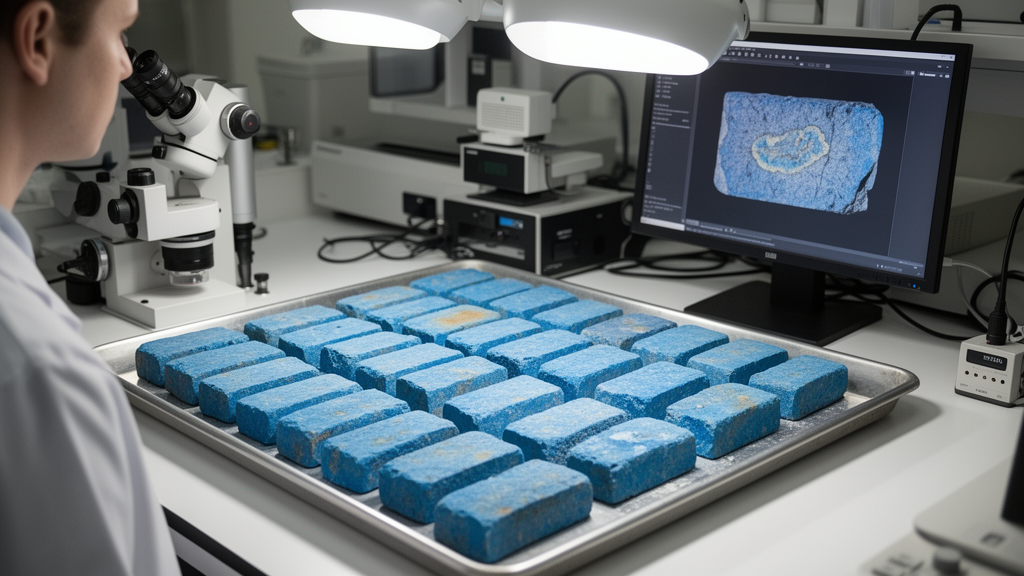
An explainable machine-learning framework classified historic blue bricks among five regional provenance groups with 95% test accuracy in a small conservation study. The researchers analyzed 52 bricks using X-ray diffraction, Raman spectroscopy and X-ray fluorescence data, reporting an area under the receiver operating characteristic curve of 0.973. The results show that the model performed strongly within the tested dataset while providing an account of the variables associated with its classifications.

The project focused on provenance identification, an aspect of architectural conservation where missing inscriptions and incomplete archives can complicate efforts to establish material authenticity. The team combined three forms of analytical information: X-ray diffraction and Raman spectroscopy provided spectral data, while X-ray fluorescence measured elemental concentrations. Those features were used with a random forest classifier to distinguish the five regional groups represented in the dataset.

After this preprocessing, the random forest achieved 95% test accuracy and an area under the receiver operating characteristic curve of 0.973. The researchers also applied Shapley additive explanations, or SHAP, to identify the variables that discriminated most strongly among the provenance groups. Rubidium, aluminum and zirconium emerged as important discriminative variables, making the model’s reasoning less opaque than a prediction based only on its final output.

Interpretation also extended to the autoencoder’s latent representation through decoder-based analysis, which linked encoded features to mineral phases. Together, these analyses support the measured classification performance and the use of explainability tools in examining the information behind the model. The principal limitation is the study’s scale: only 52 bricks from five regions were evaluated.

The reported accuracy therefore does not establish how the framework would perform on larger collections, bricks from additional regions, or materials with different compositions and manufacturing histories. Within that boundary, the study presents a technically interpretable method for using laboratory measurements to support regional provenance identification in architectural conservation.

Subject of Research: Explainable machine learning for tracing the regional provenance of historic blue bricks

Article Title: A sparse autoencoder and explainable machine learning framework for provenance tracing of historic blue bricks in architectural conservation

Article References: Song, Z., Hou, F., Chen, S., Xu, W., & Zhang, L. (2026). A sparse autoencoder and explainable machine learning framework for provenance tracing of historic blue bricks in architectural conservation. npj Heritage Science. https://doi.org/10.1038/s40494-026-03066-6

Image Credits: AI Generated

DOI: 10.1038/s40494-026-03066-6

Keywords: historic blue bricks, provenance tracing, explainable AI, sparse autoencoders, random forests, X-ray fluorescence, Raman spectroscopy, X-ray diffraction, architectural conservation, SHAP explanations, sparse, autoencoder

Cite Scienmag News

Courtney Benton. (October 22, 2026). Explainable AI classifies origins of 52 historic blue bricks. Scienmag. https://scienmag.com/explainable-ai-classifies-origins-of-52-historic-blue-bricks/

Courtney Benton. "Explainable AI classifies origins of 52 historic blue bricks." Scienmag, 22 October 2026, https://scienmag.com/explainable-ai-classifies-origins-of-52-historic-blue-bricks/. Accessed 22 October 2026.

Courtney Benton. "Explainable AI classifies origins of 52 historic blue bricks." Scienmag. October 22, 2026. https://scienmag.com/explainable-ai-classifies-origins-of-52-historic-blue-bricks/


Tags: application of explainable AI in conservation sciencearchitectural conservationautoencoderelemental analysis with X-ray fluorescence in heritage studiesexplainable AIExplainable AI for historic blue brick provenance classificationhistoric blue bricksintegration of spectral and elemental data for artifact authenticationmachine learning in architectural conservationmodel accuracy and ROC curve in historic material analysisprovenance determination of historic building materialsprovenance tracingRaman spectroscopyrandom forest classifier for regional origin identificationrandom forestsSHAP explanationsSHAP explanations for feature importance in provenance classificationsparsesparse autoencodersspectral analysis of bricks using X-ray diffraction and Raman spectroscopytransparency in AI models for cultural heritage preservationX-ray diffractionX-ray fluorescence
Share26Tweet16
Previous Post

Chilean Editors Mediate Audience Feedback, Interview Study Finds

Next Post

RNase 2 shapes macrophage antiviral responses through targeted tRNA cleavage

Related Posts

AI analysis identifies five spatial traditions in 371,918 classical Chinese poems
Anthropology

AI analysis identifies five spatial traditions in 371,918 classical Chinese poems

October 21, 2026
Grand Canal study finds visible heritage can lack cultural meaning
Anthropology

Grand Canal study finds visible heritage can lack cultural meaning

October 20, 2026
Chemists Blend Two Reductants to Bleach Waterlogged Ancient Wood Gently
Anthropology

Chemists Blend Two Reductants to Bleach Waterlogged Ancient Wood Gently

October 19, 2026
Mapping Flood Danger to Thousands of Historic Buildings Along a Chinese River Basin
Anthropology

Mapping Flood Danger to Thousands of Historic Buildings Along a Chinese River Basin

October 19, 2026
AI Learns to Redesign Ancient Ornaments Without Forgetting the Evidence
Anthropology

AI Learns to Redesign Ancient Ornaments Without Forgetting the Evidence

October 17, 2026
Ancient Jetyasar Cosmetic Powder Reveals Silk Road Trade in Aromatic Oils
Anthropology

Ancient Jetyasar Cosmetic Powder Reveals Silk Road Trade in Aromatic Oils

October 17, 2026
Next Post
RNase 2 shapes macrophage antiviral responses through targeted tRNA cleavage

RNase 2 shapes macrophage antiviral responses through targeted tRNA cleavage

  • Mothers who receive childcare support from maternal grandparents show more optimized

    Mothers who receive childcare support from maternal grandparents show more parental warmth, finds NTU Singapore study

    27656 shares
    Share 11059 Tweet 6912
  • University of Seville Breaks 120-Year-Old Mystery, Revises a Key Einstein Concept

    1061 shares
    Share 424 Tweet 265
  • Bee body mass, pathogens and local climate influence heat tolerance

    682 shares
    Share 273 Tweet 171
  • Researchers record first-ever images and data of a shark experiencing a boat strike

    546 shares
    Share 218 Tweet 137
  • Groundbreaking Clinical Trial Reveals Lubiprostone Enhances Kidney Function

    531 shares
    Share 212 Tweet 133
Science

Embark on a thrilling journey of discovery with Scienmag.com—your ultimate source for cutting-edge breakthroughs. Immerse yourself in a world where curiosity knows no limits and tomorrow’s possibilities become today’s reality!

RECENT NEWS

  • Iranian households show divergent cigarette inequality by tobacco origin
  • RNase 2 shapes macrophage antiviral responses through targeted tRNA cleavage
  • Explainable AI classifies origins of 52 historic blue bricks
  • Chilean Editors Mediate Audience Feedback, Interview Study Finds

Categories

  • Agriculture
  • Anthropology
  • Archaeology
  • Athmospheric
  • Biology
  • Biotechnology
  • Blog
  • Bussines
  • Cancer
  • Chemistry
  • Climate
  • Earth Science
  • Editorial Policy
  • Marine
  • Mathematics
  • Medicine
  • Pediatry
  • Policy
  • Psychology & Psychiatry
  • Science Education
  • Science News
  • Social Science
  • Space
  • Technology and Engineering

Subscribe to Blog via Email

Enter your email address to subscribe to this blog and receive notifications of new posts by email.

Join 5,151 other subscribers

© 2025 Scienmag - Science Magazine

Welcome Back!

Login to your account below

Forgotten Password?

Retrieve your password

Please enter your username or email address to reset your password.

Log In
No Result
View All Result
  • HOME
  • SCIENCE NEWS
  • CONTACT US

© 2025 Scienmag - Science Magazine

Discover more from Science

Subscribe now to keep reading and get access to the full archive.

Continue reading