


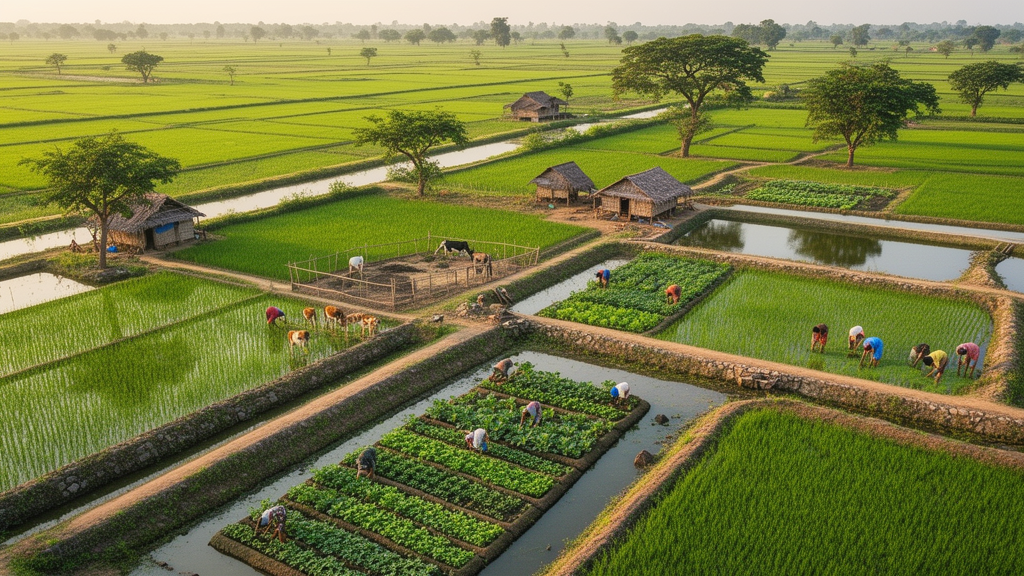
A convergent mixed-method study of farmers in seven hazard-prone sites across northern Bangladesh found that reported crop-production ranges were generally higher than those recalled for roughly 2010, while climate-related hazards were increasingly associated with unstable planting schedules, crop losses, higher costs and disrupted livelihoods. Farmers attributed the production gains primarily to improved crop varieties, fertilizer, pesticides, irrigation, machinery and more intensive management rather than to climate change. The study separates this technological intensification from the risk and instability associated with floods, riverbank erosion, drought, heat, cold waves, storms and pest outbreaks, showing how higher output and greater climate vulnerability can coexist in the same farming communities.
The research combined a household survey of 385 farmers with seven focus-group discussions, 21 key-informant interviews and satellite-derived vegetation-cover measurements. The study sites were Chilmari in Kurigram, Patnitala in Naogaon, Godagari in Rajshahi, Kishoreganj in Nilphamari, Sundarganj in Gaibandha, Kazipur in Sirajganj and Kaliganj in Lalmonirhat. Districts and upazilas were purposively selected to represent contrasting hazard contexts rather than to create a uniform regional sample. Fifty-five eligible farmers were interviewed in each village, each focus group included eight to 10 participants, and key informants included upazila agriculture officers, assistant agriculture officers and union chairpersons with direct knowledge of local agricultural conditions.
The findings apply to the sampled communities and should not be read as population-representative estimates for every farmer in northern Bangladesh. Respondents were purposively recruited because researchers could not obtain a complete population list with residential addresses, and the design used an equal quota of 55 farmers at each site rather than proportional allocation across the seven unions. Survey questions asked farmers to compare current production with a retrospective baseline extending approximately from 2010 to the 2024 fieldwork. The historical and current response ranges were not identical, making the comparison descriptive rather than a harmonized yield time series. The investigators also identified possible recall bias, attribution bias and selection bias as constraints on the results.
Farmers most frequently named temperature change and rainfall variability as their leading perceived reasons for production change, followed by pest outbreaks, soil fertility or soil conditions, and soil erosion. In a separate set of influence ratings, 67.3% of respondents described pest outbreaks as a major influence, 58.2% said the same of temperature change, and 43.9% did so for rainfall variability. A binary logistic regression associated reported temperature change with an odds ratio of 4.547, rainfall variability with 5.381, high pest and disease losses with 1.749, and drought and heat waves with 3.956 for membership in a higher-production category. These are associations within the survey data, not measured causal effects. The model’s significant Hosmer–Lemeshow test indicated an imperfect fit, and its authors explicitly warned against interpreting the results as evidence that climate variability enhances crop production.
Local accounts clarified the distinction between production level and production resilience. Respondents commonly associated higher output with high-yielding varieties, agrochemical inputs, irrigation, mechanization and intensive crop management. Climate stresses, by contrast, were linked to uncertainty, planting delays, crop loss, pest pressure and the need for additional expenditure. In Chilmari, farmers described an uneven monsoon affecting rice and jute; Kaliganj participants reported drought and pest problems; Kazipur accounts emphasized riverbank erosion and insecure access to cultivable land; and Godagari farmers described substantial irrigation requirements under heat and drought conditions. Patnitala participants reported water scarcity, Kishoreganj accounts referred to cold stress, water constraints and pests, while Sundarganj farmers described recurrent storm and flood damage. These contrasts show why a single adaptation strategy could not represent the needs of all seven locations.
Almost all respondents, 99.2%, reported that production costs had increased compared with the past. The most frequently selected causes were higher prices for fertilizer, pesticide and labor, cited by 86.1%, excessive or inappropriate pesticide use, cited by 82.9%, drought and heat waves, cited by 72.7%, and heavy rainfall, cited by 42.3%. Farmers reported using asset sales, loans, savings and private borrowing in response to these pressures: 65.5%, 62.3%, 57.9% and 40.3%, respectively, reported each response. The survey did not directly measure whether these financial strategies maintained production or their subsequent effects on household welfare. Instead, the results document their use amid substantial financial pressure. The study treated some coping responses as potentially unsustainable because borrowing, savings depletion and asset sales may weaken resilience rather than provide evidence that adaptation has succeeded.
Technology adoption was limited in the sampled population. Only 32.2% of farmers reported adopting a new agricultural practice or technology intended to improve yields, while 67.8% reported none. Tractors or sprayers were the most common adopted measures, selected by 31.17% of the full sample, followed by harvesting machinery at 22.08%. Smaller shares selected crop rotation or changes in planting time, at 9.09%; natural pest controls, at 4.94%; planting machinery, at 4.42%; deep motor pumps, at 3.12%; and disaster-resistant seed, at 2.34%. Across the full sample, 8.6% rated adopted technologies as very effective, 20.3% as effective and 3.4% as somewhat effective. Focus groups and interviews also described high-yielding or climate-resilient varieties, deeper wells, electric pumps, improved irrigation, mulching, organic farming, crop rotation and drip irrigation. Participants identified finance, technical knowledge, market access and extension support as recurring constraints on wider use.
Crop choice reflected interactions among weather, profitability, agronomy and household economics. Overall, 42.6% of respondents reported changing crop varieties. The leading reason was the higher production potential of maize, potato, mustard and other newer varieties, cited by 17.1%, followed by high production costs at 10.1%, declining soil fertility at 6.0%, increased insect infestation at 3.4%, higher temperature combined with water scarcity at 2.3%, unexpected disasters at 2.1%, and shortages of quality seed or fertilizer at 1.6%. Paddy remained dominant at about 90% of reported crop patterns, while maize increased modestly. In Chilmari, Kaliganj, Kazipur and Kishoreganj, qualitative participants described cultivation cycles declining from as many as three crops per year to two or one because of water shortages. Elsewhere, farmers used irrigation to increase cropping frequency or diversify into maize, vegetables, oilseeds, pulses and orchard production, although higher input costs and pest problems remained concerns.
Satellite analysis supplied spatial context but did not establish climatic causes. Using one Landsat image from 2010 and one from 2020 for each region, researchers classified vegetation cover at 30-meter resolution. The classified vegetation-area share decreased by 16.49 percentage points in Kaliganj, 18.73 points in Sundarganj, 14.24 points in Patnitala, 8.92 points in Kishoreganj and 2.02 points in Chilmari. It increased by 10.01 points in Kazipur and 4.71 points in Godagari. These two-date differences may reflect crop phenology, flooding, erosion, irrigation, agricultural expansion, settlement growth or other land-use processes. Because the analysis relied on one image per reference year and included no independent field validation, the mapped changes cannot be assigned to climate change, deforestation or any other single cause. The researchers therefore presented the satellite observations as an additional line of spatial evidence rather than a stand-alone indicator of environmental decline.
Overall, the study identified adaptation as a negotiated response shaped by both hazard exposure and adaptive capacity. Farmers in flood- and erosion-prone locations emphasized flexible crop calendars, early harvest, recovery planting and avoidance of exposed land. Those facing drought and heat relied more on groundwater irrigation, shorter-duration or less water-intensive crops, moisture conservation and, in Godagari, orchard and commercial production. Pest- and cold-affected settings placed greater emphasis on crop timing, tolerant varieties, irrigation and pest management. The evidence supports locally differentiated priorities involving hazard-appropriate seed, water-saving practices, seasonal advisories, integrated pest management, recovery finance, low-interest credit, extension training and accessible insurance. These are planning priorities derived from participant evidence rather than experimentally tested policy effects. Future research would require probability or panel samples, consistent yield measurements, observed meteorological data, growing-season satellite composites and field-based validation of vegetation maps.
Subject of Research: Farmers’ reported crop-production changes and climate adaptation across seven hazard-prone sites in northern Bangladesh
Article Title: Exploring the adaptation strategies of the farmers in Northern Bangladesh under climate change impacts on agricultural crop yield dynamics
Article References: Shahen, M. A., Islam, M. F., Amin, M. A., Arefin, A., Barman, T., Tamanna, R., Khatun, M. S., Afrin, M. N., Nahar, S., Ali, M. I., Rahman, M., & Hossain, M. M. (2026). Exploring the adaptation strategies of the farmers in Northern Bangladesh under climate change impacts on agricultural crop yield dynamics. Environmental Challenges, 25, Article 101686. https://doi.org/10.1016/j.envc.2026.101686
Image Credits: AI Generated
DOI: 10.1016/j.envc.2026.101686
Keywords: Northern Bangladesh, climate adaptation, crop production, flood risk, drought stress, farmer livelihoods, irrigation, crop diversification, mixed methods, NDVI, Exploring, adaptation
Cite Scienmag News
Sloane Callahan. (October 22, 2026). Mixed-method study maps climate adaptation across seven northern Bangladesh farming sites. Scienmag. https://scienmag.com/mixed-method-study-maps-climate-adaptation-across-seven-northern-bangladesh-farming-sites/
Sloane Callahan. "Mixed-method study maps climate adaptation across seven northern Bangladesh farming sites." Scienmag, 22 October 2026, https://scienmag.com/mixed-method-study-maps-climate-adaptation-across-seven-northern-bangladesh-farming-sites/. Accessed 22 October 2026.
Sloane Callahan. "Mixed-method study maps climate adaptation across seven northern Bangladesh farming sites." Scienmag. October 22, 2026. https://scienmag.com/mixed-method-study-maps-climate-adaptation-across-seven-northern-bangladesh-farming-sites/


