


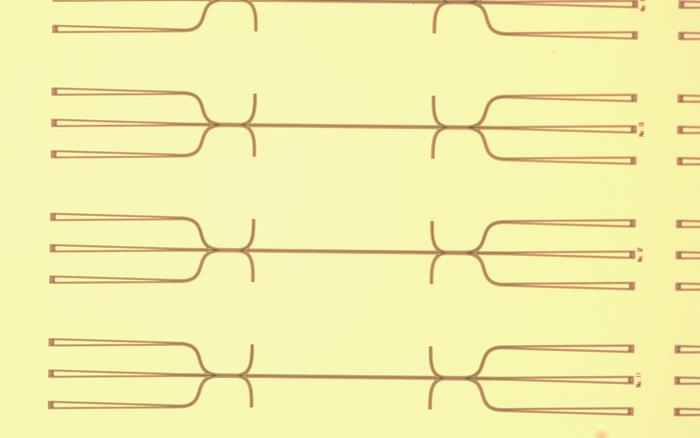
Interferometers, while essential in various light modulation applications, have traditionally been limited in their efficiency and functionality. Recent advancements in this field, particularly from researchers at the Harvard John A. Paulson School of Engineering and Applied Sciences, have introduced a groundbreaking device known as the cascaded-mode interferometer. This innovative tool marks a significant leap in optical technology, allowing for unprecedented precision in manipulating light’s frequency, intensity, and mode.
Historically, interferometers have served as pivotal instruments in fiber-optic communications, gas sensing, and optical computing. Their capability to modulate light properties has been crucial for the transmission of signals over vast distances. However, the conventional Mach-Zehnder interferometers, which are among the most frequently utilized devices, tend to struggle with simultaneous control over multiple light attributes. This shortcoming necessitates the use of multiple devices, making designs bulky and inefficient.
The newly developed cascaded-mode interferometer offers a compact solution by integrating various control mechanisms into a single waveguide constructed on a silicon-on-insulator platform. This new device embodies the concept of optical spectral shaping, enabling not only the manipulation of phase and amplitude but also allowing for the simultaneous control of multiple signal paths. Such capability is essential in advancing applications in fields like nanophotonics and on-chip quantum computing, where controlling light at microscopic scales can lead to significant technological breakthroughs.
Technically, the cascaded-mode interferometer departs from traditional beam-splitting methods. Instead, it employs a uniquely etched nanoscale grating pattern within the waveguide to facilitate energy exchanges between various light modes. This fundamental alteration in design permits finer control over the light spectrum traversing the device. The resulting manipulation yields distinct patterns of light, enabling researchers to harness specific wavelengths with remarkable precision.
In their publication within the prestigious journal Science Advances, the research team, led by postdoctoral fellow Jinsheng Lu, meticulously outlines the theoretical and experimental frameworks that demonstrate the novel device’s capabilities. Their findings offer insights not only into the existing physics of interferometers but also pave the way for expanding this technology to address numerous light modalities and applications in photonics.
The unprecedented control offered by the cascaded-mode interferometer has profound implications for commercial use. According to Federico Capasso, a prominent figure in this research and a leading professor at Harvard, this approach significantly outshines current commercial modulators utilized for high-speed communications. The ability to finely tune characteristics of multiple light paths simultaneously within a singular device could culminate in more efficient data transmission technologies, starkly minimizing the physical footprint required for traditional setups.
Moreover, the impact of this innovative interferometer extends beyond communications. In environmental monitoring, for instance, precise light modulation can enhance gas sensing technologies, improving the sensitivity and accuracy of detecting gases in various conditions. As our global climate landscape evolves, having state-of-the-art sensors equipped with this new technology could aid in better understanding and mitigating environmental changes.
In the domain of quantum computing, the implications are equally important. The capacity to manipulate light modes within a single chip can simplify the complex processes required for quantum information processing. Current quantum systems often rely on large, complicated setups encompassing numerous devices. The cascaded-mode interferometer’s design not only reduces the physical complexities involved but also potentially enhances the speed and reliability of quantum communication systems.
As the field of optics continues to evolve with tools like this interferometer, future research directions will likely focus on exploring the device’s limits and uncovering novel applications in emerging technologies. Researchers are expected to examine the interferometer’s performance across various materials and integration with other optical systems. This exploration could eventually lead to devices with capabilities far beyond current expectations, unlocking new realms in both applied physics and engineering.
Additionally, collaboration across various disciplines will be pivotal in fully realizing the potential of cascaded-mode interferometers. Engineers, physicists, and material scientists will need to work collectively to refine the device further and adapt it to specific applications. Innovation in one area often inspires breakthroughs in another, a synergy that could herald a new era of optical technologies.
As this innovative research unfolds, the scientific community is poised to witness how the cascaded-mode interferometer can reshape existing paradigms within optical applications. With advancements poised to impact numerous fields, from telecommunications to environmental science and quantum computing, the importance of this research cannot be understated. The multidisciplinary nature of this innovation underscores the interconnectedness of technology and basic scientific research, illustrating how progress in one area can leapfrog advancements in others.
In summary, the development of the cascaded-mode interferometer represents a pivotal shift in optical technology highlights the importance of continuous innovation within scientific research. The ability to harness the intricacies of light precisely and compactly opens doors to applications that may redefine modern technology. As we forge ahead into an era of rapid technological advancement, this new tool is but a glimpse into the future possibilities of optical manipulation.
Keywords
Interferometry, Signal processing, Light beam properties, Waveguides, Light signaling, Fiber optics, Optical computing, Nanophotonics, Quantum computing, Signaling cascades
Cite Scienmag News
Denise Maddox. (March 25, 2025). Introducing a Versatile Multimodal Light Manipulator: Advancing the Frontiers of Photonic Technology. Scienmag. https://scienmag.com/introducing-a-versatile-multimodal-light-manipulator-advancing-the-frontiers-of-photonic-technology/
Denise Maddox. "Introducing a Versatile Multimodal Light Manipulator: Advancing the Frontiers of Photonic Technology." Scienmag, 25 March 2025, https://scienmag.com/introducing-a-versatile-multimodal-light-manipulator-advancing-the-frontiers-of-photonic-technology/. Accessed 4 September 2026.
Denise Maddox. "Introducing a Versatile Multimodal Light Manipulator: Advancing the Frontiers of Photonic Technology." Scienmag. March 25, 2025. https://scienmag.com/introducing-a-versatile-multimodal-light-manipulator-advancing-the-frontiers-of-photonic-technology/


