


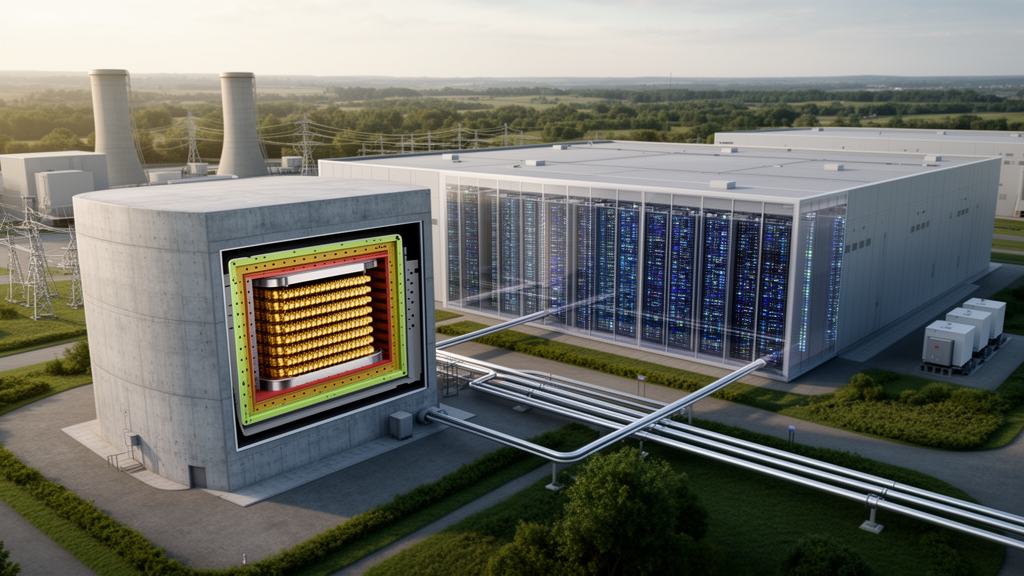
A comparative modelling study of three small modular reactor designs estimates that supplying Brazil’s reference 2.525-gigawatt data-center electricity load would require 21 ACP100 units, 43 BANDI units or 46 RITM-200N units, with sharply different initial uranium inventories and annual natural-uranium requirements. The RITM-200N had the smallest initial heavy-metal inventory, but its high fuel enrichment gave it the largest estimated natural-uranium requirement. BANDI required the largest initial inventory while producing the lowest annual natural-uranium demand.
These are planning estimates rather than forecasts of reactor construction, and the study did not evaluate economics, licensing, fuel-fabrication complexity or detailed plant siting. The study examined the possibility that small modular reactors could provide firm, dispatchable electricity for expanding data-center loads in Brazil. Data centers have high and largely continuous electricity requirements, which can strain transmission networks, reserve margins and operating flexibility as renewable generation grows.
Small modular reactors, generally defined by the International Atomic Energy Agency as reactors with electrical outputs of up to 300 megawatts, are being considered as one possible source of low-carbon, controllable power. Their modular construction and potential proximity to large electricity users could reduce some transmission pressures, although the research does not establish an SMR supply chain, plant deployment or commercial operation for Brazilian data centers. To construct a reference demand scenario, the researchers screened Brazilian ministerial ordinances issued between 2020 and 2025 concerning data-center connections to the National Interconnected System.
They identified 21 projects whose grid access had been formally recognized, then found power-demand information for 18 of them using regulatory records, developer and operator information, industry databases and news reports. The resulting projects totaled 2,525 megawatts: 1,574 megawatts, or 62 percent, in São Paulo; 776 megawatts, or 31 percent, in Ceará; 95 megawatts, or 4 percent, in Rio Grande do Sul; and 80 megawatts, or 3 percent, in Bahia. The authors stressed that this was an illustrative input assembled from identified projects and publicly available information, not a projection of Brazil’s total future data-center demand.
The comparison used three pressurized-water-reactor designs, selected because Brazil already operates this reactor class and because the available designs supplied sufficiently consistent public data on core geometry, enrichment and burnup. ACP100 is a Chinese design with a nominal output of 125 megawatts per unit; BANDI is a South Korean 60-megawatt design; and RITM-200N is a Russian design whose two-reactor plant has a combined nominal output of 110 megawatts. The authors represented each core in the community-developed OpenMC Monte Carlo transport code and calculated initial heavy-metal mass from the modelled materials, densities, volumes and number of fuel assemblies.
Because the purpose was a representative inventory estimate rather than a depletion calculation, the models did not simulate neutrons changing the fuel composition as it burned. Fuel-cycle calculations then combined the core inventories with average discharge burnup taken from technical literature, the assumed thermal efficiency of the reactors and the reference electricity demand. The authors distinguished the heavy metal initially loaded into a fleet from cumulative fuel consumption.
Initial heavy-metal mass represents the uranium loaded at the start of operation, whereas burnup measures the thermal energy produced per unit mass of initial heavy metal. Natural-uranium requirements were derived through an enrichment mass balance using product enrichment, natural-uranium assay, depleted tails assay and an allowance for conversion losses. The analysis assumed continuous full-power operation, producing a 100 percent capacity factor and an upper-bound estimate of annual electricity and uranium use.
Reducing the capacity factor to 95 or 90 percent lowered annual uranium demand by 5 or 10 percent without changing the rankings among the designs. The designs differed sharply in their fuel characteristics. ACP100 uses three uranium-dioxide enrichment zones and had an effective enrichment of 2.99 percent in the study, with 15.95 tonnes of heavy metal in one core, a net electrical output of 125 megawatts and average burnup of 16.44 megawatt-days per kilogram of heavy metal.
BANDI uses conventional low-enriched uranium dioxide in 52 assemblies, with 4.95 percent enrichment, 11.89 tonnes of heavy metal per core, a 60-megawatt output and an average burnup of 29.4 megawatt-days per kilogram. RITM-200N uses uranium dioxide in a silumin matrix at 19.75 percent enrichment. Its much more compact core contained 2.48 tonnes of heavy metal, while the two-reactor configuration produced 110 megawatts and had an average burnup of 96.4 megawatt-days per kilogram.
These comparisons concern reactor inventories and fuel-utilisation assumptions, not the practical fuel-manufacturing readiness of the three concepts. When the reference demand was assigned entirely to nuclear generation, ACP100 required 21 units providing 2,625 megawatts of installed capacity. Its fleet-wide initial heavy-metal inventory was 345.24 tonnes, its estimated specific natural-uranium requirement was 55.956 grams per megawatt-hour, and continuous operation would require 1,286.71 tonnes of natural uranium per year.
BANDI required 43 units for 2,580 megawatts, with the largest initial fleet inventory at 511.27 tonnes, but the lowest specific and annual natural-uranium requirements at 48.405 grams per megawatt-hour and 1,093.99 tonnes per year. RITM-200N required 46 units for 2,530 megawatts. Its initial inventory was only 132.48 tonnes, yet its 19.75 percent enrichment and fuel composition produced the highest specific natural-uranium requirement, 59.274 grams per megawatt-hour, and an estimated fleet demand of 1,313.68 tonnes per year.
The results show why unit size, initial inventory, burnup and enrichment cannot be treated as interchangeable measures of fuel efficiency. Regional deployment was also dependent on the discrete size of each reactor. São Paulo’s 1,574-megawatt reference load would require 13 ACP100 units, 27 BANDI units or 29 RITM-200N units, with total initial inventories of 213.72, 321.03 and 83.52 tonnes, respectively.
Ceará’s 776-megawatt demand would require seven, 13 or 15 units. By contrast, the smaller loads in Rio Grande do Sul and Bahia could each be met with one ACP100 unit or two BANDI or RITM-200N units. Installed capacity exceeds the target load in these cases because reactor outputs cannot be divided into fractional units.
The counts describe generating units, not independent nuclear sites: manufacturers’ configurations may pair reactors in one plant, and multiple plants could potentially occupy one larger site. The estimated uranium requirements would be consequential for Brazil’s developing domestic supply. The currently operating Caetité facility has a nominal capacity of about 220 tonnes of uranium per year, while projected expansions associated with Caetité and Santa Quitéria could raise production to approximately 678 and 1,950 tonnes per year, respectively.
Against those figures, the study’s full-power annual requirements of roughly 1,094 to 1,314 tonnes would represent a substantial share of projected capacity, although Brazilian uranium production is not the same as the country’s full resource potential. The study also did not assess mine and conversion supply chains in detail, and the RITM-200N’s silumin-based fuel may introduce fabrication and processing issues not captured by kilograms of natural uranium. The findings therefore identify a trade-off relevant to fuel-cycle planning: compact, highly enriched cores can minimize the uranium loaded initially without minimizing the upstream natural uranium required per unit of electricity.
Overall, the modelling supports a more nuanced view of SMRs for data centers than a simple ranking by reactor size or uranium inventory. ACP100 minimizes the number of units in the reference case but has a higher annual natural-uranium requirement than BANDI. BANDI offers the lowest estimated annual uranium use but requires the most units and the greatest initial fleet inventory.
RITM-200N offers the smallest initial inventory but not the lowest upstream fuel requirement. Because the analysis assumes that SMRs supply the entire 2.525-gigawatt reference load, operates every reactor continuously and does not model economic costs, detailed plant arrangements, licensing pathways or fuel supply constraints, it cannot identify an optimal commercial choice. Its principal contribution is a physically grounded screening framework showing how the same data-center demand can produce very different deployment and material requirements depending on a reactor’s core design, enrichment and burnup.
Subject of Research: Comparative modelling of small modular reactor deployment and uranium requirements for Brazilian data centers
Article Title: Small modular reactors for data centers: deployment and nuclear fuel requirements
Article References: de Abreu, W. V., Martinez, A. S., Silva, A. S. E., Takashi, L. K., Ribeiro Lima, Á. C., de Pontes, J. D. B. B., Ramon, L. L. S., Gonçalves, A. D. C., Silva, A. C. D., Silva, F. C. D., & Lima, M. A. C. (2026). Small modular reactors for data centers: deployment and nuclear fuel requirements. Frontiers in Nuclear Engineering, 5, Article 1971830. https://doi.org/10.3389/fnuen.2026.1971830
Image Credits: AI Generated
DOI: 10.3389/fnuen.2026.1971830
Keywords: small modular reactors, data centers, nuclear fuel, uranium demand, reactor modelling, OpenMC, fuel burnup, Brazil, pressurized water reactors, energy planning, Small, modular
Cite Scienmag News
Denise Maddox. (October 22, 2026). Research report: Small modular reactors for data centers: deployment and nuclear fuel requirements. Scienmag. https://scienmag.com/research-report-small-modular-reactors-for-data-centers-deployment-and-nuclear-fuel-requirements/
Denise Maddox. "Research report: Small modular reactors for data centers: deployment and nuclear fuel requirements." Scienmag, 22 October 2026, https://scienmag.com/research-report-small-modular-reactors-for-data-centers-deployment-and-nuclear-fuel-requirements/. Accessed 22 October 2026.
Denise Maddox. "Research report: Small modular reactors for data centers: deployment and nuclear fuel requirements." Scienmag. October 22, 2026. https://scienmag.com/research-report-small-modular-reactors-for-data-centers-deployment-and-nuclear-fuel-requirements/


