


A controlled-environment reanalysis of lettuce found that adding the elapsed time since the previous irrigation improved classification of irrigation-stress histories, while adding the nominal watering schedule did not. In the primary schedule-balanced test, adding elapsed irrigation time reduced held-out, plant- and class-balanced log-loss by 0.0414, with a 95% confidence interval of 0.0034 to 0.0807. Adding the nominal schedule instead changed log-loss by −0.0039, with a 95% confidence interval of −0.0342 to 0.0273.
The study analyzed 140 plant-day observations from 24 lettuce plants in two sequential experiments and collected no new experimental data. Its results indicate that an observation-specific drying history supplied predictive information beyond a broad watering-protocol label, but they did not identify the physiological mechanism underlying that information. The researchers reanalysed morpho-kinematic, or MK, descriptors extracted from time-lapse images of lettuce, Lactuca sativa, cultivar Gretta Erre F3486.63.
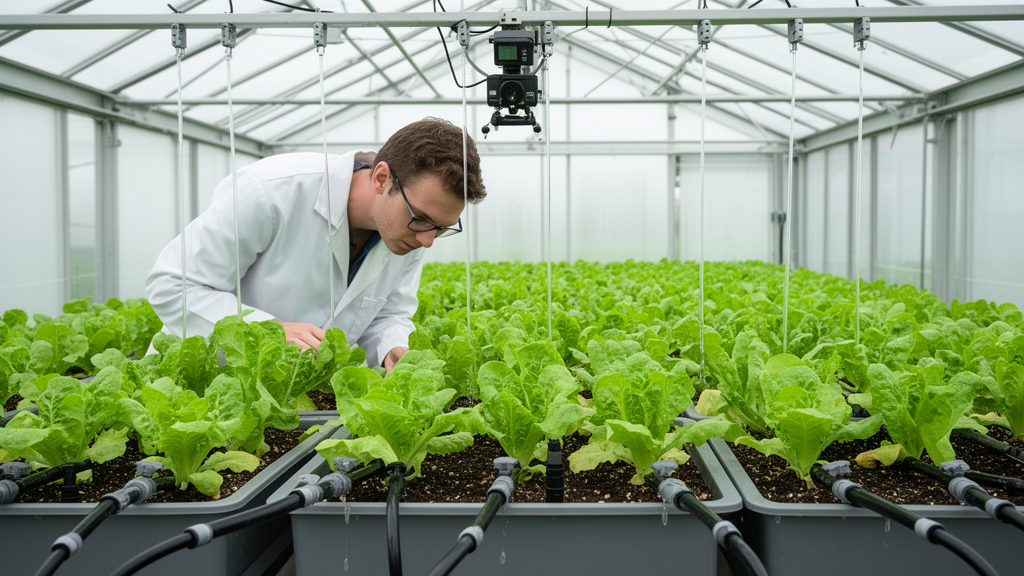
Plants were grown in 3-litre pots under controlled conditions with a 16-hour light and 8-hour dark photoperiod at 22 ± 1 °C. Each plant was monitored over six consecutive study days, from 36 to 41 days after transplanting. A fixed 2-megapixel RGB camera captured 25 images during each six-hour daily observation window at 15-minute intervals. Canopies were segmented with an Excess Green Index mask, and dense optical flow was estimated between consecutive frames to quantify movement.
For the classification analysis, the canopy was divided into three developmentally coherent sectors: a sector of young and developed leaves, a sector of older leaves, and the central rosette. Six MK features were calculated within each sector: canopy density, optical-flow magnitude, horizontal movement, vertical movement, movement threshold, and coefficient of variation. Each feature was represented as a 24-timestep time series, which was summarized with nine temporal descriptors, including mean, standard deviation, minimum, maximum, global linear slope, intercept, coefficient of determination, and slopes calculated over the first and final thirds of the observation window.
The resulting feature space contained 162 MK descriptors, combining three sectors, six features, and nine temporal summaries. The key contextual variable was Δt, defined as the interval between the last irrigation before the observation day and the start of the daily imaging window. Irrigation performed on the observation day immediately before imaging was deliberately excluded. Δt therefore represented the antecedent period during which the substrate could dry, rather than the time since a possible rewatering immediately before observation.
The nominal schedule was a separate protocol-derived variable distinguishing daily from every-other-day irrigation. This distinction allowed the analysis to test whether the realized drying interval contained information that the broader schedule category did not capture. To isolate that information, the researchers used a binary contrast that grouped the well-watered control and chronic-stress treatment together and compared them with moderate and severe acute-stress treatments.
Each class therefore included one treatment irrigated daily and one irrigated every other day, balancing the nominal schedule across classes. The authors cautioned that this was an analytical benchmark rather than a general biological reclassification of the four treatments. Eight penalized logistic-regression variants evaluated different combinations of MK descriptors, Δt, and nominal schedule, with MK coefficients regularized through an elastic-net penalty.
Primary validation used balanced treatment quartets. Each outer test fold included one plant from each treatment, while all available observations from those plants were retained together. Hyperparameters were selected with threefold grouped inner cross-validation, and all standardization, Δt transformation, and model tuning occurred separately within each training partition.
Because unequal numbers of valid observations were available for some plants, log-loss was first averaged within each plant, then across plants within each class, and finally across the two classes with equal weight. Uncertainty in paired model contrasts was estimated by cluster-bootstrap resampling of complete plant trajectories with class balance retained. The MK-only model achieved a held-out plant-class-balanced log-loss of 0.5250, balanced accuracy of 0.7582, area under the receiver-operating-characteristic curve of 0.8299, and Brier score of 0.1716.
Adding Δt lowered log-loss to 0.4836, raised balanced accuracy to 0.7798, increased area under the curve to 0.8638, and lowered the Brier score to 0.1539. By contrast, adding nominal schedule produced a log-loss of 0.5289 and did not improve discrimination. Models using schedule or Δt without MK information remained close to no-skill values, indicating that the principal predictive signal came from their combination with movement descriptors.
Robustness was examined with progressively stricter validation. Across 25 alternative balanced-quartet partitions, the improvement from adding Δt was positive in 24, with a mean contrast of 0.0432 and a median of 0.0422. A stricter balanced-quartet-day-blocked analysis excluded both the complete trajectories of four test plants and other plants’ observations from the corresponding experiment and study day.
Its point estimate remained positive at 0.0264, although the 95% confidence interval of −0.0368 to 0.0804 included zero. Leave-one-experiment-out validation, in which a model trained on one experiment was evaluated on the other, also favored adding Δt, with a contrast of 0.0140, but its interval of −0.0492 to 0.0727 was wide. The direction was therefore consistent across validation regimes, but the study did not firmly establish day-independent or cross-experiment generalizability.
Schedule-preserving permutation analyses tested whether Δt had to be matched to the MK observations from the same plant and day. Within each experiment and irrigation schedule, complete experiment-by-study-day blocks of Δt values were permuted across study days, preserving schedule and the distribution of Δt while disrupting the observed correspondence with movement responses. Perturbing Δt in held-out observations increased loss in frozen fitted models by a mean of 0.0839, with p(no reliance) = 0.001.
When the full fitting procedure was repeated after permutation, the null mean contrast was −0.0063 compared with the observed 0.0414, with p = 0.020. These results support the conclusion that the information was useful when attached to the corresponding MK profile rather than when a compatible but mismatched irrigation history was supplied. Redundancy analysis provided an independent, multivariate assessment of the MK descriptors.
It attributed 8.50% of adjusted MK variation uniquely to Δt, 1.06% uniquely to nominal schedule, and 1.55% to their shared component; 88.89% remained unexplained. Partial pseudo-F tests supported the Δt-associated component with p = 0.001 under both bootstrap weighting schemes, whereas the schedule component was not supported. The strongest constrained-axis loadings were concentrated mainly in canopy density, vertical movement, and movement magnitude within the young-leaf and central-rosette sectors, showing that the elapsed-time signal was not distributed evenly across all MK features.
An interaction model that added Δt-by-MK products improved over the model containing MK descriptors and Δt alone by 0.0533 in plant-class-balanced log-loss, with a 95% confidence interval of 0.0092 to 0.0931. Group-drop analyses also showed that adding Δt changed the classifier’s reliance on particular descriptor groups. After elapsed time was included, the model appeared to rely less on the global linear-fit coefficient of determination, descriptive minima, and vertical movement, based on contrasts whose 95% confidence intervals excluded zero.
This does not mean that those traits became biologically unimportant. Rather, Δt may have supplied information that those groups had previously conveyed indirectly. The broader interpretation is that a phenotypic signal can be context-dependent: the same kind of lettuce leaf movement observed after a longer drying interval may carry a different classification value from movement observed after a shorter interval.
Several limitations constrain how far the findings can be generalized. The dataset was small, covered one lettuce cultivar, and came from controlled pots and stable environmental conditions. The second experiment also differed from the first because it included a weekly one-day irrigation suspension for all treatments, whereas the first had a single common suspension event at 37 days after transplanting.
The researchers did not directly measure substrate water potential, leaf water potential, stomatal conductance, abscisic acid, proline, or other metabolic indicators during the MK window, so the data cannot establish which physiological process connected antecedent drying to movement expression. In field conditions, elapsed clock time may also be a poor approximation of actual drying because identical intervals can correspond to different water losses. Future studies would need direct water-status and physiological measurements, along with indices such as accumulated evapotranspiration, substrate water depletion, thermal time, or vapour-pressure-deficit exposure, to test whether the same contextual benefit occurs outside the controlled environment and across other phenotypic traits or genotypes.
Subject of Research: Machine-learning classification of lettuce irrigation-stress histories using leaf movement and elapsed irrigation time
Article Title: Elapsed irrigation time improves morpho-kinematic classification of lettuce irrigation-stress histories
Article References: Polilli, W., Platani, C., Dattoli, M. A., Stagnari, F., & Galieni, A. (2026). Elapsed irrigation time improves morpho-kinematic classification of lettuce irrigation-stress histories. Frontiers in Plant Physiology, 4, Article 1937739. https://doi.org/10.3389/fphgy.2026.1937739
Image Credits: AI Generated
DOI: 10.3389/fphgy.2026.1937739
Keywords: lettuce, plant movement, irrigation timing, water stress, plant phenotyping, morpho-kinematics, time-lapse imaging, optical flow, logistic regression, controlled environments, Elapsed, irrigation
Cite Scienmag News
Alan Morgan. (October 22, 2026). Elapsed irrigation time improves lettuce water-stress classification in controlled reanalysis. Scienmag. https://scienmag.com/elapsed-irrigation-time-improves-lettuce-water-stress-classification-in-controlled-reanalysis/
Alan Morgan. "Elapsed irrigation time improves lettuce water-stress classification in controlled reanalysis." Scienmag, 22 October 2026, https://scienmag.com/elapsed-irrigation-time-improves-lettuce-water-stress-classification-in-controlled-reanalysis/. Accessed 22 October 2026.
Alan Morgan. "Elapsed irrigation time improves lettuce water-stress classification in controlled reanalysis." Scienmag. October 22, 2026. https://scienmag.com/elapsed-irrigation-time-improves-lettuce-water-stress-classification-in-controlled-reanalysis/


