


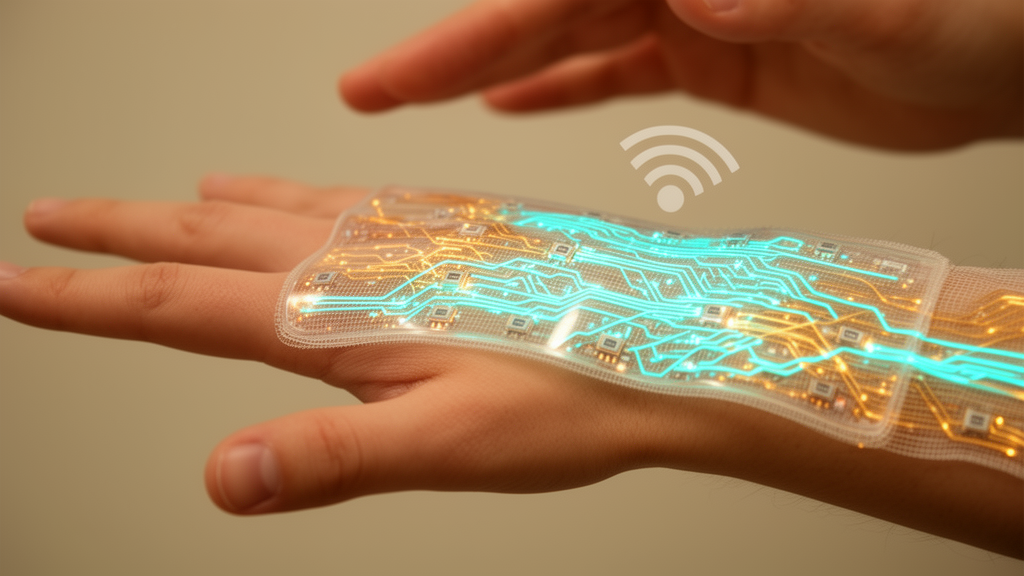
Researchers at Dongguk University in South Korea have developed a flexible, battery-free neuromorphic device that converts touch, body movement and other mechanical disturbances into electrical signals capable of driving artificial synapses. The experimental platform combines a graphene-channel ion-gel-gated transistor, or g-IGT, with two triboelectric nanogenerators, or TENGs. The nanogenerators harvest mechanical energy that would otherwise require an external power supply, allowing the device to regulate synaptic responses without a battery. The study was published in Advanced Materials on July 2, 2026.
The design was intended to reproduce, in electronic form, part of the process by which biological mechanoreceptors detect skin deformation and communicate it through neural spikes. One TENG is connected to the gate of the g-IGT and supplies pre-synaptic spikes, while a second TENG on the drain side provides post-synaptic spikes. When either nanogenerator encounters mechanical stimuli, it produces voltage pulses that control the transistor’s synaptic response. Because the circuit obtains its operating energy directly from these stimuli, it can integrate mechanical sensing, memory and learning on a single flexible platform. Low-voltage operation, flexible construction and the ability to adjust synaptic weights make g-IGTs promising elements for wearable neuromorphic systems, although the present work did not test a complete wearable product.
The researchers demonstrated several forms of memory whose behavior resembled processes associated with biological neural networks. The device exhibited sensory memory with a decay time of about 70 milliseconds and short-term memory with decay times ranging from 0.2 to 0.45 seconds. Repeated stimulation shifted the device toward a long-term-memory state with a decay time exceeding 2 seconds. It also exhibited spike-rate-dependent plasticity, in which synaptic strength changes according to the frequency of incoming spikes. This learning response remained stable while the device was bent, providing experimental evidence that the flexible architecture could retain synaptic function under mechanical deformation. These results describe device-level behavior rather than learning in biological neurons or any demonstrated clinical benefit.
To assess how the measured synaptic behavior could be used in a practical recognition task, the team incorporated it into a single-layer artificial neural network and applied publicly available human-motion data. The system classified six activities: walking, sitting, standing, lying, walking upstairs and walking downstairs. Using synaptic behavior measured from the TENG-driven device under bending, the network achieved 88.05% accuracy. Under high-noise conditions, it retained more than 75% accuracy, although performance declined when signals experienced extreme distortion. The recognition experiment was a computational evaluation based on experimentally measured device behavior; it was not a trial involving human participants wearing the device.
The work points toward self-powered systems in which mechanical events supply both the stimulus and the energy needed to process it. Potential uses identified by the researchers include wearable health-monitoring devices, electronic skin, smart prosthetics, human–machine interfaces and intelligent motion-monitoring systems. Professor Sejoon Lee, who led the study at Dongguk University’s Department of System Semiconductor, said the broader aim is to combine sensing, memory, learning and information processing in flexible electronics that rely less on batteries or external computing resources. The reported results show that a triboelectric-gated transistor can support multiple memory states, spike-rate-dependent learning and activity recognition from human-motion data. Further work would be needed to establish performance in real operating environments, under sustained mechanical stress and in practical systems that include power-management, control and signal-processing electronics.
Subject of Research: Experimental development of a battery-free flexible neuromorphic sensor for artificial tactile sensing and human activity recognition
Article Title: Dongguk University researchers develop battery-free flexible device for neuromorphic sensing
Article References: Dongguk University researchers develop battery-free flexible device for neuromorphic sensing. Original publication (Bibliographic details unavailable.)
Image Credits: AI Generated
DOI: Not provided
Keywords: neuromorphic electronics, triboelectric nanogenerator, ion-gel transistor, flexible devices, artificial synapses, tactile sensing, spike-rate plasticity, human activity recognition, self-powered sensors, Dongguk University, Dongguk, University
Cite Scienmag News
Faith Mcneil. (October 22, 2026). Battery-free flexible neuromorphic device learns from touch and motion. Scienmag. https://scienmag.com/battery-free-flexible-neuromorphic-device-learns-from-touch-and-motion/
Faith Mcneil. "Battery-free flexible neuromorphic device learns from touch and motion." Scienmag, 22 October 2026, https://scienmag.com/battery-free-flexible-neuromorphic-device-learns-from-touch-and-motion/. Accessed 22 October 2026.
Faith Mcneil. "Battery-free flexible neuromorphic device learns from touch and motion." Scienmag. October 22, 2026. https://scienmag.com/battery-free-flexible-neuromorphic-device-learns-from-touch-and-motion/


