


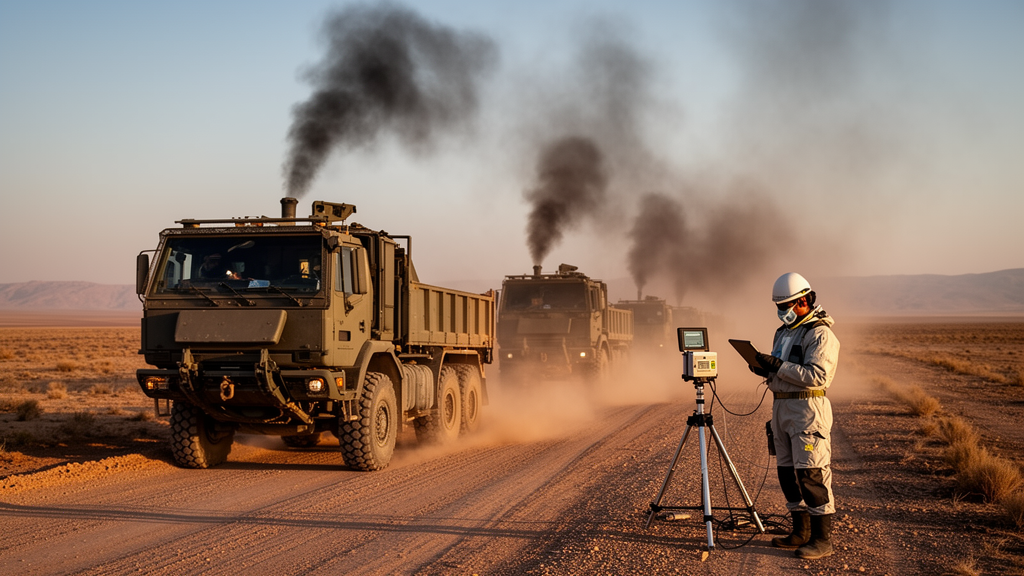
A commentary published in The BMJ argues that accurate greenhouse gas emissions data are needed to hold militaries, governments and individuals accountable for the environmental costs of armed conflict. Benjamin Neimark of Queen Mary University of London maintains that understanding the scale of conflict emissions is an essential first step in addressing the military sector’s oversized contribution to the climate crisis. The article is an argument for systematic reporting and legal accountability rather than a new empirical study of military emissions.
Neimark cites estimates that the first 14 days of the Iran war produced more than five million tonnes of carbon dioxide, exceeding Iceland’s total climate pollution in 2024. He also cites an estimate of almost 311 million tonnes released during five years of war in Ukraine, described as equivalent to France’s annual emissions. For Gaza, the commentary reports that carbon emissions during the first 15 months of the conflict exceeded 30 million tonnes. Neimark compares that quantity with the amount of carbon absorbed by 33 million acres of forests in one year. These figures are estimates presented in the commentary to illustrate the potential scale of emissions associated with recent conflicts.
The emissions considered by Neimark have both direct and indirect sources. Direct emissions include fossil fuels burned by fighter jets, cargo planes, tanks and naval ships. Indirect emissions can arise from activities such as powering military bases, making weapons, deploying troops and reconstruction after conflicts. Since the 2015 Paris agreement, military reporting of conflict-related emissions has been voluntary. As a result, researchers must conduct their own assessments of how much carbon was emitted during a conflict. Neimark argues that governments should establish mandates requiring militaries to report emissions during both peacetime and active conflict, creating a more consistent basis for evaluating the military sector’s climate footprint.
The proposal is presented against a developing legal framework. In 2025, the International Court of Justice issued an advisory opinion affirming that governments have legal responsibilities to protect the climate system, prevent harm to the best of their abilities and cooperate internationally. The commentary notes that the opinion did not directly address military emissions, but a supplementary declaration said state obligations include responsibility to address impacts resulting from armed conflict and other military activities. Several climate cases have subsequently been brought against major polluters in domestic and international courts, but Neimark says that no legal action had been taken against militaries specifically for climate-related emissions.
Emissions data could provide evidence of conflict-related environmental costs in legal proceedings, help set targets for reductions and strengthen mechanisms for accountability, according to the commentary. Such data could also distinguish the economic consequences of war from its costs to people and the climate system on which they depend. Because the source is a commentary and not an empirical evaluation of a reporting policy, it does not demonstrate that mandatory reporting alone would reduce emissions or establish the result of any future court case. Its central claim is more limited: dependable emissions measurements are a necessary foundation for documenting the climate effects of military activity, identifying responsibility and setting reduction targets.
Subject of Research: Measurement and legal accountability for greenhouse gas emissions from military activity and armed conflict
Article Title: Data vital in holding militaries accountable for the environmental toll of war
Article References: Data vital in holding militaries accountable for the environmental toll of war. Original publication (Bibliographic details unavailable.)
Image Credits: AI Generated
DOI: Not provided
Keywords: military emissions, armed conflict, greenhouse gases, carbon dioxide, climate accountability, emissions reporting, The BMJ, Paris Agreement, International Court of Justice, Data, vital, holding
Cite Scienmag News
Russell Cooper. (October 22, 2026). BMJ commentary calls for military emissions reporting during conflict. Scienmag. https://scienmag.com/bmj-commentary-calls-for-military-emissions-reporting-during-conflict/
Russell Cooper. "BMJ commentary calls for military emissions reporting during conflict." Scienmag, 22 October 2026, https://scienmag.com/bmj-commentary-calls-for-military-emissions-reporting-during-conflict/. Accessed 22 October 2026.
Russell Cooper. "BMJ commentary calls for military emissions reporting during conflict." Scienmag. October 22, 2026. https://scienmag.com/bmj-commentary-calls-for-military-emissions-reporting-during-conflict/


