


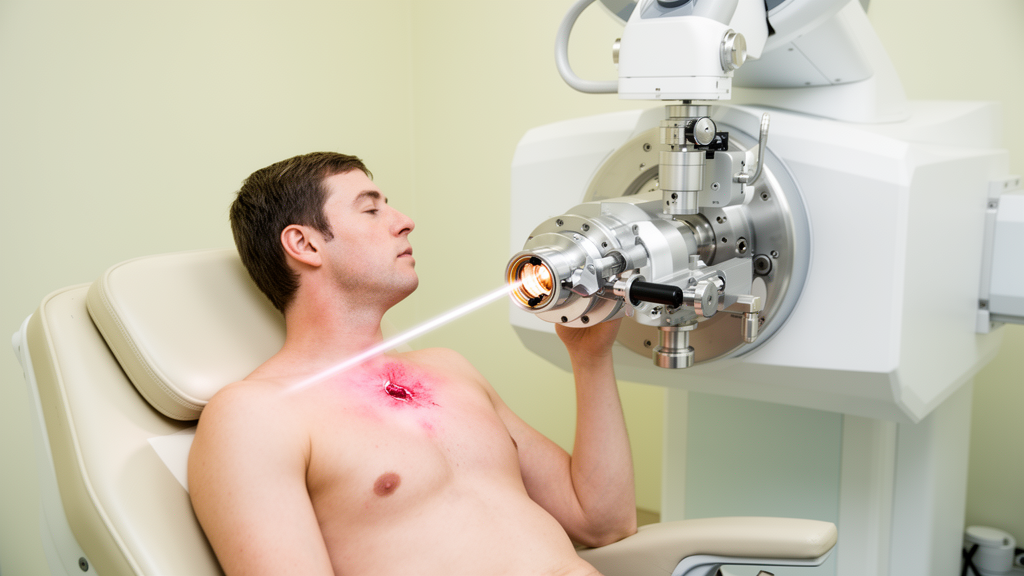
Mayo Clinic researchers have reported encouraging results from the first clinical study of minibeam radiotherapy in patients with superficial cancers that had resisted previous treatments or developed near sensitive anatomical structures. The technique delivers very high radiation doses through 0.5-millimeter-wide beamlets while limiting exposure to healthy tissue between the beams. In the trial, symptoms improved in 86% of patients, and most evaluable tumors either disappeared, shrank or remained stable during a median follow-up of about 15 months.
The findings provide initial clinical evidence for an approach that could address difficult radiation-treatment problems, although the study was small and did not report a direct comparison with conventional care. The peer-reviewed study, published in the International Journal of Radiation Oncology, Biology, Physics on August 14, 2026, examined superficial skin and soft-tissue malignancies treated with a specialized radiation-delivery system. Researchers treated 36 patients with 46 tumors, of which 40 could be evaluated.
The cancers included advanced skin cancers such as melanoma and squamous cell carcinoma, as well as soft-tissue sarcomas. Ninety percent of patients had received at least two previous cancer therapies, and all tumors were resistant to other treatments. The population was therefore heavily pretreated, while the focus on accessible surface tumors limits the findings to the type of malignancies and clinical setting studied.
Conventional radiotherapy aims to destroy cancer cells while limiting damage to surrounding healthy tissue. That balance is particularly challenging when a tumor requires a high radiation dose but lies close to an organ or structure whose function needs to be preserved. Scott Lester, a radiation oncologist at Mayo Clinic Comprehensive Cancer Center, described tumors requiring high doses that infiltrate sensitive parts of the body as particularly formidable.
To address the delivery problem, Mayo researchers developed a tungsten collimator that divides a conventional radiation beam into beamlets 0.5 millimeters wide, spaced 1 millimeter apart from center to center. The device creates alternating areas of high and low radiation exposure, called peaks and valleys. The intended advantage of this spatial pattern is that healthy tissue in the low-exposure valleys may have more opportunity to repair and regenerate than it would under a more uniform treatment field, while the narrow high-exposure peaks deliver concentrated radiation to the target.
The clinical findings were consistent with that design: patients experienced fewer radiation-related side effects than are typically seen with conventional radiation despite receiving higher doses in the targeted areas. Researchers also observed healing of tissue alongside control of tumors. Treatment could be completed in two or three sessions instead of the 10 to 30 sessions that may be required with conventional radiotherapy, reducing the number of visits for patients participating in this trial.
Among the 46 tumors, 39, or 85%, received minibeam radiotherapy alone. Seven tumors, or 15%, also received planned conventional radiation therapy. At a median follow-up of approximately 15 months, 22.5% of the 40 evaluable tumors had disappeared, 25% had shrunk and 45% remained stable.
The estimated local control rate at 12 months was 89% overall and 92% among tumors receiving minibeam radiotherapy alone. Local control meant that the cancer had not progressed in the treated area. These percentages describe outcomes observed in this trial; the study did not report a direct comparison with a conventional-treatment group.
Changes in tumor size were accompanied by substantial symptom relief. Patients reported benefits that included relief from pain and bleeding and restoration of daily physical functions, with the study team reporting improved symptoms in 86% of participants. “The study suggested a compelling benefit to quality of life for patients, from relief from pain and bleeding to restoring daily physical functions,” said Kimi Chauhan, a resident in radiation oncology at Mayo Clinic and co-first author.
Michael Grams, a radiation oncology medical physicist and the other co-first author, said the encouraging aspect was that patients tolerated the higher radiation doses even though many had cancers that had resisted previous treatments. One of the trial’s more unexpected observations involved cancer responding outside the area that received minibeam radiation. In 11% of patients, cancer outside the treated area responded even though the patients received no other cancer treatment.
This phenomenon is known as an abscopal response, which occurs when radiation delivered to one tumor is associated with a response in cancer elsewhere in the body. Mayo investigators said the observation suggests that minibeam radiotherapy may affect tumor biology and interact with the immune system. The trial did not establish how often the response will occur, how long it will last or whether minibeam treatment is responsible for it, but the finding identifies an effect that the team is now studying.
Robert Mutter, chair of research in Mayo Clinic’s Department of Radiation Oncology, said the results suggest that an ablative dose may not need to cover every part of a tumor in the same way. He said minibeam radiotherapy may expose distinct ways in which tumors die and could potentially be used to stimulate immune activity against cancer. “This represents an important shift in how we think about radiotherapy because our results suggest that you don't necessarily need to treat all of the tumor with an ablative dose,” Mutter said.
Researchers are conducting laboratory studies to understand the mechanisms that trigger the immune response and which patients are most likely to benefit from minibeam radiotherapy. The immediate development program includes an ongoing phase 1 clinical trial testing increasing doses of minibeam radiotherapy. The team is also developing studies of minibeam radiotherapy in early-stage breast cancer in combination with immunotherapy and during surgery for unresectable pancreatic cancer.
These investigations extend the approach beyond the superficial skin and soft-tissue malignancies included in the initial study. The reported outcomes belong to the completed trial in heavily pretreated patients and should not be interpreted as results from those planned studies. Overall, the first clinical evaluation found encouraging tumor control, symptom relief and tolerability with minibeam radiotherapy in patients with superficial malignancies resistant to other treatments.
Its most distinctive features are the submillimeter beamlets, concentrated high-dose regions separated by lower-exposure valleys and a treatment schedule of only two or three sessions. The study also produced an unexpected immune-related observation in 11% of patients, adding a new avenue for investigation.
Subject of Research: Clinical evaluation of minibeam radiotherapy for superficial skin and soft-tissue malignancies
Article Title: Mayo Clinic first to study minibeam radiotherapy in patients with difficult-to-treat cancers
Article References: Mayo Clinic first to study minibeam radiotherapy in patients with difficult-to-treat cancers. Original publication (Bibliographic details unavailable.)
Image Credits: AI Generated
DOI: Not provided
Keywords: minibeam radiotherapy, radiation oncology, superficial tumors, treatment-resistant cancer, melanoma, squamous cell carcinoma, soft-tissue sarcoma, tumor control, abscopal response, cancer immunology, Mayo Clinic, Mayo
Cite Scienmag News
Nathaniel Bowman. (October 21, 2026). First small trial finds minibeam radiotherapy promising for resistant surface cancers. Scienmag. https://scienmag.com/first-small-trial-finds-minibeam-radiotherapy-promising-for-resistant-surface-cancers/
Nathaniel Bowman. "First small trial finds minibeam radiotherapy promising for resistant surface cancers." Scienmag, 21 October 2026, https://scienmag.com/first-small-trial-finds-minibeam-radiotherapy-promising-for-resistant-surface-cancers/. Accessed 21 October 2026.
Nathaniel Bowman. "First small trial finds minibeam radiotherapy promising for resistant surface cancers." Scienmag. October 21, 2026. https://scienmag.com/first-small-trial-finds-minibeam-radiotherapy-promising-for-resistant-surface-cancers/


