

Wednesday, October 21, 2026
Science
No Result
View All Result
  • Login
  • HOME
  • SCIENCE NEWS
  • CONTACT US
  • HOME
  • SCIENCE NEWS
  • CONTACT US
No Result
View All Result
Scienmag
No Result
View All Result
Home Science News Policy

UCL cup pilot interviews identify barriers and enablers of reusable-cup returns

October 21, 2026
in Policy, Science News
Sloane Callahan
By Sloane Callahan Scienmag Editorial Profile - Climate Mitigation
Reading Time: 2 mins read
0
UCL cup pilot interviews identify barriers and enablers of reusable-cup returns

UCL cup pilot interviews identify barriers and enablers of reusable-cup returns

65
SHARES
587
VIEWS
Share on FacebookShare on Twitter
ADVERTISEMENT

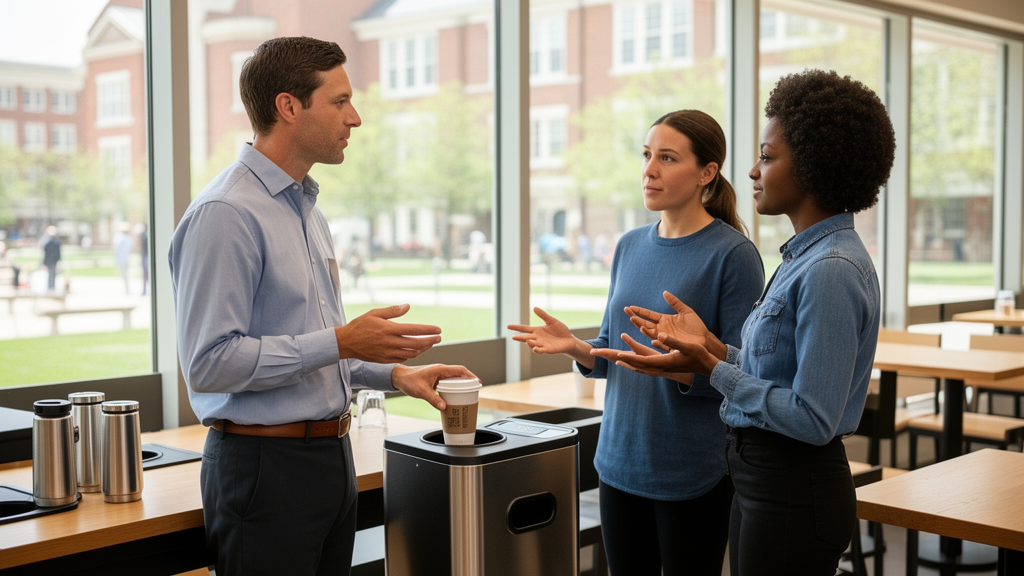
Nine interviews with students and staff participating in a University College London reusable-cup deposit pilot identified a combination of practical, social and motivational influences on cup use and return. Participants described clearer instructions, accessible drop-box locations, reminders, confidence in hygiene and useful social interactions as potential enablers, while forgetting to return cups and retaining cups for other purposes could interrupt reuse.

The qualitative study examined a pilot scheme in which participants paid a £1 deposit for a reusable cup and received the refund when they returned it. Researchers conducted semi-structured interviews with UCL students and staff, analysed the accounts inductively and then mapped 13 themes onto the Capability, Opportunity, Motivation–Behaviour, or COM-B, model. The findings reflect the reported experiences of nine participants in one university setting rather than the measured performance of the full scheme.

Psychological capability was represented by understanding the scheme and remembering to return the cup. Physical opportunity included cup design, access to drop boxes, posters and instructions, while social opportunity covered interactions about the cups. Automatic motivation included habits and positive feelings. Reflective motivation encompassed perceived ease, usefulness, reliability and hygiene, as well as alternative goals associated with using the scheme.

Participants offered several possible ways to strengthen engagement. The researchers recommend providing clearer step-by-step instructions, having staff communicate the intervention directly and offering timely reminders to encourage returns. Convenient return locations were reported as particularly important, and participants indicated that viewing the cups as hygienic and useful, alongside constructive social exchanges, could support participation. These suggestions emerged from qualitative accounts and were not evaluated as separate interventions in the reported interviews.

The study illustrates how a deposit scheme can involve more than the payment and refund of a financial deposit. It also shows that a cup may not circulate as a shared reusable asset if it is forgotten, retained as a memento or diverted to another purpose. The authors argue that the findings can inform other circular packaging initiatives and support strategies that manage packaging at its source through reduction and reuse, while the small, local qualitative sample limits how broadly the reported barriers and enablers can be applied.

Subject of Research: Qualitative study of barriers and enablers of reusable-cup use and return in a UCL deposit pilot

Article Title: Understanding engagement with a deposit return scheme for reusable cups: A qualitative study on barriers and enablers of cup use and return through the COM-B Model

Article References: Warner, I., Allison, A. L., & Schenk, P. M. (2026). Understanding engagement with a deposit return scheme for reusable cups: A qualitative study on barriers and enablers of cup use and return through the COM-B Model. PLOS Sustainability and Transformation, 5(10), e0000301. https://doi.org/10.1371/journal.pstr.0000301

Image Credits: AI Generated

DOI: 10.1371/journal.pstr.0000301

Keywords: reusable cups, deposit return schemes, qualitative interviews, behaviour change, COM-B model, plastic reduction, packaging reuse, UCL, environmental behaviour, circular economy, Understanding, engagement

Cite Scienmag News

Sloane Callahan. (October 21, 2026). UCL cup pilot interviews identify barriers and enablers of reusable-cup returns. Scienmag. https://scienmag.com/ucl-cup-pilot-interviews-identify-barriers-and-enablers-of-reusable-cup-returns/


Sloane Callahan. "UCL cup pilot interviews identify barriers and enablers of reusable-cup returns." Scienmag, 21 October 2026, https://scienmag.com/ucl-cup-pilot-interviews-identify-barriers-and-enablers-of-reusable-cup-returns/. Accessed 21 October 2026.

Sloane Callahan. "UCL cup pilot interviews identify barriers and enablers of reusable-cup returns." Scienmag. October 21, 2026. https://scienmag.com/ucl-cup-pilot-interviews-identify-barriers-and-enablers-of-reusable-cup-returns/

Tags: barriers and enablers of cup reusebehavioral insights in waste managementbehaviour changeCircular economyCOM-B modelCOM-B model in sustainability initiativesdeposit return schemesdesign and accessibility of cup drop boxesengagementenhancing participation in reusable cup schemesenvironmental behaviourmotivation and habits in environmental sustainabilitypackaging reuseplastic reductionpractical factors affecting reusable cup returnpsychological factors in reusable cup usequalitative interviewsqualitative study on reusable cup return behaviorReusable cup deposit schemereusable cupssocial influences on sustainable behaviorsUCLunderstandinguniversity-based waste reduction programs
Share26Tweet16
Previous Post

Reservoir model links targeted road-salt cuts to Wachusett water quality

Next Post

14-Item Scale Tracks Related Moral and Civic Identities in German-Speaking Youth

Related Posts

14-Item Scale Tracks Related Moral and Civic Identities in German-Speaking Youth
Psychology & Psychiatry

14-Item Scale Tracks Related Moral and Civic Identities in German-Speaking Youth

October 21, 2026
Reservoir model links targeted road-salt cuts to Wachusett water quality
Earth Science

Reservoir model links targeted road-salt cuts to Wachusett water quality

October 21, 2026
Environmental volatility is associated with adaptive caution in visual search
Biology

Environmental volatility is associated with adaptive caution in visual search

October 21, 2026
Pilot trial finds combined dementia rehabilitation and caregiver support feasible
Medicine

Pilot trial finds combined dementia rehabilitation and caregiver support feasible

October 21, 2026
Dual Williams and Lynch diagnoses found in 20-month-old boy: case report
Medicine

Dual Williams and Lynch diagnoses found in 20-month-old boy: case report

October 21, 2026
Research report: JAK-STAT signaling: a key mechanism of immune microenvironment remodeling in breast cancer and novel strategies for targeted therapy
Medicine

Research report: JAK-STAT signaling: a key mechanism of immune microenvironment remodeling in breast cancer and novel strategies for targeted therapy

October 21, 2026
Next Post
14-Item Scale Tracks Related Moral and Civic Identities in German-Speaking Youth

14-Item Scale Tracks Related Moral and Civic Identities in German-Speaking Youth

  • Mothers who receive childcare support from maternal grandparents show more optimized

    Mothers who receive childcare support from maternal grandparents show more parental warmth, finds NTU Singapore study

    27656 shares
    Share 11059 Tweet 6912
  • University of Seville Breaks 120-Year-Old Mystery, Revises a Key Einstein Concept

    1061 shares
    Share 424 Tweet 265
  • Bee body mass, pathogens and local climate influence heat tolerance

    682 shares
    Share 273 Tweet 171
  • Researchers record first-ever images and data of a shark experiencing a boat strike

    546 shares
    Share 218 Tweet 137
  • Groundbreaking Clinical Trial Reveals Lubiprostone Enhances Kidney Function

    531 shares
    Share 212 Tweet 133
Science

Embark on a thrilling journey of discovery with Scienmag.com—your ultimate source for cutting-edge breakthroughs. Immerse yourself in a world where curiosity knows no limits and tomorrow’s possibilities become today’s reality!

RECENT NEWS

  • 14-Item Scale Tracks Related Moral and Civic Identities in German-Speaking Youth
  • UCL cup pilot interviews identify barriers and enablers of reusable-cup returns
  • Reservoir model links targeted road-salt cuts to Wachusett water quality
  • Environmental volatility is associated with adaptive caution in visual search

Categories

  • Agriculture
  • Anthropology
  • Archaeology
  • Athmospheric
  • Biology
  • Biotechnology
  • Blog
  • Bussines
  • Cancer
  • Chemistry
  • Climate
  • Earth Science
  • Editorial Policy
  • Marine
  • Mathematics
  • Medicine
  • Pediatry
  • Policy
  • Psychology & Psychiatry
  • Science Education
  • Science News
  • Social Science
  • Space
  • Technology and Engineering

Subscribe to Blog via Email

Enter your email address to subscribe to this blog and receive notifications of new posts by email.

Join 5,151 other subscribers

© 2025 Scienmag - Science Magazine

Welcome Back!

Login to your account below

Forgotten Password?

Retrieve your password

Please enter your username or email address to reset your password.

Log In
No Result
View All Result
  • HOME
  • SCIENCE NEWS
  • CONTACT US

© 2025 Scienmag - Science Magazine

Discover more from Science

Subscribe now to keep reading and get access to the full archive.

Continue reading