


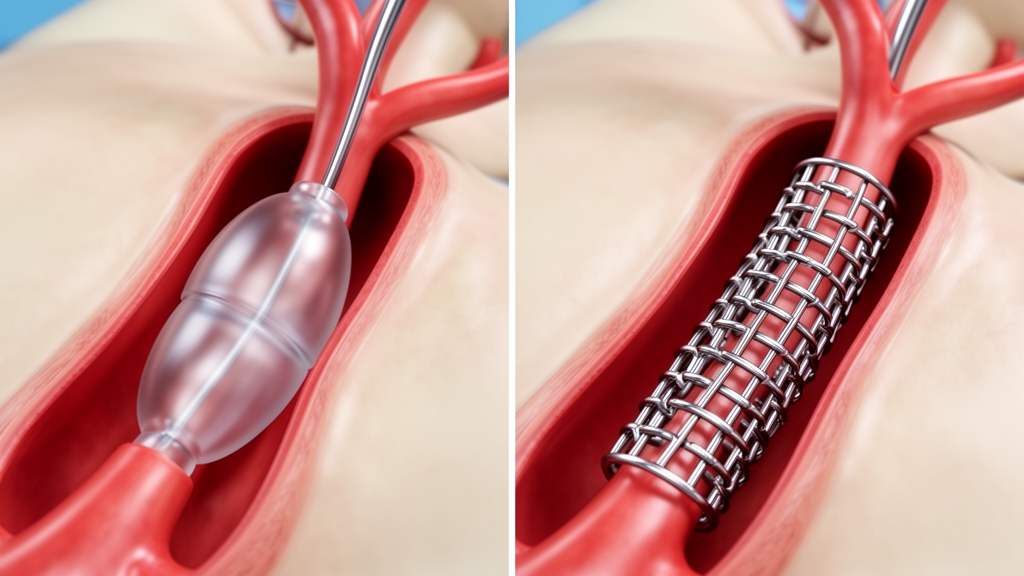
A drug-coated balloon strategy produced similar observed long-term clinical outcomes to drug-eluting stents for de novo aorto-ostial coronary lesions in a retrospective real-world registry, while exploratory angiography suggested that balloon-treated arteries may enlarge further after treatment. The finding concerns complex stenoses at the origins of the right coronary artery and left main stem, where accurate device placement is difficult because of variable anatomy, heavy calcification and turbulent blood flow. Among 197 patients treated between January 2015 and November 2019, target lesion failure occurred in 14.0% of balloon-treated lesions and 17.1% of stent-treated lesions over a median 3.7 years of follow-up.
The difference was not statistically significant, with a hazard ratio of 0.79 for balloon versus stent treatment, a 95% confidence interval of 0.35 to 1.76 and a p value of 0.563. The authors described the results as hypothesis-generating because treatment was not randomized and the angiographic comparison included only 59 lesions. The study was the single-centre SPARTAN-AOL registry study, named for the Safety of Paclitaxel-Drug-Coated Balloon Angioplasty of aorto-ostial coronary lesions program.
It included 57 patients treated with paclitaxel-coated balloons and 140 treated with drug-eluting stents. Aorto-ostial disease was defined angiographically as a new stenosis involving the coronary ostium or the first 5 mm of the right coronary artery or left main stem. Cases were excluded if patients had presented with cardiac arrest, required intubation and mechanical ventilation, or had cardiogenic shock, because the investigators reasoned that outcomes in those circumstances would be driven mainly by the severity of the initial presentation.
Patients who received both treatment strategies in the same target lesion were also excluded. Baseline clinical characteristics were broadly similar between the groups. Mean age was 69.19 years in the stent group and 71.3 years in the balloon group, and the proportions presenting with stable angina, ST-elevation myocardial infarction or non-ST-elevation myocardial infarction or unstable angina did not differ significantly.
The procedural record, however, revealed important differences in lesion complexity. Severe angiographic calcification was present in 29.8% of balloon-treated lesions and 21.4% of stent-treated lesions, while tortuosity was more frequent in the balloon group, at 21.1% versus 10.0%. Dissection during preparation was reported in 40.4% of balloon cases, compared with 1.4% of stent cases.
The mean final device diameter was 3.61 mm for balloons and 4.14 mm for stents, while the median contrast volume was 120 ml and 150 ml, respectively. The primary endpoint, target lesion failure, was a composite of target lesion revascularization, target lesion myocardial infarction and cardiovascular death. Individual components, target vessel revascularization and all-cause mortality were secondary endpoints.
Clinical outcomes were assembled from national hospital and cardiovascular outcome datasets and independently adjudicated by two reviewers, with mortality adjudication blinded to treatment. Balloon treatment was associated with numerically lower rates of target lesion revascularization, 7.0% versus 10.0% for stents, and target lesion myocardial infarction, 1.8% versus 5.7%. Cardiovascular death was numerically more frequent with balloons, 7.0% versus 5.7%, while all-cause mortality was 19.3% and 17.9%, respectively.
None of these differences was statistically significant, and the confidence intervals were wide, reflecting the small number of events. Exploratory adjusted analyses did not reveal a treatment association with target lesion failure after accounting for creatinine and calcification. Severe rather than mild calcification was independently associated with failure: the hazard ratio was 2.58, with a 95% confidence interval of 1.20 to 5.53 and a p value of 0.015.
Each 10-unit increase in creatinine was also associated with a modestly higher hazard of target lesion failure, with a hazard ratio of 1.04, a 95% confidence interval of 1.01 to 1.07 and a p value of 0.015. In the mortality model, treatment strategy again was not significantly associated with all-cause death, whereas increasing age and creatinine were. Sensitivity analyses restricted to 156 lesions classified as true ostial disease produced results consistent with the full cohort, with target lesion failure in 14.9% of balloon-treated and 16.5% of stent-treated patients.
Exploratory comparisons by vessel also found no statistically significant treatment differences, but several hazard ratios could not be estimated because of zero events in small subgroups. Mechanistic patterns differed between the two coronary origins. No target lesion revascularization events were recorded for balloon-treated right coronary artery lesions, whereas the rate was 12.7% with stents.
Among nine stent-treated right coronary artery revascularizations, angiographic evidence of stent recoil was identified in one-third, while most of the remainder predominantly showed diffuse proliferative in-stent restenosis; one episode of late stent thrombosis was also recorded. In the left main stem subgroup, all four balloon-related revascularization events involved focal or diffuse in-stent restenosis, while five stent-related events involved a mixture of malapposition, a calcific nodule, diffuse neointimal restenosis and bifurcation-related failure with ostial circumflex restenosis. These are descriptive subgroup observations rather than evidence that either strategy produced a specific failure mechanism, because the numbers were small and follow-up angiography was not routine.
Quantitative coronary angiography offered the study’s most striking signal. Baseline analysis was possible in 183 patients, and serial follow-up analysis was available for 59 lesions: 42 treated with stents and 17 with balloons. Follow-up angiography was triggered by clinical indications rather than scheduled by the protocol, and its timing varied substantially.
The median interval was 1.1 years for stent-treated lesions and 0.4 years for balloon-treated lesions, although the difference was not statistically significant. Balloon-treated lesions had a lower mean percentage diameter stenosis at follow-up, 23.41% versus 39.07% for stents, with a p value of 0.044. Follow-up minimum lumen diameter was numerically greater after balloon treatment, 2.91 mm versus 2.42 mm, but that difference did not reach conventional statistical significance, with a p value of 0.15.
The clearest angiographic contrast concerned change after the index procedure. Late lumen loss, defined as the difference between post-procedure and follow-up minimum lumen diameter, averaged minus 0.25 mm after balloon treatment, indicating a mean increase in lumen diameter, whereas stents showed late lumen loss of 0.81 mm. The difference was significant at p below 0.001.
Binary restenosis of at least 50% was numerically less frequent after balloon treatment, occurring in 12% of the small follow-up subgroup compared with 29% after stenting, but the p value was 0.17. Net lumen gain relative to the pre-procedure measurement averaged 2.21 mm for balloons and 1.55 mm for stents, with a p value of 0.076. Trend analyses suggested a greater tendency toward later lumen gain among balloon-treated right coronary artery lesions, but the authors cautioned that these patterns must be interpreted against differing follow-up durations and the absence of a standardized angiographic schedule.
Several design features limit what can be concluded. This was an observational study at one UK center, and operators selected the device, leaving room for selection bias and unmeasured confounding. Balloon experience at the institution increased over time, which may have influenced treatment choices.
Only one paclitaxel-coated balloon platform was used, limiting generalizability to other drug-coated balloons, and few cases were treated with direct stenting or cutting balloons. The sample was modest overall and especially small in vessel-specific and angiographic analyses, producing wide confidence intervals around clinical effect estimates. Angiographic follow-up was opportunistic, the QCA assessment was not performed by an independent core laboratory, and intravascular imaging was not used systematically.
Measurement at aorto-ostial sites is also difficult because of overlap, foreshortening and uncertainty about the reference segment; in most cases, reference vessel diameter was derived from one distal point. The results therefore support further prospective evaluation rather than establish equivalence or superiority, and the observed late lumen gain should be regarded as an exploratory signal rather than a demonstrated clinical benefit.
Subject of Research: Clinical and angiographic comparison of drug-coated balloons and drug-eluting stents for aorto-ostial coronary lesions
Article Title: DCB vs. DES in aorto-ostial lesions- clinical outcomes and QCA insights from SPARTAN registry
Article References: Natarajan, R., Corballis, N., Chandrasekharan, K., Merinopoulos, I., Gunawardena, T., Wickramarachchi, U., Clark, A. B., Vassiliou, V. S., Eccleshall, S. C., & SPARTAN DCB consortium (2026). DCB vs. DES in aorto-ostial lesions- clinical outcomes and QCA insights from SPARTAN registry. Frontiers in Cardiovascular Medicine, 13, Article 1953073. https://doi.org/10.3389/fcvm.2026.1953073
Image Credits: AI Generated
DOI: 10.3389/fcvm.2026.1953073
Keywords: aorto-ostial lesions, drug-coated balloons, drug-eluting stents, coronary angioplasty, target lesion failure, late lumen gain, quantitative coronary angiography, retrospective registry, aorto-ostial, lesions-, clinical, outcomes
Cite Scienmag News
Ophelia Keating. (October 21, 2026). Retrospective aorto-ostial registry finds no significant difference between balloons and stents. Scienmag. https://scienmag.com/retrospective-aorto-ostial-registry-finds-no-significant-difference-between-balloons-and-stents/
Ophelia Keating. "Retrospective aorto-ostial registry finds no significant difference between balloons and stents." Scienmag, 21 October 2026, https://scienmag.com/retrospective-aorto-ostial-registry-finds-no-significant-difference-between-balloons-and-stents/. Accessed 21 October 2026.
Ophelia Keating. "Retrospective aorto-ostial registry finds no significant difference between balloons and stents." Scienmag. October 21, 2026. https://scienmag.com/retrospective-aorto-ostial-registry-finds-no-significant-difference-between-balloons-and-stents/


