


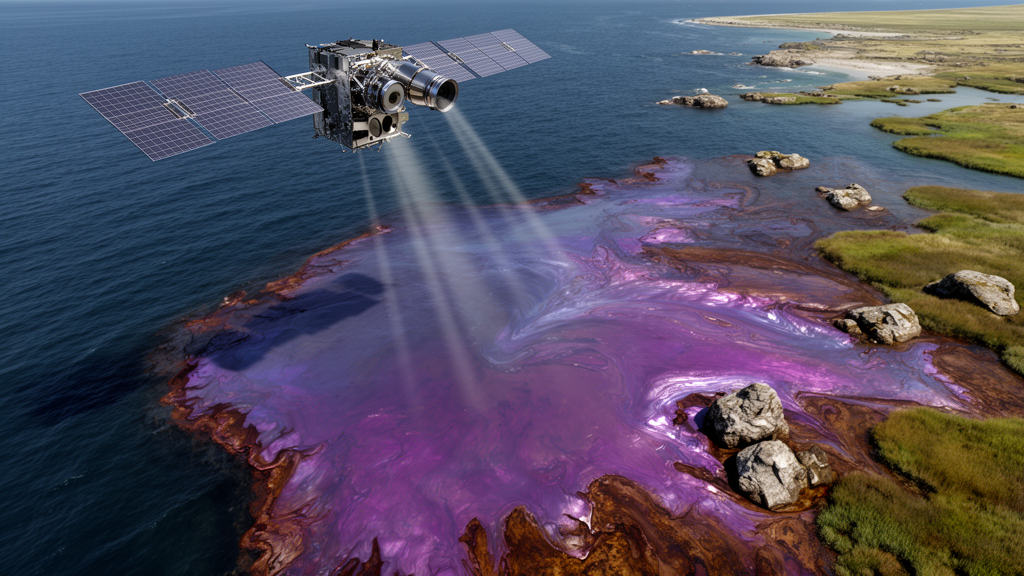
A three-stage deep-learning pipeline developed for satellite monitoring can identify whether an image is optical or synthetic aperture radar, determine whether it contains oil, and then map likely spill pixels. In the study, the optical RGB branch achieved a Dice/F1 score of 0.8756 and an intersection-over-union of 0.7787 when evaluated on 560 images, while the initial modality classifier reached 99.04% accuracy. The results support the pipeline’s potential for automated oil-spill screening, but the researchers say that full-scale pixel-level validation was completed only for optical imagery; the SAR segmentation branches remain unvalidated.
The work, published in Frontiers in Marine Science on 21 October 2026, used publicly available Sentinel-1 SAR images and complementary optical RGB datasets. More than 26,000 images were organized for separate tasks: modality classification, image-level oil detection and pixel-level segmentation. Rather than sending every observation through the same segmentation network, the proposed architecture first classifies the sensing modality, routes the image to a corresponding detector and runs the pixel mapper only when the detector identifies oil.
That conditional design is intended to limit unnecessary computation during large-scale monitoring. Oil spills are difficult to distinguish automatically because multiple ocean-surface phenomena can produce similar satellite signatures. In SAR imagery, oil often appears dark because it dampens surface waves and reduces radar backscatter, but low-wind areas, biogenic films, oceanic fronts and shadows can generate comparable dark patches.
Optical images introduce different visual characteristics and may contain reflections or dark water that resemble petroleum. The researchers therefore designed the framework as a hierarchical pipeline rather than relying on one threshold or one type of imagery. The modality classifier used a convolutional backbone followed by four-head global self-attention.
CNN layers extract local textures such as edges and speckle patterns, while attention allows each of 1,024 feature tokens to interact with tokens elsewhere in the image. After retraining on the complete 26,191-image dataset, the model classified grayscale SAR, pseudo-RGB SAR and optical RGB with 99.04% accuracy and a macro-area-under-the-ROC-curve value of 0.999. Class-level results were 0.98 precision and 1.00 recall for grayscale SAR, 0.98 precision and 1.00 recall for pseudo-RGB SAR, and 1.00 precision and 0.98 recall for optical images.
The study attributes the limited errors mainly to visually ambiguous or low-contrast scenes, although it does not establish performance across new geographic regions. Binary detection produced different outcomes by modality. For grayscale SAR, the researchers documented a progression from a basic CNN, which was strongly biased toward oil, to an improved CNN and then a CNN with multi-head attention.
The first model achieved 62.8% overall accuracy but only 2.86% recall for no-oil images. Adding class-weighted binary cross-entropy, batch normalization, augmentation and higher-resolution inputs raised the intermediate model’s accuracy to about 72% and no-oil recall to 69%. The final attention-based model, trained with SAR-specific preprocessing and class weighting, reached approximately 100% accuracy on 1,707 test images: all 85 no-oil images were correctly identified, while 1,616 of 1,622 oil images were detected.
Its oil-class precision and recall were both reported as 1.00 after rounding, with macro F1 of 0.98. The pseudo-RGB SAR detector was less successful, using a CNN with global average pooling and a two-channel SAR representation. On the full test set, it achieved 82.52% accuracy, with oil precision of 0.8958, oil recall of 0.7679 and an oil F1 score of 0.8269.
The model produced 10 false positives and 26 false negatives. By contrast, the optical RGB detector used patch embedding and four transformer blocks with multi-head self-attention. It reached 96% accuracy on 2,704 test images, detecting 1,812 of 1,830 oil images and correctly classifying 793 of 874 no-oil images.
The high recall indicates broad detection of oil-labeled images, but the false positives show that image-level screening cannot by itself establish the extent or nature of a spill. SAR preprocessing was tailored to the modality’s imaging physics. A Lee adaptive filter suppressed multiplicative speckle noise while preserving stronger edges; Sakaguchi contrast enhancement amplified boundary information; a local contrast ratio calculation emphasized fine-scale texture differences; and global standardization reduced variation in image intensity.
These operations were intended to make oil-covered water more distinguishable from look-alike surfaces, although the study notes that calm water and biogenic films can still suppress SAR backscatter in similar ways. The researchers did not report a controlled ablation isolating the contribution of every preprocessing operation; the reported SAR results belong to the complete model-development sequence, in which preprocessing, class weighting and the attention-based architecture were changed across successive models. For pixel-level mapping of optical images, the authors used a compact three-level U-Net with approximately 118,000 parameters.
Its encoder extracts progressively higher-level features, while a decoder reconstructs image resolution through bilinear upsampling and skip connections that preserve boundary information. Training combined dynamically weighted binary cross-entropy with a Dice overlap term, and balanced batches contained equal numbers of oil and non-oil samples. These measures addressed the severe imbalance between oil and background pixels.
On 560 test images of 128 by 128 pixels, the model correctly identified 4,202,616 oil pixels while missing 209,462. It also mislabeled 984,897 background pixels as oil, producing an oil precision of 0.8101, oil recall of 0.9525, overall pixel accuracy of 0.8698 and a background false-positive rate of 20.68%. The result demonstrates strong overlap between predicted and reference oil regions in the evaluated optical set, with a measured cost of overprediction rather than missed oil pixels.
Small-data comparisons favored conventional CNN, CNN-attention and U-Net designs over four fractional-order feature transformations tested by the team. In modality classification, the selected CNN with multi-head attention achieved 99.33% accuracy on a preliminary subset, compared with 12.00% to 56.67% for the fractional variants. Similar patterns appeared in optical detection and segmentation.
One fractional U-Net collapsed almost completely, producing a Dice score of 0.0467 in the small optical segmentation comparison, while the baseline U-Net scored 0.4007 on that subset and was selected for full training. These comparisons were conducted on selected subsets rather than the final test sets and therefore served as model-selection experiments rather than independent confirmations of the final results. The most important limitation is that the framework’s complete multimodal segmentation capability was not demonstrated.
In grayscale SAR segmentation, GeoTIFF ground-truth masks were mistakenly loaded as floating-point values instead of being converted into binary labels, producing an invalid Dice score of 0.318 that the researchers excluded from their quantitative claims. Pseudo-RGB SAR training with binary cross-entropy initially produced almost entirely background masks, and the intended BCE–Dice configuration could not be completed because of memory limitations and data-loading and input-output failures. The available dataset information also did not establish whether training and test scenes overlap geographically, so the study did not determine how performance would change under spatially independent evaluation.
Future work is needed with scene- or swath-level data partitions, validated binary mask preprocessing and more efficient cached data pipelines. Until those experiments are completed, the evidence supports strong optical segmentation and successful modality routing and detection, but not full-scale SAR pixel segmentation or assured real-world performance in unseen regions.
Subject of Research: Deep learning for multimodal satellite detection and pixel-level segmentation of marine oil spills
Article Title: Intelligent oil spill detection and segmentation using deep CNN and transformer architectures
Article References: Ramasubramanian, P., Krishnan, A., Pulikkathodi, M. N., Puthiyaveedu, P. E., Venkatasubbu, P., Ganesan, K. P., & Venkatesan, L. (2026). Intelligent oil spill detection and segmentation using deep CNN and transformer architectures. Frontiers in Marine Science, 13, Article 1967710. https://doi.org/10.3389/fmars.2026.1967710
Image Credits: AI Generated
DOI: 10.3389/fmars.2026.1967710
Keywords: oil-spill detection, satellite imagery, synthetic aperture radar, optical RGB, convolutional neural networks, transformers, multi-head attention, U-Net, image segmentation, marine pollution, Intelligent, spill
Cite Scienmag News
Blake Davidson. (October 21, 2026). Deep learning pipeline detects and maps satellite oil spills. Scienmag. https://scienmag.com/deep-learning-pipeline-detects-and-maps-satellite-oil-spills/
Blake Davidson. "Deep learning pipeline detects and maps satellite oil spills." Scienmag, 21 October 2026, https://scienmag.com/deep-learning-pipeline-detects-and-maps-satellite-oil-spills/. Accessed 21 October 2026.
Blake Davidson. "Deep learning pipeline detects and maps satellite oil spills." Scienmag. October 21, 2026. https://scienmag.com/deep-learning-pipeline-detects-and-maps-satellite-oil-spills/


