


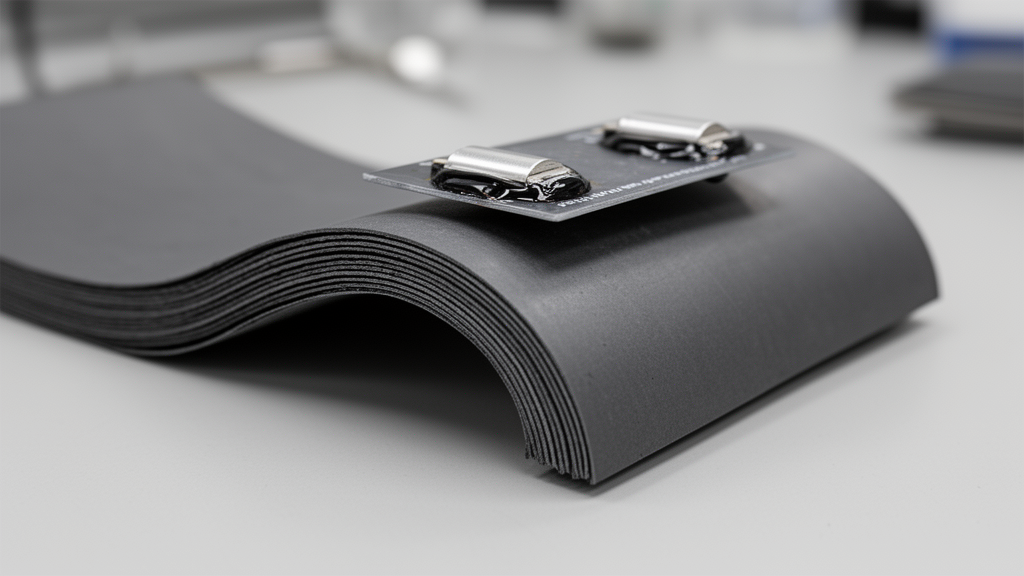
A laboratory study has shown that equal weights of graphite powder and polyvinyl chloride can be solution-cast into a self-supporting current collector for flexible solid-state supercapacitors. The 1-mm sheet delivered a specific capacitance of 2913 mF g−1 in a three-electrode test with 1 M sodium sulfate, while a complete device using a sulfuric-acid gel retained 578 mF g−1 at 5 mA g−1. After 10,000 charge–discharge cycles, the device retained 77% of its capacitance, and an electrode retained 88.9% of its initial specific capacitance after 1,500 manual bending cycles through 180 degrees. These results demonstrate a flexible collector architecture in laboratory-scale testing rather than a commercially validated power source.
The collector was produced by mixing 1 g of graphite powder smaller than 20 micrometres with 1 g of PVC in 20 mL of N,N-dimethylformamide, or DMF. The suspension was stirred magnetically for two hours, cast into a glass Petri dish about 9.5 cm in diameter, and dried in a hot-air oven at 60–80 °C for 48 hours. Casting volume, rather than the dimensions of a purchased foil, determined the resulting sheet thickness, which ranged from 0.1 to 1 mm. The route avoided the vacuum deposition, exfoliation, lamination, and electrochemical activation steps reported for other graphite-based collectors. It was not entirely an ambient process, however, because the casting solution required controlled oven drying.
The 50:50 graphite-to-PVC composition formed a continuous composite in which graphite supplied conductive pathways and the polymer supplied cohesion and flexibility. X-ray diffraction detected the characteristic graphite reflections, including a prominent (002) peak, indicating that graphitic crystallinity survived casting. Atomic-force microscopy showed interconnected graphite domains across the polymer matrix. The reported surface roughness was 16.74 nm at the smallest scan area, while larger scans captured progressively greater microscale heterogeneity as graphite stacks and clusters became visible. A 1-mm sheet had an areal mass of 40.06 ± 5.63 mg cm−2, a consideration for mass-sensitive wearable uses. The study did not evaluate solvent recovery, pilot-scale throughput, or the operational safety of large-scale DMF handling.
Four-probe measurements gave the 50:50 sheet a conductivity of 2608.53 ± 231.6 S m−1, with a coefficient of variation of 8.88% in repeated measurements. Five independent sheets were then assessed for sheet-to-sheet reproducibility, giving 2712.73 ± 644.56 S m−1 and a coefficient of variation of 23.76%. The broader variation among separate sheets indicated meaningful fabrication variability despite consistency among repeated measurements under the tested geometry. Conductivity also depended on thickness: reported means were 2608.53 ± 231.6 S m−1 for 1 mm, 1531.27 ± 88.2 S m−1 for 0.8 mm, and 956.17 ± 32.33 S m−1 for 0.6 mm. A composition containing more PVC was less conductive, whereas a 75:25 graphite-to-PVC mixture became brittle and failed to form a mechanically coherent self-supporting sheet under the reported casting conditions.
The sheet carried current while bent: a 5-by-1-cm strip lit a green LED in a 9-volt circuit after manual deflection, and it did not fracture at the tensile tester’s maximum force of 19.5 N, corresponding to a stress of 1.95 MPa. An apparent Young’s modulus of about 91 MPa was calculated from the initial elastic region, and engineering strain reached approximately 4.20% at the maximum measurable load. These measurements support the sheet’s load-bearing strength and flexibility, but they did not provide an independent measurement of the adhesion between the active coating and collector. The exact experimental percolation threshold was also not established because the tested composition spacing was too broad to resolve it; the approximately 39 vol% graphite in the selected sheet should not be interpreted as a measured threshold.
To test the collector as part of an energy-storage electrode, the researchers used acid-functionalized multiwalled carbon nanotubes as the active coating. A slurry containing the nanotubes, PVDF binder, and carbon black in an 8:1:1 weight ratio was applied to the graphite sheet and dried at 60 °C for 12 hours. The nanotubes had been treated with concentrated nitric and sulfuric acids, introducing oxygen-containing groups and changing their surface properties. Their water-contact angle fell from about 113 degrees before treatment to 64 degrees afterward, while their Raman defect-to-graphitic-band ratio rose from 0.77 to 0.98. Acid treatment therefore improved dispersion and wettability, consistent with better electrolyte access, but it also reduced the measured degree of graphitization from 92.1% to 27.3% and introduced additional disorder into the carbon structure.
Electrolyte chemistry strongly affected the three-electrode measurements. Quasi-rectangular cyclic-voltammetry curves indicated that electrical double-layer charging was the principal storage mechanism, supplemented by faradaic reactions associated with the introduced oxygen groups. The capacitive fraction estimated with Dunn’s model increased with scan rate: 67–86% for sulfuric acid, 45–72% for sodium sulfate, and 22–48% for potassium hydroxide. Sodium sulfate produced the largest reported specific capacitance, 2913 mF g−1 at 10 mA g−1 and 772 mF g−1 at 40 mA g−1. The acidic and alkaline electrolytes showed faster transport but lower charge storage, with reported values of 150 mF g−1 for sulfuric acid and 661 mF g−1 for potassium hydroxide. A carbon-paper control exceeded the graphite-PVC collector under sulfuric-acid conditions, showing that the cast sheet was designed for flexible, simple processing rather than maximum electrochemical performance.
Solid-state devices were assembled from two functionalized-CNT-coated graphite electrodes and a 0.5-mm PVA gel that served as both electrolyte and separator, with 3 mg of active material on each electrode. The PVA–H2SO4 device performed best, retaining 87% of its capacitance when current density rose from 5 to 15 mA g−1. It achieved 578 mF g−1 at 5 mA g−1, an energy density of 80.2 mWh kg−1 at a power density of 2500 mW kg−1, an areal capacitance of 1005.6 μF cm−2, and a volumetric capacitance of 3591 μF cm−3. Cycling retention differed markedly among gels: the sulfuric-acid device retained 77% after 10,000 cycles, whereas the sodium-sulfate device fell to 39% after 3,000 cycles and became largely inactive by about 9,950 cycles; the potassium-hydroxide device retained 43% after 10,000 cycles.
Mechanical testing produced encouraging but qualified durability results. During manually controlled bending and unbending through 180 degrees, the bare graphite sheet retained 92.4% of its initial conductivity after 1,500 cycles, while the functionalized-CNT-coated electrode retained 88.9% of its initial specific capacitance. Cyclic voltammetry, galvanostatic charge–discharge, and impedance measurements showed that most electrochemical function survived the bending test, although capacitance and energy density declined at the most severe angles. Raman spectroscopy, X-ray diffraction, and electron microscopy after cycling indicated that the carbon network remained recognizable, with no extensive delamination or major crystalline transformation. The authors considered gradual interfacial degradation and restricted ion transport more plausible explanations for the performance loss than complete collapse of the carbon framework.
For wearable applications, the study offers a collector that is lightweight, metal-free, self-supporting, and comparatively simple to manufacture, but its practical scalability remains unproven. The sheet’s conductivity was far below that of compacted binderless graphite foil and common copper or aluminium foils, and its apparent impedance included contributions from the gel, active-material layer, collector, interfaces, and external contacts. The reported energy and power figures also depend on the mass-accounting method and device configuration, while the three-electrode Ragone results should not be compared directly with full-device values. The central achievement is a low-temperature, vacuum-free casting route that combines graphite conduction with PVC-supported flexibility, demonstrated through electrochemical operation, electrical measurements, and manual bending. Because bending was performed by hand without a fixed-radius mandrel, motorized cycling stage, calibrated contact jig, or replicate bending specimens, the test did not establish bend radius, strain rate, dwell time, or point-by-point uncertainty.
Subject of Research: Laboratory evaluation of a solution-cast graphite-PVC current collector for flexible solid-state supercapacitors
Article Title: Scalable solution-cast flexible graphite sheet current collectors for flexible solid-state supercapacitors
Article References: Selvaraj, S., & Thampy, A. S. (2026). Scalable solution-cast flexible graphite sheet current collectors for flexible solid-state supercapacitors. Frontiers in Physics, 14, Article 1920937. https://doi.org/10.3389/fphy.2026.1920937
Image Credits: AI Generated
DOI: 10.3389/fphy.2026.1920937
Keywords: flexible supercapacitors, graphite current collectors, solution casting, solid-state energy storage, carbon nanotubes, graphite-PVC composite, wearable electronics, electrolyte performance, bending durability, electrochemical energy storage, Scalable, solution-cast
Cite Scienmag News
Denise Maddox. (October 21, 2026). Cast graphite sheets support bendable solid-state supercapacitors. Scienmag. https://scienmag.com/cast-graphite-sheets-support-bendable-solid-state-supercapacitors/
Denise Maddox. "Cast graphite sheets support bendable solid-state supercapacitors." Scienmag, 21 October 2026, https://scienmag.com/cast-graphite-sheets-support-bendable-solid-state-supercapacitors/. Accessed 21 October 2026.
Denise Maddox. "Cast graphite sheets support bendable solid-state supercapacitors." Scienmag. October 21, 2026. https://scienmag.com/cast-graphite-sheets-support-bendable-solid-state-supercapacitors/


