


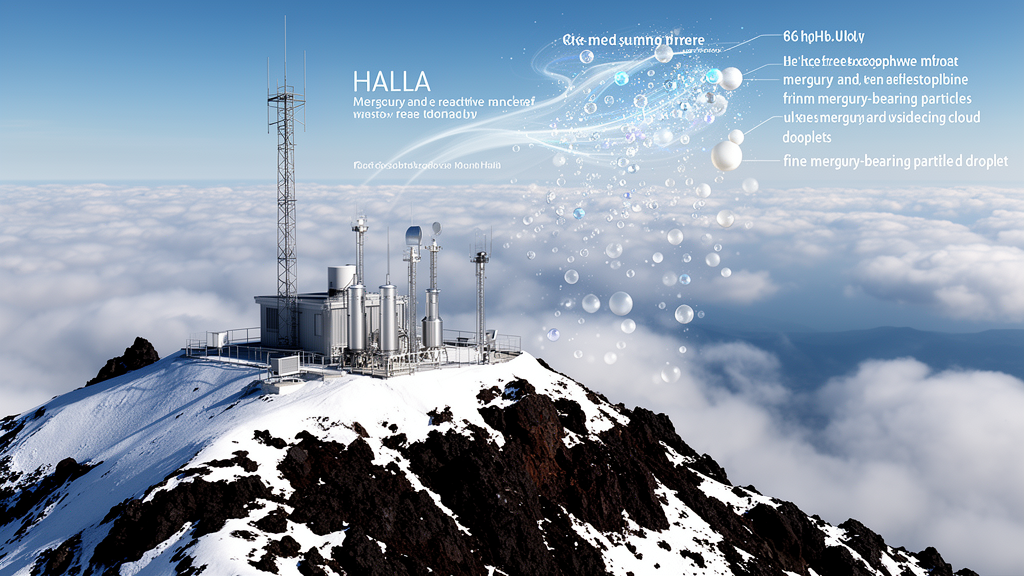
Snow and atmospheric mercury-isotope measurements from Mount Halla on Jeju Island, Korea, indicate that halogen-mediated oxidation in the free troposphere accounts for most of the mercury oxidation linked to deposition at the site. Isotope mixing models attributed 68% of the relevant oxidation to free-tropospheric photo-oxidation and 32% to near-surface oxidation, providing field-based evidence for a previously poorly constrained pathway affecting mercury deposition to the western Pacific. Asian outflow represents 50% of global anthropogenic mercury emissions, but the atmospheric oxidation pathways controlling deposition to the adjacent Pacific Ocean remain poorly constrained.
The study used multi-year snow and atmospheric mercury-isotope measurements from Mount Halla to examine mercury sources and oxidation pathways relevant to marginal Asia and the western Pacific. Its geographic scope centers on the Korean mountain site and the atmospheric influences recorded there, rather than establishing a single oxidation ratio for the entire Asia-Pacific region. The researchers examined mass-independent fractionation of even-number mercury isotopes, expressed as Δ200Hg.
This signal correlated with both air-mass transport distance and trajectory altitude. Those relationships support the interpretation that mercury photo-oxidation in the free troposphere produces the even-MIF observed in the samples. A second line of evidence came from coupled anomalies in Δ200Hg and the oxygen-isotope composition of nitrate, written as Δ17O(NO3−), measured in snow.
The authors interpret this relationship as evidence that reactive bromine generated through debromination of local sea-salt aerosol sustains oxidative capacity in the free troposphere. Under the proposed mechanism, halogen-mediated free-tropospheric photo-oxidation drives mercury deposition to Mount Halla snow, connecting marine aerosol chemistry with the oxidation of mercury arriving from Asian outflow. The 68% and 32% results are model-based estimates for the sampled Mount Halla and western Pacific setting, not direct measurements of deposition across all of Asia Pacific.
Nevertheless, its combined isotope observations and mixing model support a central role for reactive bromine and free-tropospheric mercury oxidation in the deposition signal recorded at Mount Halla. The work was published as an accepted, open-access article in Communications Earth & Environment, with the early version subject to further edits before replacement by the final version of record.
Subject of Research: Mercury-isotope evidence for bromine-driven free-tropospheric oxidation and deposition at Mount Halla
Article Title: Free tropospheric halogen oxidation drives mercury deposition in the Asia Pacific region
Article References: Lee, J. H., Kim, Y.-G., Lee, H., Lim, S. H., Savarino, J., Saiz-Lopez, A., Sonke, J. E., Kim, K., Park, K.-T., Jang, E., Han, Y., Feinberg, A., Angot, H., Bourgeois, I., & Kwon, S. Y. (2026). Free tropospheric halogen oxidation drives mercury deposition in the Asia Pacific region. Communications Earth & Environment. https://doi.org/10.1038/s43247-026-04144-0
Image Credits: AI Generated
DOI: 10.1038/s43247-026-04144-0
Keywords: mercury deposition, free troposphere, reactive bromine, mercury isotopes, atmospheric oxidation, Mount Halla, Jeju Island, western Pacific, sea-salt aerosol, snow chemistry, Free, tropospheric
Cite Scienmag News
Bethany Barker. (October 21, 2026). Mount Halla study links free-tropospheric bromine chemistry to mercury deposition. Scienmag. https://scienmag.com/mount-halla-study-links-free-tropospheric-bromine-chemistry-to-mercury-deposition/
Bethany Barker. "Mount Halla study links free-tropospheric bromine chemistry to mercury deposition." Scienmag, 21 October 2026, https://scienmag.com/mount-halla-study-links-free-tropospheric-bromine-chemistry-to-mercury-deposition/. Accessed 21 October 2026.
Bethany Barker. "Mount Halla study links free-tropospheric bromine chemistry to mercury deposition." Scienmag. October 21, 2026. https://scienmag.com/mount-halla-study-links-free-tropospheric-bromine-chemistry-to-mercury-deposition/


