


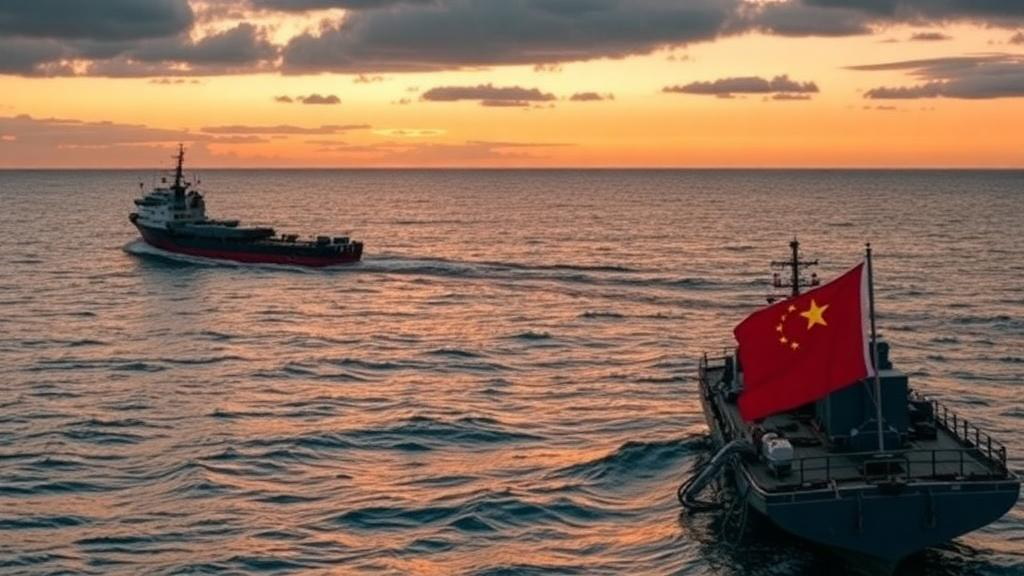
A legal analysis published in Frontiers in Marine Science argues that disputes over whether coercive encounters in the South China Sea amount to maritime police action or military force should be resolved by examining what each act actually does, rather than relying on the identity of the vessel or the weapons it carries. The article presents a four-part functionalist framework based on the target of an action, the legal basis invoked, the measures used and the systemic effect produced. Its author also proposes area-specific law-enforcement cooperation and a tiered response system designed to reduce miscalculation without requiring the parties to resolve their underlying sovereignty disputes first.
The distinction matters because two bodies of international law apply to coercive activity at sea. The United Nations Convention on the Law of the Sea provides the framework for law enforcement within maritime jurisdictions, including restrained measures that may become necessary for boarding, inspection, detention, hot pursuit and suppression of offenses such as illegal fishing. By contrast, Article 2(4) of the United Nations Charter prohibits the threat or use of force in international relations against the territorial integrity or political independence of a state or in other ways inconsistent with the purposes of the United Nations. The Convention concerns the exercise of regulatory jurisdiction, while the Charter regulates coercion between states. Both regimes contain their own tests, and the same encounter may trigger arguments under both.
Maritime law enforcement is not inherently bloodless. The International Tribunal for the Law of the Sea has described a sequence in which a pursuing vessel first signals an order to stop and may then take measures such as firing across a ship’s bow, with physical force reserved as a last resort. The governing principles of necessity and proportionality require the least harmful effective means, appropriate warnings, attention to human life and a response proportionate to the alleged violation. Domestic coast-guard laws can also authorize force. China’s Coast Guard Law permits necessary measures, including weapons, to stop unlawful infringements or imminent violations at sea, while legislation in the United States, Vietnam, the Philippines and Malaysia grants various powers involving boarding, inspection, detention, weapons or use of force.
The South China Sea makes this familiar legal structure unusually difficult to apply. Coast guards in the region combine civilian regulatory duties in peacetime with possible integration into military command during war or emergencies. Vietnam’s Coast Guard is a specialized component of the armed forces; the United States and Philippine coast guards can operate under defense command in declared war, while Malaysia’s maritime enforcement agency may come under armed-forces control in emergencies, crises or war. This dual institutional role weakens the old assumption that an enforcing agency’s legal character can be inferred from its organizational label. The article also uses the United States as a comparative case because its coast guard has rotated cutters through the region since 2019 alongside naval vessels and exercises with regional partners.
A second source of ambiguity is the convergence of equipment. Law-enforcement vessels may now carry medium- and large-caliber guns, reconnaissance systems, electronic-warfare capabilities and other technologies once associated mainly with warships. A weapon that was once treated as distinctly military may therefore be used by a coast guard during an enforcement operation, and some platforms can perform both roles. Nor can intensity alone provide a clean dividing line. The article notes that the International Court of Justice recognized a spectrum of force, distinguishing armed attacks from less grave forms without excluding lesser coercion from the UN Charter’s framework. Lawful enforcement in cases involving armed smuggling, piracy or resistance can overlap in severity with low-intensity military action, making a simple “light weapons versus heavy weapons” or “low intensity versus high intensity” test unreliable.
Adjudicatory practice adds further uncertainty. In the M/V Saiga (No. 2) case, Guinean customs craft fired solid shots and automatic guns into an unarmed tanker, seriously injuring crew members and damaging the vessel. The International Tribunal for the Law of the Sea treated the incident exclusively as a breach of the rules governing maritime law enforcement, analyzing necessity, reasonableness and the duty to preserve human life without addressing Article 2(4). In the Guyana–Suriname maritime boundary arbitration, by contrast, a naval order that specified unspecified consequences if a rig did not leave was treated as an explicit threat of force even though no force was used. The two outcomes demonstrate that courts have not formulated a unified, articulated threshold distinguishing excessive police coercion from a prohibited threat of military force.
The proposed alternative treats each coercive act as a function performed within a legal relationship. The first dimension is its target. Coercion directed at a private vessel accused of violating fisheries, customs or environmental rules presumptively serves a regulatory function. An official vessel is more complicated: if it is conducting activities subject to regulation, such as unauthorized marine research or suspected smuggling, enforcement may remain regulatory. If it is exercising sovereign rights or asserting jurisdiction, however, force used to compel its withdrawal or retreat is directed at a sovereign actor and has a military function. The second dimension asks whether the invoked legal basis is domestic regulatory authority, such as fisheries legislation, or a claim to sovereignty, national security or historical rights. The third examines whether the implementation is graduated, proportionate and directed toward compliance rather than punishment, deterrence or physical obstruction of sovereign activity.
The fourth dimension considers the systemic effect if the measure succeeds. If a private vessel complies and the regional balance of sovereignty and factual control remains unchanged, the effect is remedial and order-sustaining. If success means that another state abandons claims, withdraws from disputed waters or acquiesces in a new allocation of control, the effect is transformative and the act is military in substance. The four elements form an integrated lens rather than a mechanical checklist, and no single factor is conclusive. Audio-visual recordings of an operation are proposed as particularly important evidence because they can reconstruct vessel movements, warnings, procedural steps and the intensity of measures used. Such recordings may narrow factual disagreement, although failure to show due regard does not by itself prove that an encounter was military force.
To translate the framework into practice, the article proposes cooperation in fisheries enforcement and marine environmental protection, areas where shared interests do not require settlement of sovereignty claims. A notification system could allow parties to disclose the time, location and scope of fisheries operations before they begin, reducing the risk that routine patrols will be misread as military provocations. The article also suggests joint conservation arrangements, patrols and action against illegal fishing by third-state vessels. For environmental protection, it proposes a regional emergency-response network for oil spills and hazardous chemical leaks, followed by shared monitoring and joint protection of vulnerable ecosystems such as coral reefs. These measures are proposals rather than established regional programs, and their practical success would depend on participation and agreement among the states involved.
A second proposal is a four-tier incident-response mechanism intended to make each response commensurate with the incident. Ordinary enforcement against private vessels under domestic regulations, with boarding, inspection or fines and no change in regional control, would receive diplomatic attention but no coercive maritime countermeasure. A dispute involving a government vessel engaged in regulated activity, warnings or expulsion with limited systemic effect would lead to diplomatic protest and continued surveillance. A forced confrontation involving a government vessel, a sovereignty claim and forcible expulsion or armed interdiction would prompt strong protests, reciprocal maritime measures and crisis consultations. A military threat directed at military facilities, justified by self-defense and changing actual control would call for high-level negotiations, deterrence and dispute-resolution procedures. The article cautions that technical criteria may themselves be applied selectively, especially during political maneuvering, and that its framework would require further adjustment for extra-regional military activities such as freedom-of-navigation operations. It presents the framework as a possible shared analytical language for moving disputed encounters from competing assertions toward verifiable facts and graduated restraint, not as a demonstrated guarantee of reduced tensions.
Subject of Research: A functional framework for classifying coercive maritime conduct in disputed South China Sea waters
Article Title: “Police force” or “military force”? A functionalist framework for the South China Sea
Article References: Li, X. (2026). “Police force” or “military force”? A functionalist framework for the South China Sea. Frontiers in Marine Science, 13, Article 1967148. https://doi.org/10.3389/fmars.2026.1967148
Image Credits: AI Generated
DOI: 10.3389/fmars.2026.1967148
Keywords: South China Sea, international law, maritime enforcement, use of force, coast guards, UNCLOS, UN Charter, functionalism, regional governance, Police, force, military
Cite Scienmag News
Violet Maxwell. (October 21, 2026). Functional Test Offers New Lens on South China Sea Coercion. Scienmag. https://scienmag.com/functional-test-offers-new-lens-on-south-china-sea-coercion/
Violet Maxwell. "Functional Test Offers New Lens on South China Sea Coercion." Scienmag, 21 October 2026, https://scienmag.com/functional-test-offers-new-lens-on-south-china-sea-coercion/. Accessed 21 October 2026.
Violet Maxwell. "Functional Test Offers New Lens on South China Sea Coercion." Scienmag. October 21, 2026. https://scienmag.com/functional-test-offers-new-lens-on-south-china-sea-coercion/


