


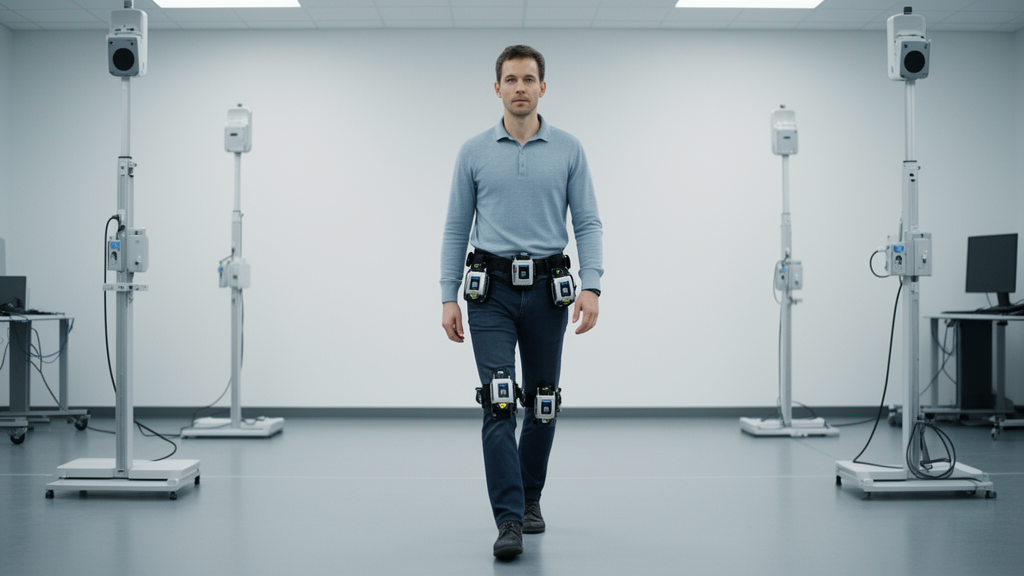
A compact artificial-intelligence system can estimate five lower-limb joint moments from just four wearable inertial measurement units, according to a study of 14 healthy adults walking on the ground and up and down stairs. The system combines shared temporal learning, task-specific attention and a calibration procedure that uses 10 seconds of unlabeled walking data from a new user. In nested leave-one-subject-out testing, the adapted model achieved an overall coefficient of determination, or R², of 0.759 ± 0.032 and an overall root mean square error of 0.136 ± 0.014 N·m/kg across the five targets. The experiment was conducted under controlled laboratory conditions, however, and the researchers said larger, more clinically diverse studies are needed before the approach can be considered for daily-life or clinical deployment.
The research focused on continuous estimation of mechanical outputs at the hip, knee and ankle rather than a single joint or movement plane. The five targets were sagittal-plane hip flexion/extension, coronal-plane hip adduction/abduction, sagittal-plane knee flexion/extension, coronal-plane knee adduction/abduction and sagittal-plane ankle dorsiflexion/plantarflexion. Reference values were generated in OpenSim 4.5 from synchronized optical motion capture and force-plate measurements collected at 100 Hz. The wearable system used customized nine-axis IMUs attached to the pelvis, right thigh, right shank and dorsum of the right foot. Only tri-axial acceleration and angular velocity entered the model, excluding magnetometer signals that could be disturbed by magnetic environments, and each participant’s joint moments were normalized to body mass and expressed in N·m/kg.
Participants, nine men and five women with an average age of 24.8 years, performed level walking, stair ascent and stair descent at self-selected speeds. The staircase had four 18-centimetre-high steps with 30-centimetre treads and no handrails. Mean speeds were 0.515 m/s during level walking, 0.459 m/s during stair ascent and 0.441 m/s during stair descent. Each stair task was repeated until six valid trials were retained, and four additional trials were excluded because of IMU data-integrity or synchronization problems. Continuous inertial data were divided into 1.05-second windows advancing five samples at a time, without gait-cycle segmentation, and overlapping predictions were averaged to reconstruct each moment sequence. The approach therefore targeted continuous temporal estimation rather than the prediction of isolated, time-normalized gait cycles.
At the center of the framework is a causal temporal convolutional network, or TCN. Its residual blocks use dilated one-dimensional convolutions to capture long temporal dependencies while preventing information from future time points entering an earlier prediction. The authors selected the architecture within each outer cross-validation fold, with three residual blocks, a kernel size of seven and 32 filters per layer most frequently selected. A hard parameter-sharing backbone processes all five targets through a common feature representation, followed by a separate point-wise channel-attention module and regression head for each moment. Attention changes the weighting of features at every time step, allowing each output to emphasize information relevant to its own joint and plane. The complete proposed model contained 53,400 trainable parameters, required 5.50 million multiply–accumulate operations per input window and recorded single-window inference latency of 1.672 ± 0.146 milliseconds on an Nvidia GeForce RTX 5080 graphics processor.
Cross-subject testing used nested 14-fold leave-one-subject-out validation. In each outer fold, one participant was held out completely and the other 13 formed the development set. Hyperparameters and training duration were selected through three subject-level inner folds, with normalization statistics estimated only from training data. The unadapted multi-task network, designated MTCN-Attn, produced an overall R² of 0.727 ± 0.049 and RMSE of 0.148 ± 0.025 N·m/kg. That was the highest numerical R² among the six external baselines tested, although the difference from Kinetics-FM-DLR-Net and Attention CNN-BiLSTM was not statistically significant after Holm correction. MTCN-Attn significantly outperformed the other four baselines, including LSTM, XCM, TCN-BiLSTM and TCN-xLSTM. The comparison should be interpreted with care because the proposed architecture underwent architecture-level hyperparameter optimization, whereas the external models largely retained their published configurations and received more limited tuning.
The model was then adapted to each unseen participant using 10 seconds of separate, unlabeled level-walking IMU data. Adaptive batch normalization, or AdaBN, reset and re-estimated the running statistics in the network’s normalization layers while leaving all trainable parameters fixed and performing no gradient-based updates. This procedure raises the overall R² to 0.759 ± 0.032 and reduces RMSE to 0.136 ± 0.014 N·m/kg. The paired increase in R² attributable to adaptation was 0.032, with a bias-corrected and accelerated bootstrap 95% confidence interval of 0.015 to 0.058 and a Holm-adjusted p value of 0.021. In practical terms, the calibration does not require the new user to provide laboratory-derived joint-moment labels; the tested protocol used only a short walking segment collected independently of the evaluation data.
Ablation experiments indicated that every major component improved prediction when added sequentially. Five independent single-task TCNs achieved an overall R² of 0.684 ± 0.050. Sharing a common backbone raised the score to 0.701 ± 0.041, a paired increase of 0.017 with a 95% confidence interval of 0.006 to 0.028. Adding point-wise channel attention produced a further increase of 0.026, with a confidence interval of 0.011 to 0.040, and raised overall R² to 0.727 ± 0.049. AdaBN supplied the final 0.032 improvement described above. All three sequential differences were significant after Holm correction. Sharing also reduced model size: the five independent networks contained 218,000 trainable parameters in total, compared with 48,000 for the shared multi-task backbone before the attention and output components were added.
Performance differed by joint, plane and locomotion mode, illustrating that the overall score does not imply uniform accuracy. The adapted framework achieved R² values above 0.60 for all 15 combinations of five targets and three activities. Ankle dorsiflexion/plantarflexion was generally easier to predict than hip flexion/extension, while hip adduction/abduction was more accurate than knee adduction/abduction. Knee flexion/extension R² exceeded 0.80 during both stair ascent and stair descent but was lower during level walking. Hip adduction/abduction was predicted better during level walking and stair descent than during stair ascent. A separate error assessment for the second knee adduction/abduction moment peak during level walking yielded an RMSE of 0.079 N·m/kg, which the authors noted is substantial relative to a previously reported 0.121 N·m/kg difference between groups with mild and severe knee osteoarthritis.
Supplementary testing on an independent public dataset containing 22 participants and the same three locomotion modes produced R² values of 0.794 ± 0.056 for hip flexion/extension, 0.704 ± 0.136 for hip adduction/abduction, 0.824 ± 0.049 for knee flexion/extension and 0.840 ± 0.062 for ankle dorsiflexion/plantarflexion. Sensor ablations also showed that all four locations contributed information: removing the shank sensor reduced knee adduction/abduction R² from 0.697 to 0.542, while removing the thigh sensor reduced knee flexion/extension R² from 0.779 to 0.638. Yet the findings remain a proof-of-concept measurement study. Reference moments were model-based inverse-dynamics estimates rather than direct measurements of internal joint loading; the sample was small, healthy and young; and all primary data came from one laboratory and one fixed staircase. Repeated sensor donning, placement errors, clinical gait patterns, other environments and real-world daily activity were not evaluated.
Subject of Research: Wearable deep-learning estimation of multi-joint, multi-planar lower-limb moments from four inertial sensors
Article Title: Multi-joint and multi-planar lower-limb moment prediction from four inertial measurement units with target-subject adaptation
Article References: Fan, X., Ma, T., Yu, N., Han, J., Guan, J., Ni, M., & Sun, T. (2026). Multi-joint and multi-planar lower-limb moment prediction from four inertial measurement units with target-subject adaptation. Frontiers in Bioengineering and Biotechnology, 14, Article 1938657. https://doi.org/10.3389/fbioe.2026.1938657
Image Credits: AI Generated
DOI: 10.3389/fbioe.2026.1938657
Keywords: wearable sensors, inertial measurement units, joint moments, deep learning, temporal convolutional network, target-subject adaptation, gait biomechanics, stair locomotion, domain adaptation, Multi-joint, multi-planar, lower-limb
Cite Scienmag News
Blake Davidson. (October 21, 2026). Four sensors predict lower-limb joint moments with subject-specific calibration. Scienmag. https://scienmag.com/four-sensors-predict-lower-limb-joint-moments-with-subject-specific-calibration/
Blake Davidson. "Four sensors predict lower-limb joint moments with subject-specific calibration." Scienmag, 21 October 2026, https://scienmag.com/four-sensors-predict-lower-limb-joint-moments-with-subject-specific-calibration/. Accessed 21 October 2026.
Blake Davidson. "Four sensors predict lower-limb joint moments with subject-specific calibration." Scienmag. October 21, 2026. https://scienmag.com/four-sensors-predict-lower-limb-joint-moments-with-subject-specific-calibration/


