


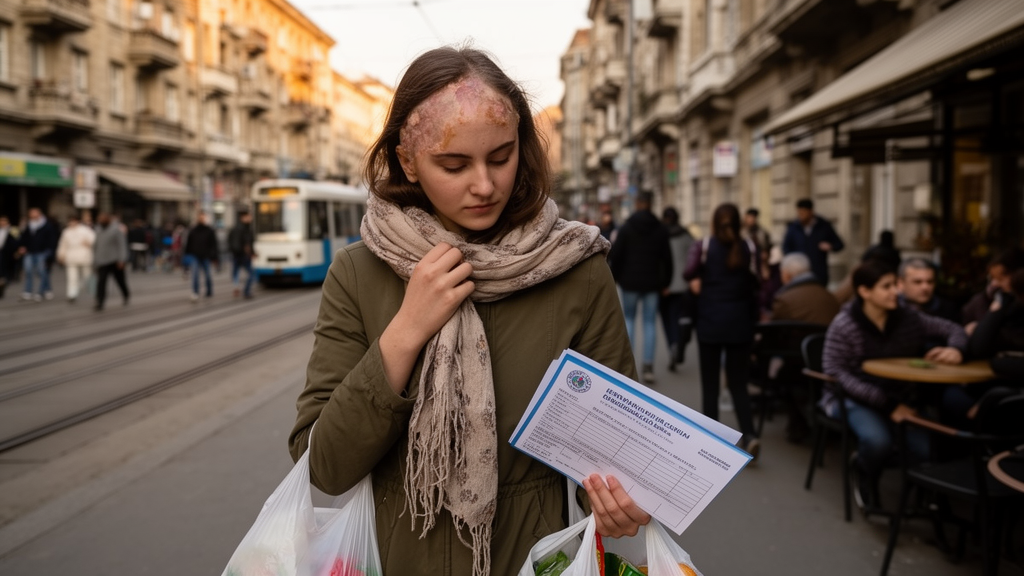
A societal-perspective cost-of-illness study estimates that alopecia areata cost Romania EUR 101.3 million to EUR 176.9 million in 2022, with the lower and upper totals derived from prevalence- and incidence-based approaches, respectively. The analysis found that the economic burden was driven less by hospitalization than by productivity losses, out-of-pocket expenses and treatment. It also found that 77.8% of adult respondents who completed a health-related quality-of-life assessment reported problems with anxiety or depression, making that the most frequently affected dimension. Researchers describe the analysis as the first national estimate of the disorder’s economic burden in Romania, but caution that its projections depend on a small, self-selected survey combined with national epidemiological, market, hospital and labor data.
The study used a 2022 reference year and a societal perspective, meaning that it included direct medical costs, direct non-medical costs and indirect productivity losses rather than focusing only on charges paid by the health system. Primary information came from a cross-sectional online survey conducted between April and October 2023. After one response was excluded because disease severity could not be established, the analytic sample contained 48 responses: 41 adults reporting for themselves and seven caregivers acting as proxies, four for pediatric patients and three for adults. Adults also completed the five-level EQ-5D-5L instrument assessing mobility, self-care, usual activities, pain or discomfort, and anxiety or depression.
National case counts were obtained from the Global Burden of Disease 2021 estimates for alopecia areata. These were combined with survey-derived proportions of mild and severe disease to estimate costs for two epidemiological scenarios. The prevalence-based scenario used 37,548.63 adult and 3,792.18 pediatric cases, while the incidence-based scenario used 65,413.8 adult and 6,964.62 pediatric cases. Survey-based unit costs were then extrapolated nationally. Treatment, medical services and associated expenses were costed from the bottom up; hospital costs were estimated from 72 discharges recorded nationally in 2022; and productivity losses were calculated with a hybrid approach that combined reported absence from work with national wage data.
Under the prevalence approach, the estimated annual cost for adults aged 20 or older was EUR 97.95 million, consisting of EUR 59.50 million for mild disease and EUR 38.45 million for severe disease. The incidence-based estimate was EUR 170.56 million, including EUR 103.61 million for mild cases and EUR 66.95 million for severe cases. Productivity losses were the largest adult cost component under both approaches, accounting for approximately 45.2% of the total. Associated expenses contributed 28.5%, medical services 14.2%, treatment 12.0% and hospitalizations 0.1%. When treatment spending was replaced with a lower-cost pharmaceutical-market scenario, estimated adult treatment expenditure fell to about 0.5% of the total and productivity losses rose to 51.2%.
For patients under 20, the prevalence-based annual estimate was EUR 3.35 million and the incidence-based estimate was EUR 6.37 million. Associated expenses were the largest pediatric component, contributing 41.8% and 40.4% of the two totals, while caregiver productivity losses accounted for 38.5% and 40.7%. Treatment represented 19.5% and 18.8%, respectively, and hospitalizations remained below 0.3%. Pediatric medical-service spending was not collected, so it was absent from these estimates. Overall, the findings indicate that the measurable burden fell mainly on patients, families and employers through non-medical spending and lost work rather than on hospitals through reimbursed inpatient care.
Average annual cost per adult patient was EUR 2,608.6 in the prevalence-based analysis and EUR 2,607.4 in the incidence-based analysis. The estimated cost was higher for mild adult disease, at EUR 3,248.3, than for severe disease, at EUR 1,999.4. The researchers said this should not be interpreted as evidence that severe alopecia areata is inexpensive. Mild patients were more likely to remain in full-time employment, making them eligible for measured absenteeism costs, whereas severe patients were more likely to be retired. The survey also found slightly higher treatment and medical-service spending among mild patients. Pediatric estimates showed the opposite pattern: the average was EUR 882.9 under the prevalence approach and EUR 915.1 under the incidence approach, with severe cases averaging EUR 1,991.3 compared with EUR 513.5 for mild cases.
Healthcare use in the survey was concentrated in outpatient care. Fifteen of the 41 adult patients reported general-practitioner visits for alopecia areata during the preceding year, while 23 reported specialist visits. Seven adults reported day admissions and six reported inpatient admissions. At the national level, only 72 hospitalizations carried a main diagnosis of alopecia areata in 2022, corresponding to an average inpatient cost of EUR 1,583.5 per adult episode and EUR 1,031.3 per child episode. The researchers interpreted the pattern as one consistent with management largely in ambulatory care, although they noted that uneven access to dermatology services, including in rural areas, may be an important constraint.
Quality-of-life results highlighted the psychological component of the disease. Among 27 adults who completed the EQ-5D-5L, 21 reported problems with anxiety or depression and 19 reported pain or discomfort. Nine reported problems with usual activities, four with self-care and none with mobility. Problems with anxiety or depression were also reported by six of the seven caregiver proxies. The mean adult EQ-VAS self-assessment of overall health was 51.0 on a scale from 0, representing the worst imaginable health, to 100, the best imaginable. Because the survey used a generic measure rather than a dermatology- or alopecia-specific instrument, the authors said that disease-specific and clinically validated mental-health measures may provide more sensitive estimates in future studies.
Several limitations constrain interpretation. Recruitment through Facebook and a patient association used convenience sampling, so respondents may have been more digitally connected, engaged in care or severely affected than the wider Romanian population; no response rate could be calculated. The adult sample was also predominantly female, urban and highly educated. Only four caregiver-reported pediatric patients supported the pediatric cost model, making those projections exploratory. The study performed no inferential statistics, relied on retrospective 12-month recall, and imputed missing cost data. Its national estimates also depended on modeled GBD 2021 case counts, an expert mapping between self-reported hair loss and GBD severity states, and hospital unit costs supplied by a private financial-controlling firm. Presenteeism, pediatric medical-service costs, specific expenses such as wigs and psychological counseling costs were not captured.
Despite those uncertainties, the analysis presents a first national accounting framework for alopecia areata in Romania and identifies where costs were estimated to arise. The authors call for larger, representative studies using validated productivity and disease-specific quality-of-life instruments. Their results suggest that planning for alopecia areata should extend beyond hospital expenditure to encompass ambulatory dermatology capacity, access across regions, out-of-pocket support and the effects of anxiety, depression and work disruption on patients and caregivers.
Subject of Research: Estimated societal costs, healthcare use and quality of life associated with alopecia areata in Romania
Article Title: On the economic burden of alopecia areata in Romania
Article References: Olaru, M., Tatu, A. L., Olteanu, R., Lapadatu, R., Vladescu, C., Strilciuc, S., & Nicolescu, A. C. (2026). On the economic burden of alopecia areata in Romania. Frontiers in Health Services, 6, Article 1943557. https://doi.org/10.3389/frhs.2026.1943557
Image Credits: AI Generated
DOI: 10.3389/frhs.2026.1943557
Keywords: alopecia areata, economic burden, cost of illness, Romania, productivity losses, out-of-pocket costs, healthcare utilization, quality of life, EQ-5D-5L, mental health, economic, burden
Cite Scienmag News
Ophelia Keating. (October 21, 2026). Alopecia areata’s Romanian burden extends far beyond hospital care. Scienmag. https://scienmag.com/alopecia-areatas-romanian-burden-extends-far-beyond-hospital-care/
Ophelia Keating. "Alopecia areata’s Romanian burden extends far beyond hospital care." Scienmag, 21 October 2026, https://scienmag.com/alopecia-areatas-romanian-burden-extends-far-beyond-hospital-care/. Accessed 21 October 2026.
Ophelia Keating. "Alopecia areata’s Romanian burden extends far beyond hospital care." Scienmag. October 21, 2026. https://scienmag.com/alopecia-areatas-romanian-burden-extends-far-beyond-hospital-care/


