


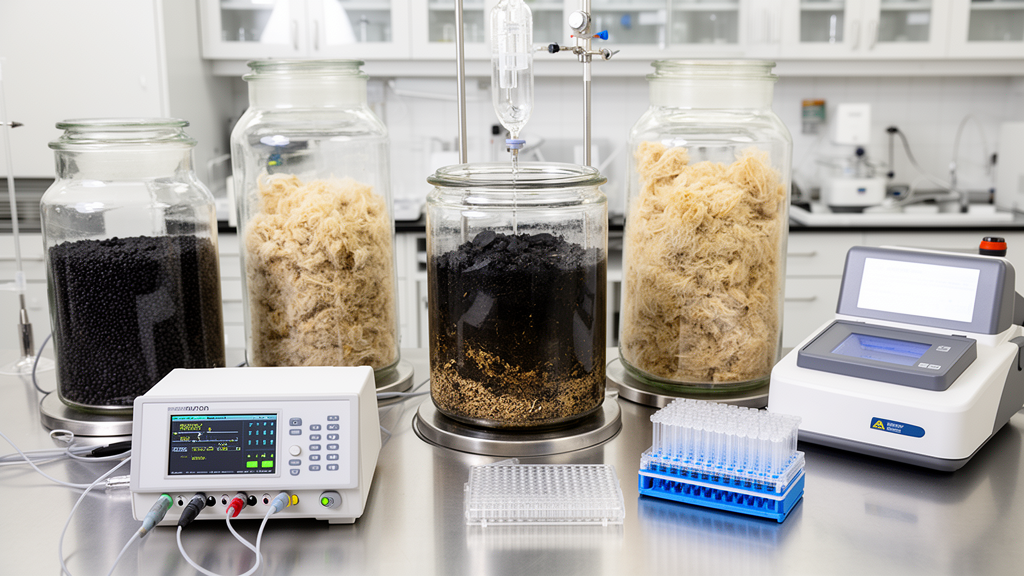
Adding sawdust biochar to laboratory reactors treating chicken manure increased cumulative biogas production by 19.65% while reducing the absolute abundance of several antibiotic resistance gene classes more effectively than corn-stover biochar, according to a controlled study published in Frontiers in Bioengineering and Biotechnology. Corn-stover biochar produced the larger energy gain, raising cumulative gas output by 27.69%, but it also favored the accumulation of particular resistance genes. The bench-scale comparison therefore indicates that choosing biochar for more than surface area or gas yield may affect both energy recovery and antibiotic resistance markers in manure digestion.
Researchers at the Biogas Institute of the Ministry of Agriculture and Rural Affairs in Chengdu, China, operated nine 1-liter glass digesters for 45 days. Each reactor received 130 grams of chicken manure, 20 grams of wheat straw, anaerobic-sludge inoculum and water adjusted to 6% total solids. The experiment compared three conditions in triplicate: a control without biochar, a corn-stover biochar treatment and a sawdust biochar treatment. Preliminary trials at 1%, 5% and 10% selected a 5% dosage because it produced the best overall combination of methane yield, pH stability and volatile fatty acid degradation. The same dosage was then used for both biochars so that material type, rather than dosage, would distinguish the treatments.
The agricultural-residue biochars had been produced by pyrolysis at 550 degrees Celsius but had sharply contrasting physical structures. Their measured Brunauer-Emmett-Teller specific surface areas were 44.85 and 2.46 square meters per gram for corn-stover and sawdust biochar, respectively, an approximately 18-fold difference. Sawdust biochar also had a smaller micropore volume, measuring 0.0020 cubic centimeters per gram, compared with 0.015 for corn-stover biochar, and a larger average pore size of 2.95 nanometers rather than 1.85 nanometers. Corn-stover biochar contained higher concentrations of several elements associated with microbial metabolism, including manganese, phosphorus, potassium, magnesium, calcium, iron and aluminum. The researchers therefore regarded surface structure and elemental composition as important properties that could contribute to the differing outcomes.
Both biochars improved the stability and pace of digestion. During the first nine days, daily gas production in the amended reactors rose more rapidly, and from days 7 through 9 it was more than twice the level in the control. The biochar treatments held a pH of about 7.5, while the control declined to 6.7. Peak volatile fatty acid concentrations reached 19,919.1 milligrams per liter with corn-stover biochar, 17,900.0 milligrams per liter with sawdust biochar and 14,162.3 milligrams per liter in the control. After day 8, however, the amended reactors showed faster declines in volatile fatty acids and persistently lower soluble chemical oxygen demand than the control. The authors interpreted these combined patterns as evidence that the biochar treatments accelerated progression through hydrolysis, acidification, acetogenesis and methanogenesis.
Free ammonia created a pronounced difference among the reactors. Its concentration exceeded 385.7 milligrams per liter in the control and reached 1,432.78 milligrams per liter at the end of digestion, whereas free ammonia remained below 100.0 milligrams per liter in both biochar treatments. The researchers characterized the control as an “inhibited steady state”: pH remained within a range that prevented abrupt acidification, but substantial volatile fatty acid accumulation and ammonia toxicity suppressed microbial activity and gas production. In the biochar reactors, the alkaline and alkaline-earth metals retained in the materials contributed buffering capacity, while more vigorous biogas formation also supported alkalinity. As volatile fatty acids declined and total ammonia nitrogen changed after day 17, the amended reactors remained between pH 7.0 and 7.5; the control pH rose to 8.9.
Cumulative gas yields reached 477.16 milliliters per gram of volatile solids in the corn-stover treatment and 447.11 milliliters per gram in the sawdust treatment. The researchers proposed that corn-stover biochar’s much larger specific surface area provided more attachment sites for microorganisms, adsorbed organic substrates and shortened mass-transfer distances. Its porous structure could also support electron transfer associated with methanogenesis. Sawdust biochar’s lower surface area provided fewer colonization niches, but the material still improved gas production and pH stability under the experimental conditions. The results do not isolate surface area as the sole cause of the production difference because the two biochars also differed in elemental composition and chemical properties.
Resistance-gene outcomes depended on both the material and the gene subtype. Total macrolide resistance-gene abundance fell by 50.4% with sawdust biochar and by 44.6% in the control, but increased by 8.9% with corn-stover biochar. In the latter treatment, the final abundances of ermA, ermF and ermT were respectively 1.4, 1.1 and 1.3 times their initial values. Sulfonamide genes showed the clearest sawdust advantage: total abundance decreased by 61.2%, compared with reductions of 38.9% for corn-stover biochar and 36.5% for the control. Sawdust biochar also produced a 50.8% reduction in total tetracycline resistance genes, compared with a 13.9% reduction in the corn-stover treatment. The genes were not all affected uniformly: tetG and tetM declined in all three groups, whereas tetQ and tetX showed varying accumulation.
Microbial sequencing linked the community shifts to the improvement in gas production. Methanosarcina rose to relative abundances of 96.09% in the corn-stover treatment and 96.16% in the sawdust treatment, compared with 72.33% in the control. Biochar also favored bacteria associated with hydrolysis and methanogenesis, including Sphaerochaeta and Fastidiosipila, while Caldicoprobacter, which the study links to complex-cellulose degradation, became more abundant after treatment. Sphaerochaeta reached 21.19% relative abundance with corn-stover biochar, whereas Fastidiosipila reached 20.77% with sawdust biochar. These community changes accompanied greater gas production, but microbial succession alone did not directly explain the contrasting absolute resistance-gene abundances.
Sawdust biochar instead limited overall microbial colonization, reflected in lower absolute abundance of 16S rRNA genes and the class 1 integron integrase gene intI1 by the end of digestion. The two measurements were positively correlated, with a Pearson correlation coefficient of 0.8, and both were positively associated with several resistance genes. Statistical modeling identified total ammonia nitrogen, pH and free ammonia as environmental factors acting indirectly through potential microbial hosts and intI1. Because those chemical conditions were similar in the two biochar treatments, the authors concluded that they were unlikely to explain the superior resistance-gene attenuation with sawdust biochar. Reduced total microbial abundance, possible inhibition of horizontal gene transfer and biochar antioxidant effects were proposed as possible contributors, but the experiment did not directly establish which mechanism was decisive.
The findings reveal a practical trade-off within biochar-assisted manure digestion. Sawdust biochar combined a 19.65% increase in cumulative gas with reductions of 50.4% in total macrolide genes, 61.2% in total sulfonamide genes and 50.8% in total tetracycline genes. Corn-stover biochar achieved a larger 27.69% gas increase, yet it increased total macrolide abundance and achieved only a 13.9% reduction in total tetracycline genes. The evidence comes from nine bench-scale reactors using manure from one poultry farm, one selected biochar dose and a 45-day operating period. It does not demonstrate performance in full-scale facilities or establish that sawdust biochar would prevent environmental antibiotic resistance. Within the tested system, however, the controlled comparison shows that biochar selection can influence the balance between improved biogas recovery and attenuation of specific resistance-gene groups.
Subject of Research: Bench-scale anaerobic digestion of chicken manure with agricultural biochars to improve biogas production and attenuate antibiotic resistance genes
Article Title: Simultaneous enhancement of biogas production and antibiotic resistance gene removal by sawdust biochar in anaerobic digestion of chicken manure
Article References: Jiang, X., Shen, T., Lei, Y., & Guo, X. (2026). Simultaneous enhancement of biogas production and antibiotic resistance gene removal by sawdust biochar in anaerobic digestion of chicken manure. Frontiers in Bioengineering and Biotechnology, 14, Article 1897972. https://doi.org/10.3389/fbioe.2026.1897972
Image Credits: AI Generated
DOI: 10.3389/fbioe.2026.1897972
Keywords: sawdust biochar, corn-stover biochar, chicken manure, anaerobic digestion, biogas production, antibiotic resistance genes, ammonia inhibition, microbial communities, biochar surface area, wastewater treatment, Simultaneous, enhancement
Cite Scienmag News
Juliet Wilcox. (October 21, 2026). Lab study: Sawdust biochar raises chicken-manure biogas while reducing resistance genes. Scienmag. https://scienmag.com/lab-study-sawdust-biochar-raises-chicken-manure-biogas-while-reducing-resistance-genes/
Juliet Wilcox. "Lab study: Sawdust biochar raises chicken-manure biogas while reducing resistance genes." Scienmag, 21 October 2026, https://scienmag.com/lab-study-sawdust-biochar-raises-chicken-manure-biogas-while-reducing-resistance-genes/. Accessed 21 October 2026.
Juliet Wilcox. "Lab study: Sawdust biochar raises chicken-manure biogas while reducing resistance genes." Scienmag. October 21, 2026. https://scienmag.com/lab-study-sawdust-biochar-raises-chicken-manure-biogas-while-reducing-resistance-genes/


