


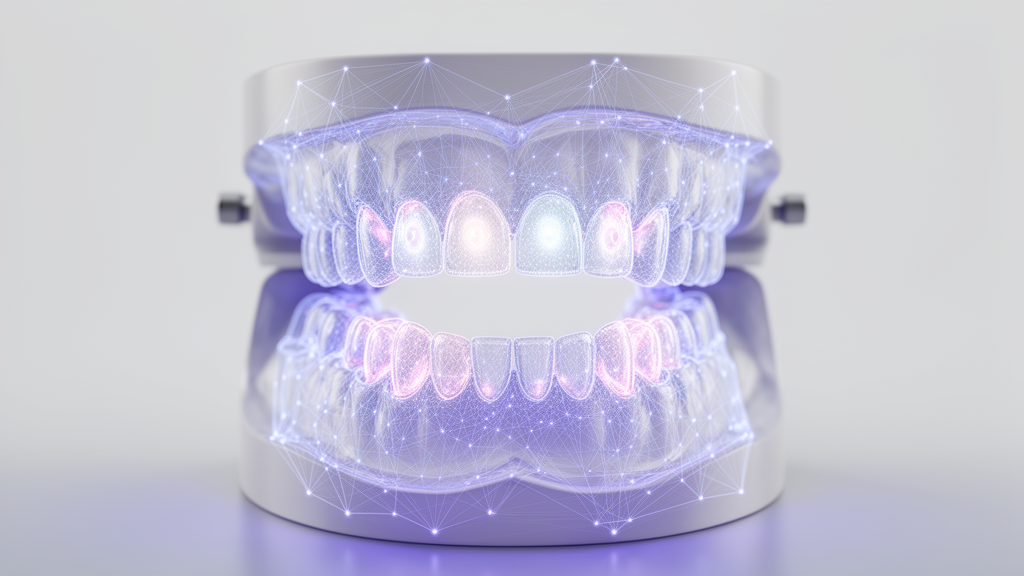
A geometry-aware neural network that analyzed paired upper- and lower-jaw 3D scans achieved 80.46% accuracy across five dental occlusion classifications in a proof-of-concept study. The system, called QDentalNet, reached its result on a held-out test cohort drawn from 200 registered intraoral-scan pairs annotated by an experienced orthodontic specialist. Its architecture combines hierarchical mesh learning with simulated quantum classification heads, but the authors stress that their experiment does not demonstrate quantum advantage: the quantum circuits ran on a classical simulator, and the classical-head comparison was not capacity-matched. The reported findings offer a technical route toward automating analysis of three-dimensional occlusal relationships, while the small dataset, class imbalance and absence of physical quantum-hardware testing constrain how broadly the results can be applied.
Occlusion describes how opposing teeth meet during jaw closure and movement, and malocclusion can involve sagittal, vertical and transverse relationships between the upper and lower arches. The study investigated five independently annotated outputs: right sagittal relationship, left sagittal relationship, anterior bite condition, transverse bite condition and dental midline alignment. These are multi-label characteristics rather than mutually exclusive categories, so one scan pair could contribute to several task distributions. Conventional orthodontic assessment relies heavily on clinician interpretation of intraoral scans, photographs, study casts and cephalometric radiographs. Three-dimensional records can reveal spatial discrepancies that are difficult to represent fully in two dimensions, but automated systems have often analyzed each jaw separately or compressed the arches into broad global descriptors, leaving the fine-grained relationships between opposing surfaces underrepresented.
QDentalNet was designed to address that paired-arch problem directly. Upper and lower STL meshes were first placed in a common coordinate system so that their occlusal alignment was preserved. To limit computational demands, each arch, which averaged 182,444 triangular faces in the source data, was uniformly downsampled to 8,192 faces. Nearest-neighbor matching between face centers then linked spatially corresponding regions of the two arches. The displacement between matched centers became an interaction vector whose direction and magnitude encoded information about vertical separation, anteroposterior displacement and transverse asymmetry. These vectors gave the network an explicit representation of the relationship between opposing surfaces rather than leaving the model to infer contact only from separately processed arch shapes.
Two specialized modules refined the geometric representation. Face Rotation Convolution, or FRC, addressed the arbitrary starting vertex assigned to a triangulated face by processing three cyclic orderings of its corner coordinates with a shared multilayer perceptron and averaging the results. The operation makes the representation invariant to cyclic changes in vertex ordering, but the authors explicitly distinguish this from invariance to arbitrary rigid-body rotation of an entire mesh. Because the model uses coordinate-based features, a global rotation can still change those values. The second module, Face Kernel Correlation, compared face-normal orientations with 48 channels of learnable directional kernels. Each face had a spatial neighborhood of 10 nearest faces from the same arch and two nearest faces from the opposing arch, allowing the system to describe local variations in surface orientation without claiming to calculate differential curvature directly.
The shared mesh representation then entered five parallel task towers, each using a lightweight multilayer perceptron to adapt the common embedding for one clinical output. Before global pooling, a separate attention map was learned for every task so that, for example, midline alignment and transverse bite could focus on different anatomical evidence. The network also used auxiliary heads to estimate contact points on each arch. These point estimates contributed a geometric regularization signal to the main classification objective. Together with weighted cross-entropy, the study added a symmetric contact loss and an attention-sparsity term. The contact term encouraged corresponding upper- and lower contact predictions to lie close together, while the symmetry component softly encouraged correspondence between left and right contact descriptors. It was a soft prior rather than a requirement for perfect symmetry, an important distinction because midline deviations and unilateral crossbites can themselves be clinically meaningful.
At the output stage, each task embedding was projected into six values and encoded as rotation angles for a six-qubit variational quantum circuit. Three trainable variational layers with strongly entangling connections processed the encoded state, and measurements of the Pauli-Z operator were passed to a classical layer to produce task logits. The circuits were implemented in PennyLane with a PyTorch interface and evaluated with the same simulator configuration throughout the experiments. The model was trained for 250 epochs on two Nvidia Tesla T4 GPUs, using AdamW and separate learning rates for the classical and quantum parameters. The test data were kept isolated during architecture development, hyperparameter tuning and checkpoint selection, and a later five-fold cross-validation analysis used the finalized configuration without further tuning.
Performance varied markedly across the five tasks in the held-out evaluation. QDentalNet achieved 92.31% accuracy for the left sagittal relationship and 87.50% for the right sagittal relationship, but only 75.00% for anterior bite and 65.00% for midline alignment; its transverse-bite accuracy was 82.50%. Across five random seeds, it recorded mean accuracy of 78.22% with a standard deviation of 4.3, mean precision of 78.59% with a standard deviation of 5.31, mean recall of 76.67% with a standard deviation of 3.91, and mean F1 score of 77.12% with a standard deviation of 2.35. The five-fold analysis likewise showed substantial task-level variability. Mean accuracy ranged from 88.60% for the left sagittal relationship to 61.79% for midline alignment, with the latter’s 95% confidence interval extending from 55.32% to 68.26%.
Ablation experiments indicated that several parts of the geometry-aware design contributed to the reported result. Removing cross-jaw interaction vectors lowered overall accuracy to 59.25%, compared with 80.46% for the complete network. Removing the FKC module produced 70.44% overall accuracy, while replacing task-specific attention with uniform global max-pooling yielded 65.28%. A configuration without the FRC module achieved 59.99% overall accuracy, although the paper’s detailed interpretation focuses on differences in individual task results. Loss ablations showed a progression from 73.10% accuracy with weighted cross-entropy alone to 74.11% after adding bilateral symmetry, 78.50% after adding symmetric contact loss, and 80.46% when the complete objective also included attention sparsity. These are component-removal results within the developed system, not evidence that every component would have the same effect in a different dataset or implementation.
The clearest uncertainty concerns the quantum component. Replacing the variational quantum heads with fully connected classical layers produced 75.00% average accuracy rather than 80.46% for the proposed network. However, the study describes this as an architectural ablation: the two classifier designs differed in formulation and optimization, and the researchers did not include a systematically capacity-matched set of classical alternatives. Consequently, the five-percentage-point difference cannot be attributed specifically to quantum processing. The complete system also required 155.74 milliseconds per inference in the reported table, compared with 75.51 milliseconds for the classical-head version. Its 80.46% held-out accuracy was higher than descriptive reference results for other 3D dental models—including 71.00% for Point Transformer V3, 66.25% for MeshCNN and 65.19% for MeshNet—but those studies did not use an identical experimental protocol and should not be treated as controlled head-to-head results.
Several further limitations constrain the practical interpretation of the study. The publicly available Bits2Bites dataset contains only 200 scan pairs, and rare categories such as reverse bite and scissor bite have very few cases, leading the researchers to use inverse-frequency weights and label smoothing. A limited number of augmented training-derived examples were added to the validation set for extremely underrepresented classes, potentially creating sample-level dependence and affecting model-selection estimates. The held-out test set contained only original scans, and patient-independent partitioning before augmentation would be needed in a larger study. The public data may also inadequately represent anatomy, demographics and scanner conditions across broader clinical populations. In addition, the symmetry term reflected points across the normalized mesh’s x=0 plane rather than a separately estimated patient-specific midsagittal plane, while the fixed 8,192-face sampling resolution was not tested across alternative resolutions. QDentalNet therefore demonstrates a promising proof of concept for multi-attribute analysis of paired dental meshes, but its quantum claims remain exploratory and its clinical generalizability requires larger, independently partitioned and more diverse datasets.
Subject of Research: Automated classification of five dental occlusion attributes from paired 3D intraoral-scan meshes
Article Title: QDentalNet: a geometry-aware hierarchical mesh learning and quantum-enhanced network for automated dental occlusion classification
Article References: Ilanghovan, R., Alden Jenish, S., Karthik, R., Suganthi, K., & Praveen, R. (2026). QDentalNet: a geometry-aware hierarchical mesh learning and quantum-enhanced network for automated dental occlusion classification. Frontiers in Artificial Intelligence, 9, Article 1931803. https://doi.org/10.3389/frai.2026.1931803
Image Credits: AI Generated
DOI: 10.3389/frai.2026.1931803
Keywords: dental occlusion, 3D intraoral scans, mesh learning, deep learning, quantum circuits, orthodontics, computer vision, multi-task classification, geometric features, QDentalNet, geometry-aware, hierarchical
Cite Scienmag News
Blake Davidson. (October 21, 2026). Quantum-simulated mesh network classifies five dental occlusion attributes. Scienmag. https://scienmag.com/quantum-simulated-mesh-network-classifies-five-dental-occlusion-attributes/
Blake Davidson. "Quantum-simulated mesh network classifies five dental occlusion attributes." Scienmag, 21 October 2026, https://scienmag.com/quantum-simulated-mesh-network-classifies-five-dental-occlusion-attributes/. Accessed 21 October 2026.
Blake Davidson. "Quantum-simulated mesh network classifies five dental occlusion attributes." Scienmag. October 21, 2026. https://scienmag.com/quantum-simulated-mesh-network-classifies-five-dental-occlusion-attributes/


