

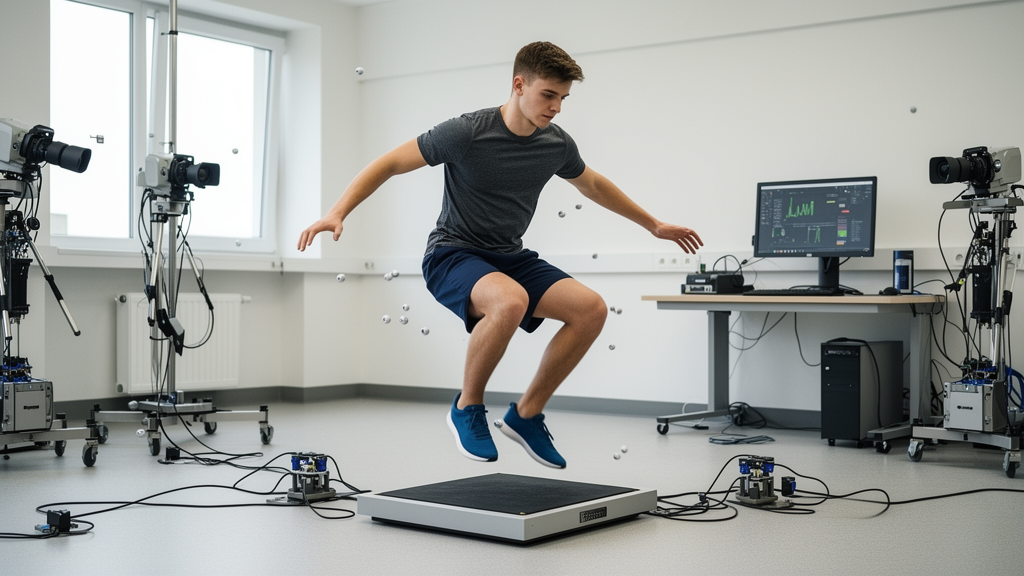
In a controlled experiment involving 23 healthy young men, changing how a single-leg landing began altered two force-based measures of postural stability at both individualized drop heights tested. A step-off landing was associated with shorter vertical time to stabilization, or V-TTS, and a lower Dynamic Postural Stability Index, or DPSI, than either an actively propelled single-leg jump or single-leg hop. Some differences between initiation patterns were larger from the lower platform, showing that drop height and movement initiation cannot be treated as interchangeable features of a landing protocol.
The study used a single-sex convenience sample of strength and conditioning students, and it did not measure injury risk or clinical benefit. Researchers implemented a within-participant 3 × 2 factorial experiment in which every participant completed three movement initiation patterns at two heights. The Low height was set from the mean of each participant’s left- and right-leg countermovement jump heights, while the High height was derived from the bilateral countermovement jump.
The realized platform heights averaged 21.5 ± 3.7 cm in the Low condition and 46.3 ± 7.4 cm in the High condition. Because the box could be adjusted only in fixed increments, its mean absolute deviation from the individual target was 1.3 ± 0.9 cm at Low and 1.4 ± 1.1 cm at High. The two realized ranges did not overlap, and the average separation within each participant was 24.8 ± 4.9 cm.
Participants landed on their dominant leg, defined as the limb they preferred for kicking a soccer ball, and were instructed to stabilize into a quiet single-leg stance held for 20 seconds. In the step-off condition, the dominant leg moved forward from the platform without active vertical propulsion. In the single-leg jump condition, the dominant leg stepped forward onto the lower force plate while the non-dominant leg remained on the platform and supplied submaximal forward propulsion.
In the single-leg hop condition, the dominant leg itself performed a submaximal vertical hop and landed on the same limb. The jump and hop therefore differed in propulsion direction and in the limb generating propulsion. Participants were told to use submaximal effort, but propulsive impulse, take-off velocity and jump height were not quantitatively matched.
Three-dimensional ground-reaction forces were recorded at 1,000 Hz with two synchronized force plates. The principal outcomes were calculated from the post-contact force signal. V-TTS estimated the time required for the filtered vertical force to remain within a defined stability band, using a sequential-averaging method over a five-second post-contact window.
DPSI summarized root-mean-square deviations in vertical, anteroposterior and mediolateral force during the first three seconds after touchdown and was treated as a dimensionless index. Anteroposterior and mediolateral TTS were designated as exploratory outcomes. Linear mixed-effects models tested movement pattern, height and their interaction, with participant included as a random effect to account for repeated observations.
The statistical analysis found significant Pattern × Height interactions for both primary outcomes: the effect of initiation pattern depended on the prescribed height. At Low, all three pairwise comparisons were significant after adjustment for multiple testing. The single-leg hop required 0.154 seconds more to stabilize vertically than the step-off landing, with a 95% confidence interval of 0.112 to 0.196 seconds, and its DPSI was 0.079 higher, with a 95% confidence interval of 0.066 to 0.092.
The single-leg jump also had a V-TTS 0.081 seconds longer than the step-off, with a 95% confidence interval of 0.038 to 0.123 seconds, while its DPSI was 0.059 higher, with a 95% confidence interval of 0.047 to 0.072. The hop’s V-TTS was also 0.074 seconds longer than the jump’s, with a 95% confidence interval of 0.032 to 0.116 seconds. At High, both actively initiated landings still differed from the step-off, but the difference between the jump and hop was no longer statistically clear.
Relative to the step-off, the jump had a V-TTS 0.069 seconds longer, with a 95% confidence interval of 0.027 to 0.111 seconds, and a DPSI 0.041 higher, with a 95% confidence interval of 0.028 to 0.054. The hop had a V-TTS 0.061 seconds longer, with a 95% confidence interval of 0.019 to 0.104 seconds, and a DPSI 0.054 higher, with a 95% confidence interval of 0.041 to 0.067. The adjusted hop-versus-jump contrasts were −0.008 seconds for V-TTS and 0.013 for DPSI; neither was significant after adjustment.
Collapsed across initiation patterns, High was associated with a V-TTS 0.047 seconds longer and a DPSI 0.087 higher than Low. The interaction was not uniform across every pairwise comparison. The hop-versus-step-off and hop-versus-jump differences in V-TTS were larger at Low, as were the jump-versus-step-off and hop-versus-step-off differences in DPSI.
However, the jump-versus-step-off V-TTS difference and the hop-versus-jump DPSI difference showed no clear evidence of changing between the two heights. The exploratory horizontal TTS results did not reveal adjusted pairwise differences among initiation patterns at either height. The vertical component was larger than the horizontal components and followed the condition pattern of the composite DPSI, although that relationship does not establish the mechanism responsible for the differences.
Statistical parametric mapping supplied a time-resolved description of the force waveforms. During take-off, movement pattern produced main effects in vertical, anteroposterior and mediolateral ground-reaction force, and Pattern × Height interactions appeared in all three components. The active patterns differed from the step-off across broad portions of the vertical take-off phase at both heights.
During landing, interactions were also present across all three force components, and vertical-force patterns differed in every pairwise comparison at each height. Anteroposterior differences were frequent but less uniformly distributed, while mediolateral differences were brief and localized. In the step-off trial, however, the take-off interval represented unloading and stepping rather than propulsion.
The waveform analysis therefore locates differences in force history but cannot identify the underlying joint movements or muscle activity. Peak vertical ground-reaction force was positively associated with DPSI before adjustment for initiation pattern, height and their interaction, and the association remained positive after adjustment. These associations were not independent validations because peak force and both stability outcomes came from the same force recording.
Within-session repeatability was good for DPSI, with an intraclass correlation coefficient of 0.92 and a 95% confidence interval of 0.87 to 0.95. V-TTS had moderate repeatability, with a coefficient of 0.77 and a 95% confidence interval of 0.64 to 0.85. Because the standard errors of measurement were calculated using pooled reliability estimates rather than separate condition-level coefficients, they should be treated as approximations.
The findings have important boundaries. The sample comprised only 23 healthy young men with an average of 5.7 ± 3.2 years of systematic sports training, and each person performed dominant-leg landings with two successful trials per condition. The small convenience sample limits precision and restricts generalization to women, other age groups, injured populations, non-dominant landings and other task designs.
Only three initiation patterns and two individualized heights were studied, and the experiment did not compare individualized with fixed-height prescriptions. Force measurements alone could not resolve kinematic or neuromuscular mechanisms, while selecting TTS algorithms using repeatability data from the same sample may have produced optimistic reliability estimates. The methodological implication is that comparisons of V-TTS and DPSI across studies should match initiation pattern, height prescription, landing limb, effort instructions and signal-processing methods, rather than treating differences in landing protocol as interchangeable.
Subject of Research: Effects of movement initiation and individualized drop height on force-based postural stability during single-leg landing in healthy young men.
Article Title: Effects of movement initiation pattern on dynamic postural stability across two individualized drop heights during single-leg landing in young men
Article References: Li, Y., Cheng, R., Kingma, I., Bishop, C., Fu, W., Li, F., Li, M., Hautier, C., & Zhang, Q. (2026). Effects of movement initiation pattern on dynamic postural stability across two individualized drop heights during single-leg landing in young men. Frontiers in Physiology, 17, Article 1973245. https://doi.org/10.3389/fphys.2026.1973245
Image Credits: AI Generated
DOI: 10.3389/fphys.2026.1973245
Keywords: single-leg landing, dynamic postural stability, time to stabilization, ground-reaction force, drop height, movement initiation, landing biomechanics, young men, postural stability, force plate, Effects, movement
Cite Scienmag News
Scienmag. (October 21, 2026). Landing Initiation Alters Postural Stability in Young Men. https://scienmag.com/landing-initiation-alters-postural-stability-in-young-men/
Scienmag. "Landing Initiation Alters Postural Stability in Young Men." Scienmag, 21 October 2026, https://scienmag.com/landing-initiation-alters-postural-stability-in-young-men/. Accessed 21 October 2026.
Scienmag. "Landing Initiation Alters Postural Stability in Young Men." Scienmag. October 21, 2026. https://scienmag.com/landing-initiation-alters-postural-stability-in-young-men/


