

Wednesday, October 21, 2026
Science
No Result
View All Result
  • Login
  • HOME
  • SCIENCE NEWS
  • CONTACT US
  • HOME
  • SCIENCE NEWS
  • CONTACT US
No Result
View All Result
Scienmag
No Result
View All Result
Home Science News Medicine

Chinese Ophthalmic Nurses Negotiate Trust in Generative AI

October 21, 2026
in Medicine
Ophelia Keating
By Ophelia Keating Scienmag Editorial Profile - Health Services Research
Reading Time: 2 mins read
0
Chinese Ophthalmic Nurses Negotiate Trust in Generative AI

Chinese Ophthalmic Nurses Negotiate Trust in Generative AI

65
SHARES
587
VIEWS
Share on FacebookShare on Twitter
ADVERTISEMENT

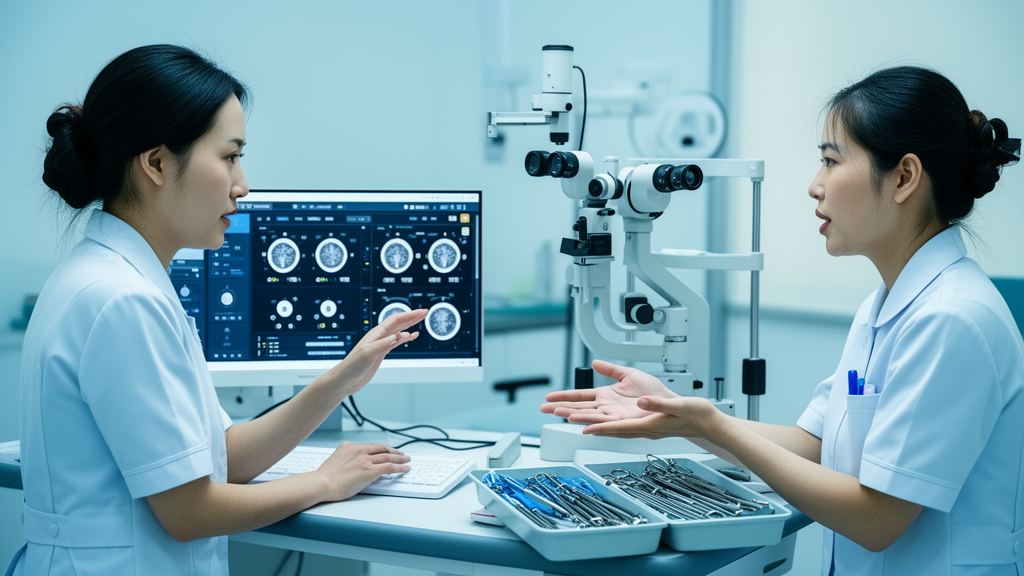
Ophthalmic nurses in China approached generative artificial intelligence with curiosity but not blanket acceptance, according to a qualitative descriptive study of how they establish, adjust and defend trust in tools such as ChatGPT and DeepSeek. The interviews suggest that trust is a dynamic, context-dependent process shaped by professional obligations, the nurse–patient relationship and the organizational environment of eye care.

Researchers conducted semi-structured, in-depth interviews with 26 ophthalmic nurses selected through maximum-variation sampling. Participants worked in tertiary, secondary and primary eye-care settings across eastern, central and western China, providing coverage of different levels and locations of care. The interviews used the Critical Incident Technique, while the transcripts were examined with Braun and Clarke’s reflexive thematic analysis. Reporting followed the Consolidated Criteria for Reporting Qualitative Research, or COREQ.

Three themes emerged from the analysis. The first, described by the researchers as a “tentative approach,” captured a progression from curiosity to a conditional appraisal of generative AI’s competence. Nurses did not treat the technology as uniformly reliable or unreliable; instead, their trust was calibrated in a graded, task-specific manner. The researchers tentatively called this pattern “gradient calibration,” indicating that acceptance varied with the task and context rather than representing a single position toward generative AI.

The second theme, “guarding professional boundaries,” concerned the anchoring of trust in ethical obligation and the nurse–patient relationship. This focus is particularly relevant to ophthalmic nursing, where visual outcomes can be irreversible, ophthalmic medication requires precision, and visually impaired patients may depend on nurse-mediated support. The findings indicate that the possible reconfiguration of professional roles and relationships by generative AI forms part of nurses’ trust negotiations. They also show that trust is not only a judgment about technical performance: ethical tension and responsibility toward patients influence how nurses engage with the tools.

The third theme placed trust negotiation within the wider organizational ecology of ophthalmic care. Institutional conditions, professional expectations and the workplace context shaped how nurses approached and used generative AI. Taken together, the themes show trust emerging through negotiation rather than as a fixed attitude of acceptance or refusal. The study does not measure whether generative AI improves diagnostic accuracy, patient outcomes or nursing performance, nor does it establish how common particular responses are among ophthalmic nurses. Because the evidence comes from interviews with 26 participants, its conclusions describe the experiences and reasoning of this sample. Transferability beyond the sampled Chinese eye-care settings requires further study.

Subject of Research: Trust negotiation in generative AI use among ophthalmic nurses in China

Article Title: Navigating the unknown: a qualitative descriptive study of ophthalmic nurses’ trust negotiation with generative artificial intelligence in China

Article References: Zhu, M., Zhang, X., Zhu, Y., Zhang, L., Li, R., Li, A., & Qu, L. (2026). Navigating the unknown: a qualitative descriptive study of ophthalmic nurses’ trust negotiation with generative artificial intelligence in China. BMC Nursing. https://doi.org/10.1186/s12912-026-05437-7

Image Credits: AI Generated

DOI: 10.1186/s12912-026-05437-7

Keywords: ophthalmic nursing, generative artificial intelligence, trust calibration, qualitative interviews, nurse–patient relationship, clinical ethics, organizational context, eye care, thematic analysis, Navigating, unknown, qualitative

Cite Scienmag News

Ophelia Keating. (October 21, 2026). Chinese Ophthalmic Nurses Negotiate Trust in Generative AI. Scienmag. https://scienmag.com/chinese-ophthalmic-nurses-negotiate-trust-in-generative-ai/

Ophelia Keating. "Chinese Ophthalmic Nurses Negotiate Trust in Generative AI." Scienmag, 21 October 2026, https://scienmag.com/chinese-ophthalmic-nurses-negotiate-trust-in-generative-ai/. Accessed 21 October 2026.

Ophelia Keating. "Chinese Ophthalmic Nurses Negotiate Trust in Generative AI." Scienmag. October 21, 2026. https://scienmag.com/chinese-ophthalmic-nurses-negotiate-trust-in-generative-ai/


Tags: challenges and facilitatorsChinese eye care settings and AI integrationclinical ethicscontext-dependent trust in healthcare AI toolscritical incident technique in qualitative research on AIeye careGenerative AI trust negotiation among ophthalmic nurses in Chinagenerative artificial intelligencegraded trust calibration in ophthalmic nursingimpact of organizational environment on AI acceptanceinfluence of professional obligations on AI trustNavigatingnurse-patient relationshipnurse-patient relationship influence on AI trustophthalmic nursingorganizational contextqualitativequalitative interviewsqualitative study on AI adoption in eye caresemi-structured interviews in healthcare researchthematic analysistrust calibrationunknownuse of thematic analysis in healthcare AI studies
Share26Tweet16
Previous Post

CMIP6 models reveal a slowing southward spread of AMOC weakening

Next Post

Uric Acid–HDL Ratio Shows Exploratory Mortality Pattern After Hip Fracture

Related Posts

Uric Acid–HDL Ratio Shows Exploratory Mortality Pattern After Hip Fracture
Medicine

Uric Acid–HDL Ratio Shows Exploratory Mortality Pattern After Hip Fracture

October 21, 2026
SGLT2 inhibitors show modest, uncertain benefit for functional mitral regurgitation
Medicine

SGLT2 inhibitors show modest, uncertain benefit for functional mitral regurgitation

October 21, 2026
Blood tau proteins linked to muscle and motor measures in adult SMA
Medicine

Blood tau proteins linked to muscle and motor measures in adult SMA

October 21, 2026
Study finds no clear mental health link with magnesium or omega-3 intake
Medicine

Study finds no clear mental health link with magnesium or omega-3 intake

October 21, 2026
MRI links Crohn’s disease to coordinated brain changes
Medicine

MRI links Crohn’s disease to coordinated brain changes

October 21, 2026
Retrospective colorectal cancer study links nerve invasion to metastasis
Medicine

Retrospective colorectal cancer study links nerve invasion to metastasis

October 21, 2026
Next Post
Uric Acid–HDL Ratio Shows Exploratory Mortality Pattern After Hip Fracture

Uric Acid–HDL Ratio Shows Exploratory Mortality Pattern After Hip Fracture

  • Mothers who receive childcare support from maternal grandparents show more optimized

    Mothers who receive childcare support from maternal grandparents show more parental warmth, finds NTU Singapore study

    27656 shares
    Share 11059 Tweet 6912
  • University of Seville Breaks 120-Year-Old Mystery, Revises a Key Einstein Concept

    1061 shares
    Share 424 Tweet 265
  • Bee body mass, pathogens and local climate influence heat tolerance

    682 shares
    Share 273 Tweet 171
  • Researchers record first-ever images and data of a shark experiencing a boat strike

    546 shares
    Share 218 Tweet 137
  • Groundbreaking Clinical Trial Reveals Lubiprostone Enhances Kidney Function

    531 shares
    Share 212 Tweet 133
Science

Embark on a thrilling journey of discovery with Scienmag.com—your ultimate source for cutting-edge breakthroughs. Immerse yourself in a world where curiosity knows no limits and tomorrow’s possibilities become today’s reality!

RECENT NEWS

  • Uric Acid–HDL Ratio Shows Exploratory Mortality Pattern After Hip Fracture
  • Chinese Ophthalmic Nurses Negotiate Trust in Generative AI
  • CMIP6 models reveal a slowing southward spread of AMOC weakening
  • Clinical pastoral students describe conditions for emotional intelligence growth

Categories

  • Agriculture
  • Anthropology
  • Archaeology
  • Athmospheric
  • Biology
  • Biotechnology
  • Blog
  • Bussines
  • Cancer
  • Chemistry
  • Climate
  • Earth Science
  • Editorial Policy
  • Marine
  • Mathematics
  • Medicine
  • Pediatry
  • Policy
  • Psychology & Psychiatry
  • Science Education
  • Science News
  • Social Science
  • Space
  • Technology and Engineering

Subscribe to Blog via Email

Enter your email address to subscribe to this blog and receive notifications of new posts by email.

Join 5,150 other subscribers

© 2025 Scienmag - Science Magazine

Welcome Back!

Login to your account below

Forgotten Password?

Retrieve your password

Please enter your username or email address to reset your password.

Log In
No Result
View All Result
  • HOME
  • SCIENCE NEWS
  • CONTACT US

© 2025 Scienmag - Science Magazine

Discover more from Science

Subscribe now to keep reading and get access to the full archive.

Continue reading