


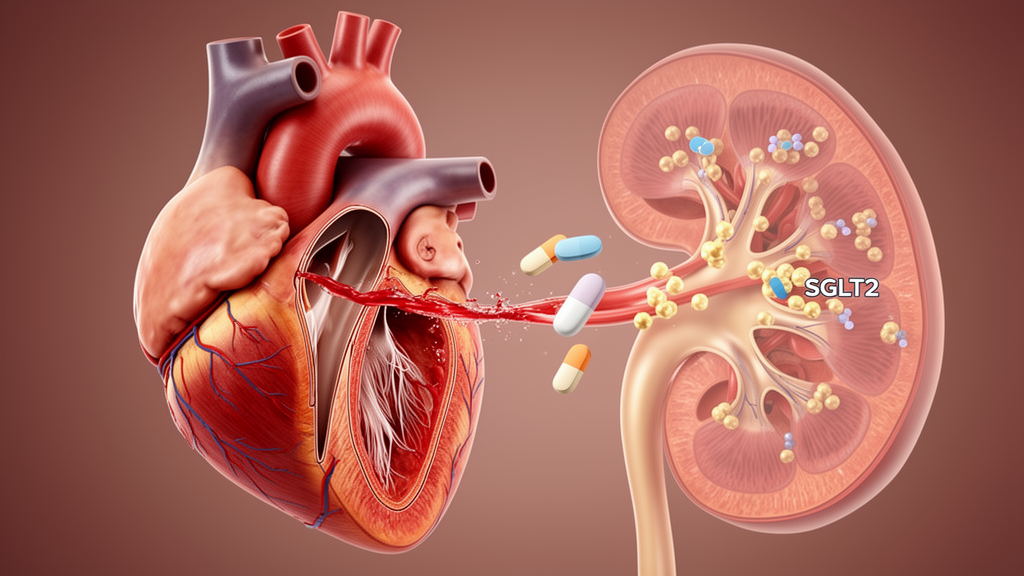
Sodium-glucose cotransporter-2 inhibitors added to guideline-directed medical therapy were associated with modest reductions in functional mitral regurgitation in a systematic review and meta-analysis of three randomized controlled trials involving 455 adults with heart failure. Across the trials, the drugs reduced the effective regurgitant orifice area by a mean of 0.086 square centimeters and mitral regurgitant volume by 10.87 milliliters compared with control treatment. Both pooled effects favored SGLT2 inhibitors, but the results were statistically fragile, showed substantial variation among studies and were rated as low-certainty evidence. The analysis therefore offers a signal that these drugs may ease functional valve leakage, not proof of a valve-specific treatment effect.
Functional mitral regurgitation, also called secondary mitral regurgitation, occurs when disease or remodeling in the left ventricle distorts the geometry of the mitral valve rather than damaging its leaflets directly. The reviewed evidence describes an imbalance between leaflet tethering and the forces that close the valve, often accompanied by displacement of the papillary muscles, dilation of the mitral annulus and reduced ventricular closing forces. It occurs in approximately one-third of people with heart failure and is associated with a poor prognosis. Because SGLT2 inhibitors are already part of heart-failure care and have been associated with reverse ventricular remodeling, researchers examined whether they might also reduce functional mitral leakage.
The review searched PubMed, Embase, Scopus, Web of Science and the Cochrane Central Register of Controlled Trials from database inception through July 21, 2026. The authors screened 745 records, assessed four full-text reports and included three randomized trials. Those studies were conducted in South Korea, China and Egypt between 2024 and 2025, and together initially randomized 472 participants; 455 completed follow-up and entered the quantitative analysis. The included populations had chronic heart failure and functional mitral regurgitation despite stable background therapy that included components of guideline-directed medical therapy, such as beta-blockers, renin-angiotensin system inhibitors and mineralocorticoid receptor antagonists.
The trials differed substantially in design and follow-up. EFFORT was a six-center, double-blind, placebo-controlled trial conducted in South Korea; it assigned 128 participants to ertugliflozin or placebo and followed them for 12 months. The DEFORM trial in China enrolled 104 patients, used dapagliflozin 10 mg once daily or guideline-directed therapy alone, and assessed outcomes after three months. A third Egyptian trial enrolled 240 patients, compared dapagliflozin 10 mg once daily with guideline-directed therapy alone and followed participants for six months. Two of the studies were open-label, although echocardiographic outcomes were assessed with blinding to allocation, while EFFORT used placebo. The pooled cohort had a mean age of 61.5 years and was 70.3% male.
For the primary imaging outcomes, adding an SGLT2 inhibitor produced a mean difference in effective regurgitant orifice area of −0.086 square centimeters, with a 95% confidence interval from −0.150 to −0.022 and a p-value of 0.0089. For mitral regurgitant volume, the mean difference was −10.87 milliliters, with a 95% confidence interval from −17.32 to −4.43 and a p-value of 0.0009. These reductions are clinically modest. The analysis also found substantial heterogeneity among the three trials: I² was 72.5% for effective regurgitant orifice area and 63.5% for regurgitant volume. The reviewers considered these levels substantial and examined the variation alongside differences in participant characteristics, interventions, follow-up durations and baseline regurgitation severity.
Leave-one-out sensitivity analyses showed that the apparent benefit depended partly on the evidence contributed by individual trials. Removing the Abou Warda study reduced heterogeneity for effective regurgitant orifice area from 72.5% to 46.9%, indicating that this larger, open-label trial was a major source of variation. However, omitting the placebo-controlled EFFORT trial removed statistical significance for both primary outcomes. Without EFFORT, the estimated difference in effective regurgitant orifice area was −0.103 square centimeters, but its 95% confidence interval extended from −0.236 to +0.029; the corresponding p-value was 0.1251. For regurgitant volume, the estimate remained negative at −12.03 milliliters after EFFORT was removed, but the p-value rose to 0.0801. The evidence was therefore downgraded for inconsistency and imprecision.
The clinical-event results were stronger numerically but even more vulnerable to sparse-data problems. The pooled analysis associated SGLT2 inhibitor therapy with a 55% relative reduction in heart-failure hospitalization, with a risk ratio of 0.45 and a 95% confidence interval of 0.28 to 0.73. It also found a 74% relative reduction in cardiovascular death, with a risk ratio of 0.26 and a 95% confidence interval of 0.12 to 0.58. Neither analysis detected between-study heterogeneity, but the certainty was rated low for hospitalization and very low for cardiovascular mortality. Using the control-group event rates, the review estimated that heart-failure hospitalization would fall from 177 to 80 per 1,000 patients, while cardiovascular death would fall from 97 to 25 per 1,000. These are pooled estimates from a total of 455 participants, not definitive treatment effects.
The review cautioned that the event estimates were dominated by a single study and are substantially larger than the benefits reported in much larger SGLT2 inhibitor outcome trials. For context, the authors cited broader outcome evidence involving more than 20,000 randomized patients, with approximate hazard ratios of 0.72 for first heart-failure hospitalization and 0.87 for cardiovascular death. The present review’s risk ratios of 0.45 and 0.26 imply much larger relative effects, including a nearly fourfold reduction in cardiovascular mortality based on only 26 events. Small-study effects, event sparsity, unblinded ascertainment of secondary outcomes and possible selective reporting provide more plausible explanations than a genuine amplification of benefit. The included trials were designed primarily as mechanistic studies rather than clinical-outcome trials.
Mechanistic measurements suggested that the drugs might influence the ventricle and surrounding structures rather than repair the mitral leaflets. In the Egyptian trial, reductions in regurgitation occurred alongside decreases in indexed left ventricular mass and volume. EFFORT and DEFORM, however, found no significant between-group difference in left ventricular volume despite reductions in regurgitation. Both reported improvements in measures related to contractile function, filling pressures or atrial geometry, including global longitudinal strain, ejection fraction, E/e′ and left atrial volume index. The authors proposed that improved contractile performance, lower filling pressures or reduced atrial stretch might improve leaflet coaptation before measurable ventricular volume regression develops. They also considered left atrial unloading particularly relevant because atrial fibrillation occurred in 26.3% of the pooled cohort. These observations were hypothesis-generating, as none of the trials tested whether any specific change mediated the reduction in regurgitation.
Several features limit interpretation and generalizability. Preload reduction can change measured regurgitation through temporary effects on ventricular geometry and transmitral pressure, and the DEFORM trial’s three-month imaging did not distinguish a hemodynamic effect from durable remodeling. In that study, background furosemide was reduced or discontinued more often in the dapagliflozin group, so participants were not volume-matched at follow-up. Baseline severity also varied: mean effective regurgitant orifice area was 0.20 square centimeters in EFFORT, compared with 0.43–0.45 square centimeters in the Egyptian trial. The trials excluded patients with preserved ejection fraction, and EFFORT excluded ejection fractions below 35%, limiting conclusions for advanced dysfunction and atrial functional mitral regurgitation. Only dapagliflozin and ertugliflozin were studied, adverse-event reporting was too inconsistent for safety synthesis, and study-level data prevented reliable individual-participant subgroup analysis. Larger placebo-controlled trials with standardized loading conditions, adjudicated endpoints and prespecified valvular outcomes are needed before the pooled effect can be considered confirmatory.
Subject of Research: Effects of SGLT2 inhibitors on functional mitral regurgitation in adults with heart failure
Article Title: Efficacy of sodium-glucose cotransporter-2 inhibitors on functional mitral regurgitation associated with heart failure: a systematic review and meta-analysis of randomized controlled trials
Article References: Kajo, C., Alaraibi, A. J., Almutairi, O. T., Alaraibi, Y. H., Alibrahim, A., Almutawah, Y. K. A., Alasfar, S. W. S., Ali, M. W., Hajjiri, A., Alqaryuti, M., Alfehaid, A., & Arekat, D. (2026). Efficacy of sodium-glucose cotransporter-2 inhibitors on functional mitral regurgitation associated with heart failure: a systematic review and meta-analysis of randomized controlled trials. Frontiers in Cardiovascular Medicine, 13, Article 1976876. https://doi.org/10.3389/fcvm.2026.1976876
Image Credits: AI Generated
DOI: 10.3389/fcvm.2026.1976876
Keywords: SGLT2 inhibitors, functional mitral regurgitation, heart failure, mitral valve, randomized controlled trials, meta-analysis, echocardiography, cardiovascular death, heart failure hospitalization, evidence certainty, Efficacy, sodium-glucose
Cite Scienmag News
Ophelia Keating. (October 21, 2026). SGLT2 inhibitors show modest, uncertain benefit for functional mitral regurgitation. Scienmag. https://scienmag.com/sglt2-inhibitors-show-modest-uncertain-benefit-for-functional-mitral-regurgitation/
Ophelia Keating. "SGLT2 inhibitors show modest, uncertain benefit for functional mitral regurgitation." Scienmag, 21 October 2026, https://scienmag.com/sglt2-inhibitors-show-modest-uncertain-benefit-for-functional-mitral-regurgitation/. Accessed 21 October 2026.
Ophelia Keating. "SGLT2 inhibitors show modest, uncertain benefit for functional mitral regurgitation." Scienmag. October 21, 2026. https://scienmag.com/sglt2-inhibitors-show-modest-uncertain-benefit-for-functional-mitral-regurgitation/


