


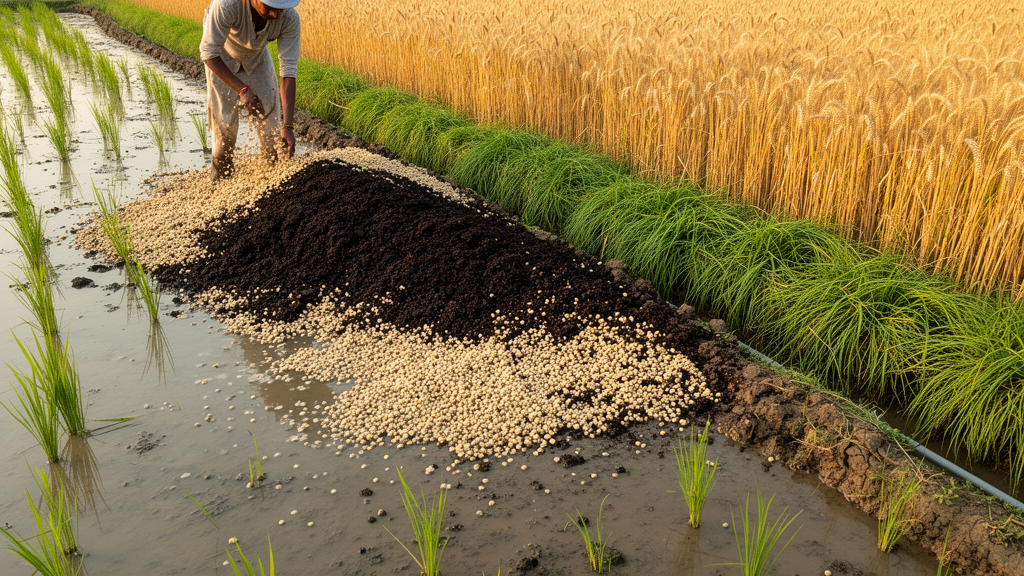
A field-level study across Uttar Pradesh found that combining fermented organic manure (FOM) with the full recommended dose of inorganic fertilizers was associated with the highest numerical grain yields in both rice and wheat and with higher values for several measured soil-fertility indicators. The treatment with the strongest descriptive results, designated T₃, applied 100% of the recommended inorganic fertilizer rate together with 125% of the project’s base FOM rate: 1.5625 tonnes per hectare for rice and 10 tonnes per hectare for wheat. Compared with inorganic fertilizer alone, T₃ was associated with mean rice grain-yield increases of 6.4–7.3% and wheat grain-yield increases of 10.8–12.7%, depending on whether the demonstrations took place at Krishi Vigyan Kendra instructional farms or in farmers’ fields.
These were descriptive differences in a participatory demonstration program, not statistically established treatment effects. The program was implemented during the 2025–2026 cropping season through 25 Krishi Vigyan Kendras, or KVKs, across Uttar Pradesh under the Central Sector Scheme for awareness and demonstrations of FOM and liquid FOM. Although 224 frontline demonstrations were conducted, the published analysis included only records with sufficiently complete and consistent field-level data.
It used 40 rice and 110 wheat demonstrations in farmers’ fields, together with 6 rice and 11 wheat demonstrations at KVK instructional farms. Each farmers’ field treatment occupied 1,200 square metres, while instructional-farm plots covered 400 square metres per treatment. Progressive farmers were selected by the KVKs, and scientists supervised the demonstrations, but formal plot-level randomization was not used.
The remaining demonstrations were excluded because required field-level information was incomplete or unavailable. The treatments were arranged to compare fertilizer quantity with manure supplementation. At instructional farms, seven combinations were evaluated: 100% recommended inorganic fertilizer alone; that fertilizer rate with 75%, 100%, or 125% FOM; 75% recommended inorganic fertilizer alone; and 75% fertilizer with 100% or 125% FOM.
Farmers’ field demonstrations compared full-rate inorganic fertilizer with the same fertilizer rate plus 100% or 125% FOM. Both rice and wheat received a recommended nutrient rate of 120 kg nitrogen, 60 kg phosphorus pentoxide and 40 kg potassium oxide per hectare. The base FOM rates were 1.25 tonnes per hectare for rice and 8 tonnes per hectare for wheat.
Locally adapted high-yielding varieties were used, and irrigation, weed management and plant-protection practices followed the recommendations of the respective KVKs. Grain yield, straw yield, harvest index, crop-growth attributes, post-harvest soil measurements and economic returns were recorded. FOM was prepared from locally available farmyard manure, cattle dung and urine, crop residues, green biomass and jaggery.
The ingredients were fermented for approximately 30–45 days with periodic turning and suitable moisture and aeration conditions. The resulting material had a moisture content of 30–40%, a pH of 6.5–7.5 and an electrical conductivity no higher than 4 decisiemens per metre. Its combined total nitrogen, phosphorus pentoxide and potassium oxide content was at least 1.2%, while total organic carbon was at least 14% and the carbon-to-nitrogen ratio was below 20:1.
Batch-wise characterization was not consistently available across all participating locations, a limitation that may have contributed to variation in the manure’s nutrient contribution and performance. At the KVK instructional farms, mean rice grain yield under T₃ was 5,330 kg per hectare, 7.3% above the 4,968 kg per hectare recorded with full-rate inorganic fertilizer alone. Mean wheat yield reached 4,461 kg per hectare, 12.7% above the reference treatment’s 3,958 kg per hectare.
T₃ also recorded the highest numerical straw yields and harvest indices at these sites: 6,839 kg per hectare and 43.8% for rice, and 5,322 kg per hectare and 45.6% for wheat. In farmers’ fields, the corresponding T₃ means were 5,320 kg per hectare for rice and 4,641 kg per hectare for wheat, representing increases of 6.4% and 10.8% over inorganic fertilizer alone. T₂, combining full-rate fertilizer with 100% FOM, also exceeded the fertilizer-only reference numerically in both settings: rice yield was 5,188 kg per hectare at instructional farms and 5,232 kg per hectare in farmers’ fields, while wheat yield was 4,353 and 4,445 kg per hectare, respectively.
The 75%-fertilizer treatment without FOM generally produced the weakest growth and yield means at instructional farms. Crop-growth measurements followed the same descriptive pattern as yield. Under T₃ at instructional farms, rice had a mean plant population of 47 hills per square metre, 467 effective tillers per square metre, 183 grains per panicle, a panicle length of 26.5 cm and a 1,000-grain weight of 27.5 g.
The full-fertilizer treatment without FOM recorded 46 hills, 422 tillers, 164 grains per panicle, 23.2 cm and 26.6 g, respectively. Under T₃ in farmers’ fields, wheat had 241 plants and 545 effective tillers per square metre, 41 grains per spike, a 10.8 cm spike length and a 35.4 g 1,000-grain weight. The corresponding fertilizer-only means were lower for each of these numerical measures.
Researchers did not directly measure nutrient release, nutrient uptake or nutrient-use efficiency, so the parallel changes in growth, yield and soil properties should be interpreted as observed associations rather than demonstrated mechanisms. Soil measurements showed their clearest numerical separation after the complete rice–wheat cycle. At instructional farms, mean soil organic carbon (SOC) under T₃ increased from 0.271% before the cycle to 0.304% after wheat harvest, an absolute gain of 0.033 percentage points and a relative increase of 12.18%.
Available nitrogen rose from 125.3 to 164.3 kg per hectare, available phosphorus from 15.6 to 20.3 kg per hectare and available potassium from 165.1 to 185.5 kg per hectare. By contrast, under inorganic fertilizer alone, SOC declined from 0.271% to 0.269%, while the three available-nutrient measures fell to 118.5, 14.9 and 160.8 kg per hectare. The full-fertilizer treatment receiving 100% FOM also recorded post-cycle means of 0.298% SOC and 158.3, 18.9 and 182.0 kg per hectare of available nitrogen, phosphorus and potassium.
At instructional farms, T₇—75% fertilizer plus 125% FOM—also reached 0.304% SOC, although its post-cycle available-nutrient values were lower than those under T₃. Farmers’ field soils began with a higher mean SOC concentration of 0.447%. Following the cycle, T₃ increased it to 0.515%, a gain of 0.068 percentage points or 15.21% relative to the initial value.
Available nitrogen, phosphorus and potassium rose from initial means of 221.2, 16.9 and 176.1 kg per hectare to 261.8, 22.3 and 199.7 kg per hectare. Under fertilizer alone, SOC fell to 0.429%, available nitrogen to 214.3 kg per hectare and available phosphorus to 16.4 kg per hectare, while potassium was nearly unchanged at 176.0 kg per hectare. T₂, with full-rate fertilizer plus 100% FOM, ended with 0.495% SOC and available nitrogen, phosphorus and potassium values of 259.1, 20.8 and 196.0 kg per hectare.
These measurements cover one evaluated cropping cycle and should not be interpreted as evidence of durable long-term soil improvement or carbon sequestration. Higher productivity did not translate into the strongest net economics because FOM added costs for production, transportation, labor and field application. At KVK instructional farms, T₃ generated the highest mean gross return for rice, ₹139,946 per hectare, but its cultivation cost was ₹58,708 per hectare, leaving a net return of ₹81,238 and a benefit–cost ratio of 1.38.
Fertilizer alone had a higher benefit–cost ratio of 1.58. For wheat, T₃ produced the highest gross return, ₹127,491 per hectare, but a net return of ₹57,702 and a benefit–cost ratio of 0.83, compared with ₹68,968 and 1.52 under fertilizer alone. Farmers’ fields showed the same pattern: the full-rate fertilizer treatment without FOM had the highest mean net returns and benefit–cost ratios for both crops, even though T₃ had the highest gross returns.
In farmers’ rice fields, fertilizer alone recorded a net return of ₹79,969 per hectare and a benefit–cost ratio of 1.52, compared with ₹75,259 and 1.16 under T₃. For farmers’ wheat, the corresponding values were ₹78,262 and 1.82 for fertilizer alone, versus ₹61,802 and 0.87 under T₃. The findings therefore separate agronomic performance from profitability.
FOM-integrated treatments were associated with higher numerical yields, straw production, harvest indices and selected soil-fertility measurements, while its cost reduced or failed to improve net returns in several settings. The analysis is limited by its use of descriptive means without inferential testing, incomplete exclusion of demonstrations, variation among soils, varieties, management practices and input prices, and inconsistent FOM characterization. Multi-season, replicated trials with formal randomization, standardized manure analysis and appropriate statistical evaluation are needed to determine whether these responses are reproducible and whether locally produced FOM can remain economically viable after its full production and delivery costs are included.
Subject of Research: Fermented organic manure effects on rice–wheat productivity, soil fertility and economics in Uttar Pradesh
Article Title: Integrated effects of fermented organic manure on soil fertility, productivity, and economic performance of the rice–wheat cropping system in Uttar Pradesh
Article References: Singh, R., Singh, A. K., Yadav, P., Yadav, S., Singh, A., Pandey, S. R., Singh, V. K., Raghubanshi, N., Singh, Y. P., Kumar, M., Singh, S., & Kumari, R. (2026). Integrated effects of fermented organic manure on soil fertility, productivity, and economic performance of the rice–wheat cropping system in Uttar Pradesh. Frontiers in Sustainable Food Systems, 10, Article 1968370. https://doi.org/10.3389/fsufs.2026.1968370
Image Credits: AI Generated
DOI: 10.3389/fsufs.2026.1968370
Keywords: fermented organic manure, rice–wheat cropping system, grain yield, soil organic carbon, available nutrients, integrated nutrient management, economic returns, field demonstrations, Uttar Pradesh, Integrated, effects, fermented
Cite Scienmag News
Alan Morgan. (October 21, 2026). Research report: Integrated effects of fermented organic manure on soil fertility, productivity, and economic performance of the rice–wheat cropping system in Uttar Pradesh. Scienmag. https://scienmag.com/research-report-integrated-effects-of-fermented-organic-manure-on-soil-fertility-productivity-and-economic-performance-of-the-rice-wheat-cropping-system-in-uttar-pradesh/
Alan Morgan. "Research report: Integrated effects of fermented organic manure on soil fertility, productivity, and economic performance of the rice–wheat cropping system in Uttar Pradesh." Scienmag, 21 October 2026, https://scienmag.com/research-report-integrated-effects-of-fermented-organic-manure-on-soil-fertility-productivity-and-economic-performance-of-the-rice-wheat-cropping-system-in-uttar-pradesh/. Accessed 21 October 2026.
Alan Morgan. "Research report: Integrated effects of fermented organic manure on soil fertility, productivity, and economic performance of the rice–wheat cropping system in Uttar Pradesh." Scienmag. October 21, 2026. https://scienmag.com/research-report-integrated-effects-of-fermented-organic-manure-on-soil-fertility-productivity-and-economic-performance-of-the-rice-wheat-cropping-system-in-uttar-pradesh/


