


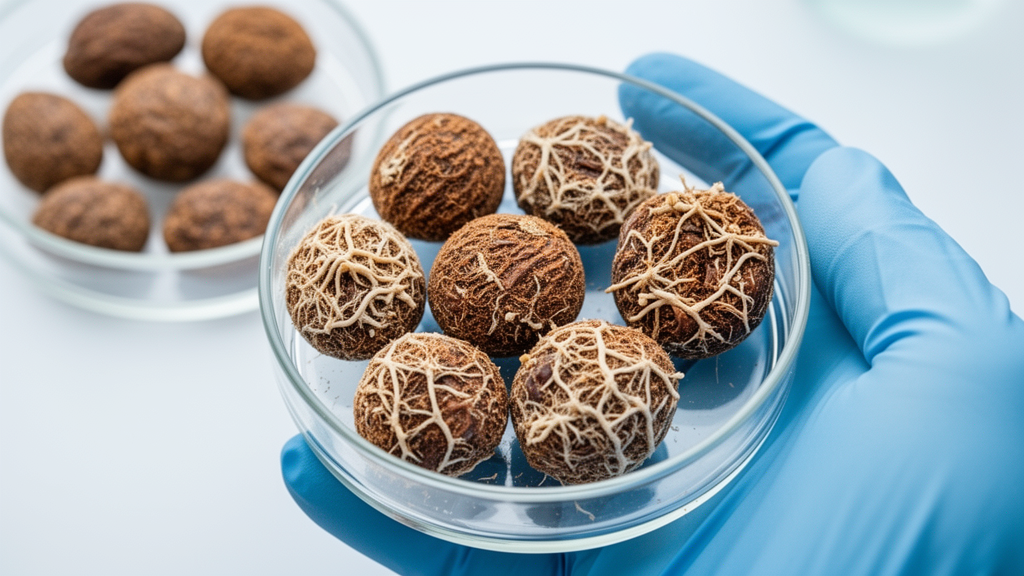
In a 24-hour laboratory rumen study, replacing yellow corn with date pits treated by the fungus Aspergillus parasiticus did not significantly alter methane output, major short-chain fatty-acid proportions, ammonia concentration or total protozoal counts. The treatment did, however, reduce cumulative gas production and the degradation of dry and organic matter as the proportion of fungi-degraded date pits increased. The results position the fermented agricultural by-product as a potential energy feed for ruminants, but the experiment did not test live animals, growth, milk production, feed intake or long-term health.
Researchers prepared five isocaloric and isonitrogenous total mixed rations for an in vitro gas-production assay using rumen fluid collected from three slaughtered Holstein cows. Each diet contained 50% clover hay and 50% concentrate, with yellow corn progressively replaced by fungi-degraded date pits at 0%, 25%, 50%, 75% or 100%. Six analytical bottles were prepared per treatment: three for fermentation and protozoal measurements and three for estimating truly degraded dry and organic matter.
The statistical analysis used three inoculum replicates, and the experiment was conducted in a single run. To produce the experimental ingredient, the date pits were washed, dried at 80 °C for eight hours and ground to pass a 0.6 mm sieve. Approximately 25 kg of the powder was then inoculated with A. parasiticus during an aerobic solid-state fermentation carried out in autoclavable bags for two weeks.
The fermentation medium was adjusted to pH 5.5 and supplemented with lactose, with continuous aeration, agitation and cooling during incubation. After fermentation, the colonized material was autoclaved twice and exposed to ultraviolet radiation for one hour before the bags were opened, a biosafety measure intended to reduce viable fungal spores and limit environmental dispersal during sample handling. Safety was assessed by measuring four aflatoxins—AFB1, AFB2, AFG1 and AFG2—with an enzyme-linked immunosorbent assay.
The researchers reported a total aflatoxin concentration of 0.72 ppm, below the maximum limit they cited for animal feed and indicating no apparent safety concern in the tested material. That result applies to the particular fermented sample analyzed; it does not establish that every batch produced through the same process would have identical contamination levels. During the 24-hour incubation at 39 °C, cumulative gas production declined from 177.24 mL per gram of dry matter in the all-corn control to 153.09 mL per gram when fungi-degraded date pits completely replaced corn.
Truly degraded dry matter fell from 760.10 to 695.00 g/kg, while truly degraded organic matter decreased from 769.98 to 703.17 g/kg. Statistical tests identified both linear and quadratic responses for these three measures, each with p = 0.001, indicating systematic changes across the replacement series rather than isolated differences between adjacent diets. Despite the lower overall gas production, methane production did not differ significantly among the diets: values ranged from 18.92 to 19.84 mL per gram of degraded organic matter.
Rumen pH moved in the opposite direction, rising from 6.32 in the control to 6.49 in the diet containing only fungi-degraded date pits. The increase was significant for both the linear trend, with p = 0.012, and the quadratic trend, with p = 0.032. The authors associated this response with the date-pit diets’ greater fiber content and potentially lower fermentable-carbon availability relative to corn.
They also noted that sugars can be incorporated into microbial glycogen, which may limit the production of fermentation acids. By contrast, the partitioning factor, total protozoa and ammonia nitrogen did not differ significantly among diets. The partitioning factor, expressed as milligrams of truly degraded organic matter per milliliter of gas production, ranged from 3.70 to 4.02 mg/mL.
The main short-chain fatty acids also remained stable. Acetic acid accounted for 42.92% to 43.82% of the measured molar proportions across the diets, propionic acid for 24.26% to 24.91%, and n-butyric acid for 19.45% to 20.06%. None of these major fatty acids showed significant treatment effects.
Heptanoic acid was the exception: its molar proportion increased linearly as fungi-degraded date pits replaced corn, with p = 0.029, while the quadratic tendency did not meet the conventional significance threshold. Thus, the largest observed differences in rumen chemistry were concentrated in the extent of substrate degradation and gas generation rather than in the balance of the principal volatile fatty acids used to characterize fermentation. Molecular analysis offered only a limited view of the methane-producing community.
The researchers extracted DNA from rumen samples, used nested polymerase chain reaction with methanogen-specific primers and sequenced products approximately 179 base pairs long. Phylogenetic analysis placed 11 operational taxonomic units in a major cluster associated with Methanobrevibacter, including sequences from several date-pit replacement levels. One subcluster contained nine units with bootstrap support ranging from 39% to 67%, while another included two units supported at 58%.
The authors explicitly cautioned that these results described phylogenetic affiliations among detected sequences rather than a comprehensive characterization of the entire rumen methanogenic community. The modest bootstrap values also limit the strength of the inferred evolutionary clustering. There was no notable association between the phylogenetic grouping and methane production across the diets.
The researchers noted that this agrees with the absence of a clear relationship between methanogen abundance and methane emissions reported previously, but the current experiment neither established such a relationship nor ruled one out. More broadly, the findings show that fungi-degraded date pits can replace yellow corn in a short-term laboratory rumen system without detectable disruption of several major fermentation indicators. They do not show that the ingredient improves ruminant productivity, lowers greenhouse-gas emissions at farm level or provides an economic advantage.
Feed costs, palatability, intake, growth, milk yield, carcass traits and animal health were outside the scope of the study. For the authors, the results support further investigation of fungi-degraded date pits as a locally available energy source that could reduce reliance on conventional concentrate in ruminant diets. The ingredient offers a route to adding value to a date-processing by-product, and the absence of significant changes in methane output and principal fermentation measures provides a rationale for in vivo testing.
Nevertheless, the reduced gas production and nutrient degradability at higher replacement levels remain important constraints.
Subject of Research: In vitro assessment of fungi-degraded date pits as a corn replacement for ruminant diets
Article Title: Efficacy of fungi-degraded date pits as a potential alternative dietary energy source in farm animal diets
Article References: Sallam, S. M. A., Attia, M. F. A., El-Nile, A. E., El-Azab, M., Shehab El-Deen, M. A., Aladhadh, M., Ghareeb, A. Z., Hafez, E. E., Salama, A. M. M., & Ghareeb, D. A. (2026). Efficacy of fungi-degraded date pits as a potential alternative dietary energy source in farm animal diets. Frontiers in Veterinary Science, 13, Article 1892086. https://doi.org/10.3389/fvets.2026.1892086
Image Credits: AI Generated
DOI: 10.3389/fvets.2026.1892086
Keywords: ruminant nutrition, date pits, corn replacement, rumen fermentation, methanogens, fungal fermentation, short-chain fatty acids, livestock feed, agricultural by-products, in vitro study, Efficacy, fungi-degraded
Cite Scienmag News
Roger Howard. (October 21, 2026). Fungal-treated date pits show promise in laboratory ruminant feeding study. Scienmag. https://scienmag.com/fungal-treated-date-pits-show-promise-in-laboratory-ruminant-feeding-study/
Roger Howard. "Fungal-treated date pits show promise in laboratory ruminant feeding study." Scienmag, 21 October 2026, https://scienmag.com/fungal-treated-date-pits-show-promise-in-laboratory-ruminant-feeding-study/. Accessed 21 October 2026.
Roger Howard. "Fungal-treated date pits show promise in laboratory ruminant feeding study." Scienmag. October 21, 2026. https://scienmag.com/fungal-treated-date-pits-show-promise-in-laboratory-ruminant-feeding-study/


