


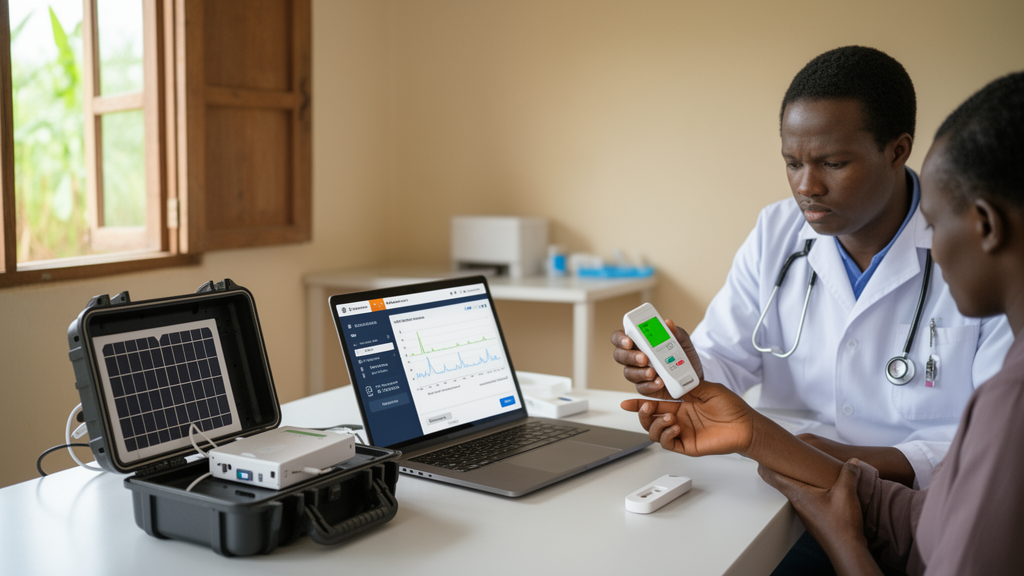
A 2026 Perspective argues that privacy-enhancing technologies designed for compute-rich health systems may fail when transplanted into miniaturised biosensors operating in low- and middle-income countries (LMICs). The authors identify three linked mismatches: encryption and secure computation can exceed the capacity of low-power devices, differential privacy can impose disproportionate accuracy costs on small or underrepresented populations, and technical controls may outpace local regulation and governance. Instead of a single privacy architecture, they propose a deployment agenda built around computational proportionality, equity-aware privacy budgets and community data sovereignty.
The concern is not abstract. Wearable monitors, point-of-care diagnostics and community-scale environmental sensors are producing continuous and potentially intimate health data in settings where electricity, connectivity, computing resources and regulatory capacity vary sharply. The 2026 Perspective in Frontiers in Sensors uses earlier field studies to illustrate the operational limits. In Rwanda, wearable measurements from 42 patients with suspected sepsis agreed strongly with manually recorded heart and respiratory rates, and more than 97% of the collected data were usable, but technical or practical difficulties affected about 29% of patients. In Sierra Leone, a Lassa fever study faced sensor-adhesion, Bluetooth, cellular and workflow problems; 81.3% of continuous physiological data were excluded on quality grounds, and each device cost about US$170, excluding the accompanying Android handset.
Those findings show why national income labels cannot determine whether a biosensor is deployable. Success also depends on the platform, clinical environment, power and communications infrastructure, implementation support and the ability of health services to interpret and act on the data. Privacy protection adds another layer, because the same miniaturisation that makes sensors portable can allow a device to generate a continuous stream of biologically revealing measurements. In the Perspective, the relevant question is therefore broader than whether data can be encrypted: it is whether a complete system can protect people and communities while remaining usable in the infrastructure and institutions actually available. The authors do not argue against biosensor deployment, but contend that privacy-by-design must be embedded from the outset if sensing systems are to be adopted equitably and sustainably.
Secure multiparty computation (MPC) and homomorphic encryption (HE) illustrate the first structural problem. MPC can distribute computation among parties, but its multiple interaction rounds generate communication costs that scale poorly with data complexity. HE permits calculation on encrypted data, yet frequent ciphertext refreshes, or bootstrapping, can make it impractical for demanding workloads. The Perspective cites evidence that software-based fully homomorphic encryption can be several orders of magnitude slower than equivalent unencrypted computation and may need specialised hardware acceleration. Such overhead may be manageable in cloud-connected hospitals or genomic platforms, but not on a milliwatt-scale microcontroller with days of battery life and intermittent connectivity. HE could remain viable when intensive operations are moved to a capable gateway, institutional server or cloud, illustrating why deployment location is part of the technical design rather than an afterthought.
Federated learning (FL) offers a more tractable alternative because models can be trained locally while raw sensor data remain on devices and only updates are communicated to an aggregator. But federated learning does not remove resource demands. Reviews of privacy-preserving AI in cloud-edge-device systems identify device heterogeneity, energy limits, communication overhead and security burdens as persistent barriers. Profiling on constrained wearables has also found that lower communication energy can come with greater on-device computation, longer convergence and reduced accuracy. The authors do not conclude that FL is universally unsuitable. Its practicality, they argue, depends on model architecture, memory, training strategy, client selection, communication protocols and whether computation can be shared with a nearby edge server. A system optimised downward from cloud-first assumptions may still exceed the memory, energy or connectivity budget of the intended hardware.
Differential privacy (DP) presents a different challenge because its guarantee is bought through added statistical noise. Although there is no context-independent standard for choosing the privacy budget parameter epsilon, the equity paradox becomes especially consequential in small, imbalanced biosensor cohorts. Empirical studies cited in the Perspective have found unequal utility costs when populations are rare, difficult to model or already show lower baseline performance. A census-linked analysis also found that DP can distort small-area counts and mortality estimates more strongly for minority populations and less urban areas. These findings do not prove that differential privacy will always be inequitable in LMIC applications; large datasets, transfer learning, suitable architectures and careful hyperparameter selection can reduce some trade-offs. They do show that standard benchmarks cannot simply be assumed to transfer to smaller populations, particularly where privacy noise can reduce the practical utility of models intended to serve those populations.
Community-scale sensing also creates privacy subjects that conventional individual-centred tools may not fully capture. Wastewater epidemiology can reveal pathogen or biomarker concentrations across a neighbourhood, while environmental networks and high-resolution biosensors can expose information about groups rather than identifiable people. Human mitochondrial DNA recovered from urban sewage has been used to estimate the geographic distribution of mitochondrial haplogroups, demonstrating that pooled samples can carry information about the genetic composition of geographically identifiable communities. The relevant privacy subject may therefore be a village, neighbourhood, institution or demographic group rather than an individual data contributor. In small, densely connected settlements, conventional guarantees such as k-anonymity and individual-level DP may need context-specific assessment. The authors caution that LMICs are not a uniform legal environment: legislation, enforcement, consent rules and cross-border data-transfer practices differ substantially across countries and even between institutions within them.
The proposed replacement agenda begins with computational proportionality: select a PET according to the intended device, power supply, connectivity and local computing capacity, rather than choosing on theoretical privacy strength alone. Suggested options include lightweight noise injection during on-device inference, quantised-gradient FL with asynchronous aggregation for unreliable links, and synthetic data used at an edge device to pre-train models before field deployment. Trusted execution environments may offer a middle ground because hardware-supported protection can be less costly than MPC or HE, although they remain susceptible to side-channel attacks involving memory access and timing. Equity-aware privacy budgeting is equally important. Systems should be tested on population-relevant data, assessed across demographic groups and monitored after deployment to detect whether privacy noise disproportionately reduces performance for particular communities.
Technical decentralisation alone does not establish data sovereignty. With FL or multiparty homomorphic encryption, raw measurements may remain within a community while models and aggregated results still move across institutions. Who owns or controls a federated model, who may inspect its outputs, and who can authorise onward sharing must therefore be designed alongside encryption and access controls. Synthetic datasets may support model development without releasing individual measurements, but generators can reproduce features of their training data, so synthetic output requires validation against attacks such as membership inference. The authors also argue that wastewater surveillance and neighbourhood sensing challenge conventional individual consent. Participatory structures used in health research could help define collective interests, representation, access and downstream use before deployment, making governance part of the sensor system rather than an afterthought. They propose community data sovereignty as a design requirement, not a guaranteed outcome of using decentralised technology.
Five research questions define what the authors consider the next stage: establishing the memory, energy, latency and communication floor for privacy-preserving operation on low-power hardware; calibrating DP for small and underrepresented populations; formulating protections for information about communities rather than individuals; determining the organisational capacity required to operate PET-enabled networks; and measuring how privacy architecture, community control and public trust affect participation. The Perspective synthesises established concerns rather than reporting a new field trial, and its proposed solutions remain research directions. Nevertheless, its central message is practical: the strongest theoretical privacy guarantee is not automatically the most deployable or equitable one. For miniaturised biosensors to become sustainable health infrastructure in resource-constrained systems, privacy-by-design must be tested against local hardware, demographic composition, collective governance and trust rather than imported unchanged from high-income, high-compute environments.
Subject of Research: Deployment of privacy-enhancing technologies for miniaturised biosensors in resource-constrained health systems
Article Title: Privacy-enhancing technologies for next-generation miniaturised biosensors: towards equitable deployment in low- and middle-income countries
Article References: Sekhon, S., Galera-Zarco, C., & Zieni, B. (2026). Privacy-enhancing technologies for next-generation miniaturised biosensors: towards equitable deployment in low- and middle-income countries. Frontiers in Sensors, 7, Article 1896505. https://doi.org/10.3389/fsens.2026.1896505
Image Credits: AI Generated
DOI: 10.3389/fsens.2026.1896505
Keywords: privacy-enhancing technologies, miniaturised biosensors, low- and middle-income countries, differential privacy, federated learning, homomorphic encryption, health equity, data sovereignty, digital health, community surveillance, Privacy-enhancing, technologies
Cite Scienmag News
Denise Maddox. (October 21, 2026). Privacy-enhancing technologies for next-generation miniaturised biosensors: towards equitable deployment in low- and middle-income countries. Scienmag. https://scienmag.com/privacy-enhancing-technologies-for-next-generation-miniaturised-biosensors-towards-equitable-deployment-in-low-and-middle-income-countries/
Denise Maddox. "Privacy-enhancing technologies for next-generation miniaturised biosensors: towards equitable deployment in low- and middle-income countries." Scienmag, 21 October 2026, https://scienmag.com/privacy-enhancing-technologies-for-next-generation-miniaturised-biosensors-towards-equitable-deployment-in-low-and-middle-income-countries/. Accessed 21 October 2026.
Denise Maddox. "Privacy-enhancing technologies for next-generation miniaturised biosensors: towards equitable deployment in low- and middle-income countries." Scienmag. October 21, 2026. https://scienmag.com/privacy-enhancing-technologies-for-next-generation-miniaturised-biosensors-towards-equitable-deployment-in-low-and-middle-income-countries/


