

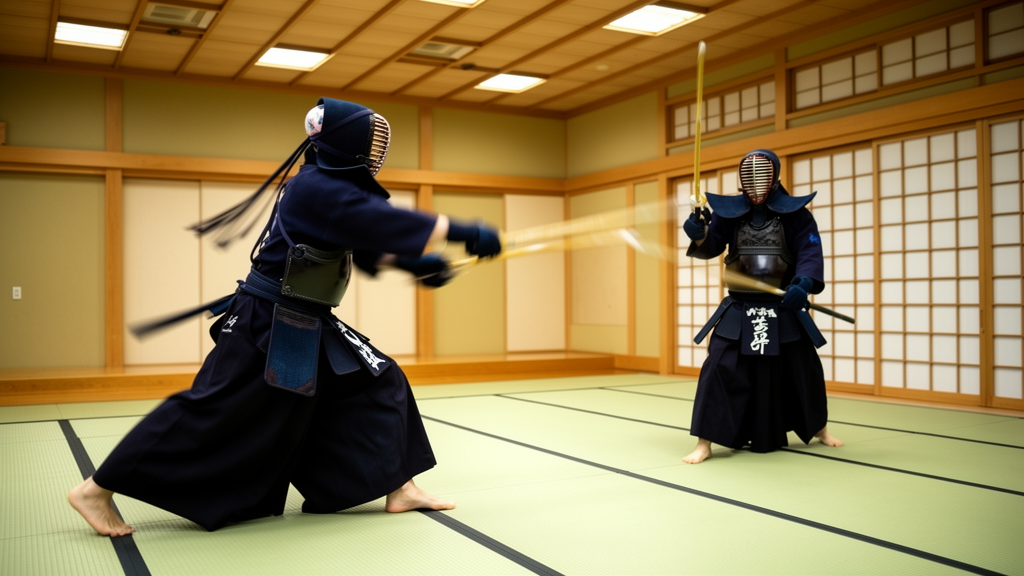
In a small experimental study of collegiate Kendo athletes, elite competitors showed lower odds of premature shinai movement and greater peak acceleration and peak jerk after initiating a counterattack than sub-elite competitors. The study did not detect statistically significant differences between the groups in reaction time or response-selection accuracy, and it found no statistically significant overall group difference in pre-movement muscle activity. The researchers compared nine elite and nine sub-elite male university athletes across 24 counterattack trials per participant, for 432 trials in total.
The elite group had experience competing as team members in the All Japan Student Kendo Championship, while the sub-elite group consisted of athletes who had achieved top placements in regional tournaments. The two groups were therefore both highly trained, although the elite athletes were older on average, with a mean age of 20.9 years compared with 19.6 years in the sub-elite group. Participants viewed life-size videos of four skilled Kendo practitioners, all fourth-dan holders, performing either a straight Men strike toward the head or a right Kote strike toward the forearm near the wrist.
The opponent’s intended target was not fully apparent when the shinai first began to rise, so the stimulus provided a continuous stream of visual information rather than a single discrete cue. Each video began after a delay of three, four or five seconds, and the combinations of opponent, delay and attack type were presented in a randomized order that was the same for all participants. From a ready position, participants were instructed to select and execute the corresponding counterattack.
For a Men strike, the required action was Men-Kaeshi-Do, in which the incoming Men attack was parried and a Do strike was directed toward the opponent’s torso. For a Kote strike, they performed Kote-Kaeshi-Men, parrying the forearm attack and striking toward the head. Because the opponent appeared on a flat screen, participants could not physically block the incoming shinai or make contact with the opponent, so they were told to perform the counterattack as realistically as possible.
An accelerometer attached to the shinai recorded vertical acceleration at 1,000 Hz. Movement onset was defined as the point when acceleration departed from the baseline by more than three standard deviations and the initial upward counterattack motion began. The analysis also separated transient acceleration fluctuations before the official movement onset, identifying them as premature reactions rather than allowing them to alter the reaction-time calculation.
The mixed-effects models found no statistically significant between-group difference in reaction time. Adjusted reaction times were 386.8 milliseconds for the elite group and 391.0 milliseconds for the sub-elite group, with an estimated elite-minus-sub-elite difference of −4.2 milliseconds and a 95% confidence interval from −38.8 to 30.4 milliseconds. There was also no statistically significant group difference in false responses: adjusted probabilities were 5.9% for elite athletes and 4.6% for sub-elite athletes, and the elite-to-sub-elite odds ratio was 1.33 with a 95% confidence interval of 0.37 to 4.76.
These results do not show that the groups were equivalent; the authors noted that the small sample limited statistical precision. The clearest measured differences occurred in the movement that followed initiation. Adjusted peak vertical acceleration was 23.1 m/s² for elite athletes and 15.8 m/s² for sub-elite athletes.
The estimated difference was 7.3 m/s², with a 95% confidence interval of 3.4 to 11.2 m/s² and p < 0.001. Peak jerk, which is the rate of change of acceleration, was 758.2 m/s³ in the elite group and 456.9 m/s³ in the sub-elite group. The estimated difference was 301.3 m/s³, with a 95% confidence interval of 144.3 to 458.3 m/s³ and p < 0.001.
Age-adjusted sensitivity analyses did not materially change the direction or overall interpretation of either result. These acceleration measures should not automatically be read as evidence of better movement smoothness. In this task, participants were required to move explosively from an almost static ready posture, so the investigators interpreted larger acceleration and jerk values as indicators of a sharper transition from stillness into action.
One possible explanation, which the authors did not directly test, is that elite athletes had more fully specified the selected counterattack by movement onset. Perceptual processing, decision confidence and online action selection were not measured, however, and the study therefore cannot establish why the post-onset movement differed. The groups also differed in the occurrence of objectively detected premature reactions.
Such an event was a transient acceleration fluctuation that exceeded the baseline threshold during the interval from 500 milliseconds before the opponent’s visible movement until the athlete’s official movement onset and then returned toward baseline. Adjusted probabilities were 7.1% for elite athletes and 18.6% for sub-elite athletes. The elite-to-sub-elite odds ratio was 0.37, with a 95% confidence interval of 0.15 to 0.70 and p = 0.004.
The finding establishes a difference in early movement fluctuations, but it does not show that every fluctuation represented an inappropriate response or directly demonstrate superior cognitive inhibition. Surface electromyography was used to measure activity in the anterior deltoid, biceps brachii and flexor carpi radialis during the 200 milliseconds immediately before movement onset. Each muscle’s activity was normalized to a baseline recorded while the participant held a standardized static chudan-no-kamae posture.
The adjusted overall baseline ratio was 1.36 for the elite group and 1.66 for the sub-elite group, indicating activity above the static reference in both groups. The estimated elite-to-sub-elite ratio was 0.82, with a 95% confidence interval of 0.66 to 1.02 and p = 0.078. A group-by-muscle interaction was not detected, but the nonsignificant overall result should not be interpreted as proof that the groups had equivalent pre-movement muscle activity.
Several limitations restrict generalization beyond the study’s narrow population and task. It included only 18 men from a university Kendo club, and age, academic year and competitive experience were closely related to group membership. Although age-adjusted analyses did not materially alter the principal findings, the small design could not fully separate those influences.
The video task also omitted physical contact, measured only shinai acceleration and three upper-limb muscles, and did not directly assess perception, decision-making, inhibitory control or neural activity. The results show that measurable differences between these two groups were present in premature movement fluctuations and post-initiation shinai kinetics even where reaction time and response accuracy did not differ significantly, but larger studies with live opponents and broader movement and cognitive measures would be needed to clarify the mechanisms involved.
Subject of Research: Skill-related differences in preparation and movement onset during Kendo counterattacks
Article Title: Reaction strategies before and after the initiation of counterattacks in elite and sub-elite Kendo athletes
Article References: Matsuzaki, K., Nabeyama, T., Arita, Y., Ono, S., & Kizuka, T. (2026). Reaction strategies before and after the initiation of counterattacks in elite and sub-elite Kendo athletes. Frontiers in Sports and Active Living, 8, Article 1947221. https://doi.org/10.3389/fspor.2026.1947221
Image Credits: AI Generated
DOI: 10.3389/fspor.2026.1947221
Keywords: Kendo, counterattacks, athletic expertise, reaction time, response accuracy, peak acceleration, peak jerk, premature reactions, muscle activity, motor control, Reaction, strategies
Cite Scienmag News
Scienmag. (October 21, 2026). Elite Kendo athletes differ in movement sharpness and premature reactions, study finds. https://scienmag.com/elite-kendo-athletes-differ-in-movement-sharpness-and-premature-reactions-study-finds/
Scienmag. "Elite Kendo athletes differ in movement sharpness and premature reactions, study finds." Scienmag, 21 October 2026, https://scienmag.com/elite-kendo-athletes-differ-in-movement-sharpness-and-premature-reactions-study-finds/. Accessed 21 October 2026.
Scienmag. "Elite Kendo athletes differ in movement sharpness and premature reactions, study finds." Scienmag. October 21, 2026. https://scienmag.com/elite-kendo-athletes-differ-in-movement-sharpness-and-premature-reactions-study-finds/


