


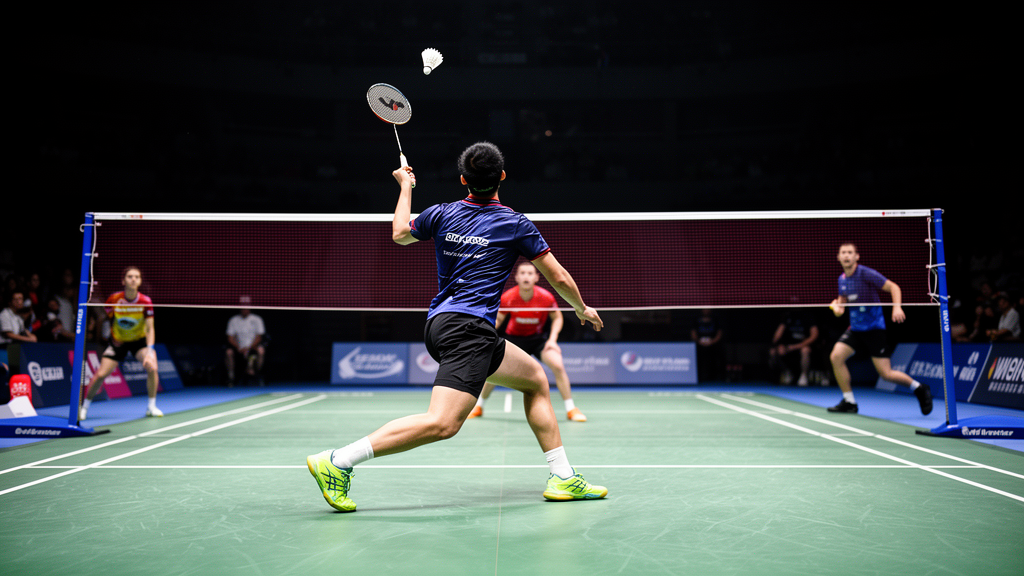
Elite male badminton players used measurably different lower-limb coordination strategies from amateur players during a standardized rear-court backhand footwork and backhand-clear task, according to a cross-sectional study that combined three-dimensional motion capture with surface electromyography. After correction for multiple comparisons, seven of 12 joint-coordination contrasts differed between the groups. By contrast, none of 63 comparisons of trunk–lower-limb muscle coherence across alpha, beta and lower-gamma frequency bands remained statistically significant, providing no corrected evidence that the groups differed in frequency-specific neuromuscular coupling.
The study recruited 36 men, divided equally between 18 elite players and 18 amateur players. Elite participants had received systematic training in a structured competitive program, held a National Level-2 Athlete certificate or higher and had competed at provincial level or above. The amateur group had at least two years of regular practice and could perform the movement independently, but did not meet the competitive classification or registration criteria. The groups were similar in age, height, body mass and body mass index. Mean badminton training experience, however, was substantially greater in the elite group: 8.6 years compared with 4.3 years in the amateur group. Because training duration was not included as a statistical covariate, the findings describe differences between the competitive-level groups as they were, rather than isolating an effect of competitive status independent of experience.
Each player completed 10 valid trials of a sport-specific sequence. Starting from the central ready position, participants moved rapidly toward the rear-court backhand area on their non-racket side, established a support position, rotated the trunk and hit a rear-court backhand clear toward a designated target. A programmable machine delivered shuttlecocks under fixed conditions, allowing investigators to standardize the incoming trajectory. Three-dimensional kinematics were recorded at 200 Hz, while wireless surface electromyography was sampled at 1,000 Hz. The analysis cycle ran from movement initiation to racket–shuttlecock contact and was divided into movement initiation, braking and support, and stroke force-generation phases. All inferential analyses retained individual trials rather than averaging them before comparison.
Joint coordination was assessed with continuous relative phase, a method that describes the timing relationship between two joints. For the hip–knee, hip–ankle and knee–ankle pairs, each point in the normalized movement cycle was classified as in-phase, anti-phase, proximal-dominant or distal-dominant. The percentages across the entire cycle were compared with trial-level linear mixed-effects models incorporating group, trial and their interaction, with participant as a random intercept. False-discovery-rate correction was applied separately to the 12 coordination comparisons and 63 muscle-pair–frequency-band coherence comparisons. This distinction between nominal and corrected evidence is crucial: 23 of the 63 coherence contrasts had unadjusted P values below 0.05, but all had adjusted q values of at least 0.098, above the study’s 0.05 significance threshold.
For the hip–knee joint pair, elite players spent more of the complete cycle moving in phase and less moving in anti-phase than amateurs. The estimated difference was 1.549 percentage points for in-phase coordination, with a 95% confidence interval of 0.328 to 2.770, and −5.100 percentage points for anti-phase coordination, with a 95% confidence interval of −8.291 to −1.909. Both differences had false-discovery-rate-adjusted q values of 0.025. Neither the proximal-dominant nor distal-dominant hip–knee proportions differed significantly after correction; their respective q values were 0.573 and 0.157. Because the analysis summarized the entire cycle, it did not reveal when during the approach, braking or stroke preparation these contrasts occurred.
Elite players also showed a more proximal pattern in the ankle’s relationship with the joints above it. Hip–ankle coordination was 3.259 percentage points more proximal-dominant and 12.158 percentage points less distal-dominant in the elite group. Knee–ankle coordination was 2.758 percentage points more proximal-dominant and 15.629 percentage points less distal-dominant. Elite players additionally spent 11.296 percentage points more of the cycle in knee–ankle anti-phase coordination. All five contrasts survived false-discovery-rate correction at q = 0.025. The pattern is compatible with greater hip-led organization and less reliance on ankle-led adjustment, but the measurements do not directly establish differences in hip strength, joint moments, braking force, movement efficiency or joint loading. A higher anti-phase proportion also should not automatically be treated as a deficit; during rapid braking, the knee and ankle may perform complementary roles in controlling body descent and maintaining ground contact.
To examine whether the coordination differences were accompanied by altered common drive among trunk and lower-limb muscles, the investigators analyzed 21 muscle pairs. Seven lower-limb muscles were monitored: tibialis anterior, lateral gastrocnemius, soleus, vastus medialis, vastus lateralis, biceps femoris and gluteus maximus. These were paired with the latissimus dorsi, erector spinae and rectus abdominis. Coherence was estimated from short-time Fourier transforms and summarized as the area of significant coherence in alpha, 8–15 Hz; beta, 15–30 Hz; and lower-gamma, 30–50 Hz bands. The smallest unadjusted P value, 0.003, occurred for tibialis anterior–latissimus dorsi coherence in the lower-gamma band, where the estimated elite-minus-amateur difference was 0.043772 with a 95% confidence interval of 0.017528 to 0.070017. Its adjusted q value was 0.098, however, so the result does not provide corrected statistical support for a group difference in that pair or in any other analyzed muscle-pair–frequency-band combination.
The coherence data also presented a technical challenge that reinforces the need for caution. Of 22,680 trial-level area-of-significant-coherence observations, 7,553 were below 0.0005 and would have appeared as zero if rounded to three decimal places, although none was exactly zero. Residual diagnostics showed departures from normality in all 63 coherence models, while four of the 12 coordination models also showed residual-normality deviations. The authors used group-specific variance components and 10,000 participant-cluster bootstrap resamples, with all 10 trials retained together for each resampled participant. These checks supported the seven corrected coordination findings but did not alter the absence of FDR-significant coherence findings. The analysis also treated surface electromyography as a measure of shared oscillatory activity rather than muscle-activation strength and did not normalize signals to maximal voluntary contraction because linear scaling would not alter the coherence coefficient.
Several boundaries constrain how the results can be applied. The laboratory task reproduced neither the tactical demands nor the environmental variability of competition, and all participants were tested without acute fatigue. The sample included only men, contained 18 players per group and was too small to provide strong statistical power across 63 coherence comparisons. The complete-cycle percentages also discarded the detailed temporal sequence of coordination changes, potentially hiding brief or phase-specific effects. Most importantly, the cross-sectional design cannot show that training caused the differences: they could reflect accumulated training adaptation, pre-existing neuromuscular characteristics, talent selection, competitive experience or a combination of these influences. Training duration was not controlled statistically, and years of training alone cannot represent training volume, intensity, coaching quality or competitive experience. The findings apply specifically to backward-lateral movement into a rear-court backhand clear and should not automatically be transferred to forehand lunges, jump smashes or other techniques.
For badminton science, the defensible takeaway is therefore narrower than a claim that elite athletes use a single ideal motor strategy. During the tested sequence, elite players exhibited a distinctive organization of adjacent lower-limb joints across the full backhand footwork cycle, characterized by greater hip–knee synchrony and greater proximal contribution in the hip–ankle and knee–ankle relationships. Those patterns may help motivate longitudinal and intervention research focused on proximal control, braking and coordinated hip–knee–ankle positioning. The present measurements do not demonstrate better performance, lower tissue stress or reduced injury risk, and the muscle-coherence component remains inconclusive. Confirming whether the observed coordination differences precede or follow training, whether they persist under fatigue and competition-like conditions, and whether reproducible coherence differences exist will require larger, more diverse and specifically designed longitudinal studies.
Subject of Research: Lower-limb coordination and trunk–lower-limb muscle coherence in elite and amateur male badminton players
Article Title: CRP-derived lower-limb coordination pattern distributions and frequency-band trunk–lower limb intermuscular coherence during badminton backhand footwork: a cross-sectional study
Article References: Xie, H., & Li, H. (2026). CRP-derived lower-limb coordination pattern distributions and frequency-band trunk–lower limb intermuscular coherence during badminton backhand footwork: a cross-sectional study. Frontiers in Physiology, 17, Article 1922514. https://doi.org/10.3389/fphys.2026.1922514
Image Credits: AI Generated
DOI: 10.3389/fphys.2026.1922514
Keywords: badminton, elite athletes, joint coordination, continuous relative phase, surface electromyography, intermuscular coherence, backhand footwork, motion capture, biomechanics, lower limbs, CRP-derived, lower-limb
Cite Scienmag News
Cassandra Pierce. (October 21, 2026). Elite badminton players show altered lower-limb coordination during backhand footwork. Scienmag. https://scienmag.com/elite-badminton-players-show-altered-lower-limb-coordination-during-backhand-footwork/
Cassandra Pierce. "Elite badminton players show altered lower-limb coordination during backhand footwork." Scienmag, 21 October 2026, https://scienmag.com/elite-badminton-players-show-altered-lower-limb-coordination-during-backhand-footwork/. Accessed 21 October 2026.
Cassandra Pierce. "Elite badminton players show altered lower-limb coordination during backhand footwork." Scienmag. October 21, 2026. https://scienmag.com/elite-badminton-players-show-altered-lower-limb-coordination-during-backhand-footwork/


