


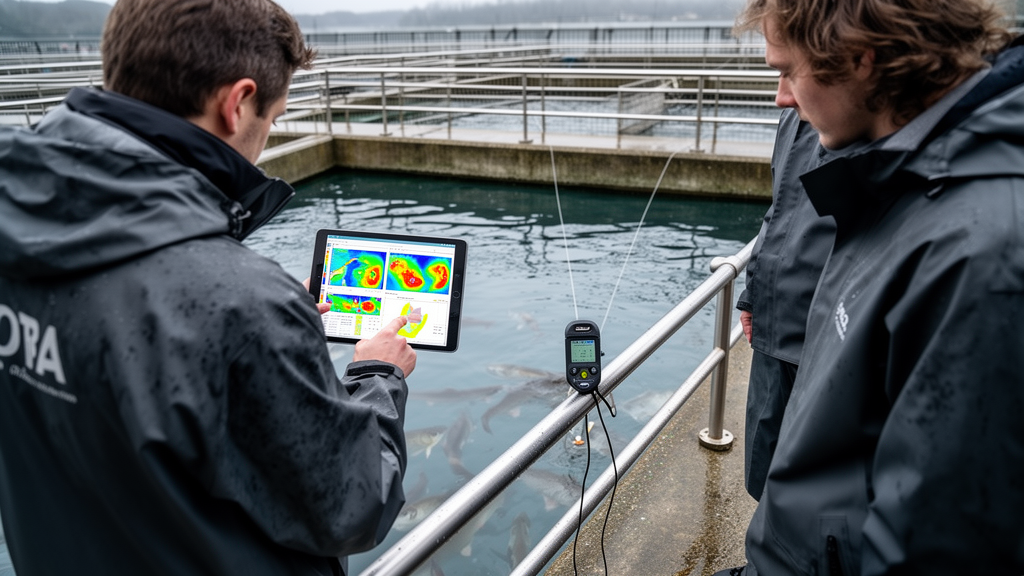
A machine-learning system used by the Texas Marine Coldwater Response Collaborative helped decision-makers anticipate cold-stunning risks along the southern Texas coast, but an interview study found that its value depended on how well its forecasts fit changing operational decisions. Fifteen collaborative members evaluated archived water- and air-temperature forecasts during a simulated event based on December 2022 conditions. The research did not test whether the model prevented ecological or economic harm; instead, it examined how natural-resource managers, coastal economic operators and weather forecasters interpreted uncertainty, formed expectations about the model and used its predictions as conditions evolved.
The operational tool combined a neural-network-based model for predicting water temperature with supplemental air-temperature forecasts. The water-temperature model was initialized in 2007 and operationalized in 2010. The simulation also included deterministic National Weather Service air-temperature guidance and a 100-member probabilistic air-temperature ensemble displayed as 10th-to-90th-percentile fan plots. Participants reviewed predictions presented seven days before the simulated event, four days before, one day before and one day after its onset. They thought aloud while assessing the likelihood of water temperatures crossing 8°C, the threshold associated with severe hypothermic stunning in green sea turtles, and 4.5°C, a secondary threshold relevant to fish-kill assessment. Their numerical likelihood ratings supported the qualitative interview exercise and were not analyzed as quantitative outcomes.
Seven days before onset, natural-resource managers and coastal economic operators concentrated on the deterministic water-temperature predictions because cold-stunning decisions concern the temperature experienced by wildlife in the water. The five-day water forecast had not yet crossed the relevant turtle threshold, so these participants generally judged the immediate risk to be low. Weather forecasters took a broader view, using the longer-range probabilistic air-temperature forecast to judge whether a future cold-stunning event was plausible and to expand their situational awareness. One forecaster said the ensemble’s lower percentiles were far below the thresholds, while another noted that the 10-day ensemble extended beyond the National Weather Service forecast. Some users also questioned what a week-long air forecast could reveal, reflecting their concern about wider uncertainty at longer lead times.
Four days before the simulated onset, the forecasts began showing threshold exceedance and more agreement among systems. Participants’ questions shifted from whether an event might occur to when it would begin, how long it could last and how cold conditions might become. Natural-resource managers and coastal economic operators continued to use deterministic water-temperature trends as the main basis for action, but they also examined probabilistic air temperatures for possible best- and worst-case outcomes. Although the water-temperature system did not provide uncertainty estimates, participants recognized uncertainty in its deterministic output. Familiarity with the tool and with the model developers helped them decide which decisions could be made while waiting for greater confidence, such as positioning resources locally without committing to more extensive travel.
Trust was generally high at this stage, but it was not identical across participants. Natural-resource managers and coastal economic operators connected trust to the model’s performance during previous events, its agreement with observations and familiar patterns of cold-stunning development. Forecasters were more deliberative, comparing the water-temperature prediction with National Weather Service guidance, the probabilistic ensemble and their meteorological expertise. Agreement among those sources strengthened confidence; unexplained discrepancies prompted scrutiny. Limited familiarity with the commercial probabilistic air-temperature system also produced hesitation. One forecaster requested a probabilistic ensemble of water temperatures, which participants regarded as more relevant than air-temperature uncertainty because it would directly represent variability in the variable used to trigger response.
One day before onset, every participant interpreted the information as warning of an imminent threat. The water-temperature forecast indicated the projected beginning and end of a turtle cold-stunning event, while narrower air-temperature uncertainty ranges suggested a short-lived event of roughly 24 to 48 hours. Participants began activating turtle response, coordinating searches and rescue, assessing possible fisheries closures and discussing pauses in coastal activity. Uncertainty about the minimum temperature did not prevent action, but it influenced its scale: the information was sufficient to activate wildlife response and increase monitoring, yet not necessarily to impose the more consequential fisheries closure. Forecasters who noticed a sharp observed air-temperature decline not fully captured by either air-temperature forecast suspected a warm bias and considered the water-temperature forecast potentially too warm as well.
Once the event was underway, observed air and water temperatures fell below both decision-relevant thresholds, making conditions more severe than most participants had anticipated. Some natural-resource managers and coastal economic operators treated the cold miss as consistent with uncertainty they had already recognized, noting that the forecasts had correctly warned of a threshold crossing and provided useful advance notice. Their attention turned to how long search, rescue and operational suspensions should continue. Most extended their estimate of the event’s end by about 12 to 36 hours. This involved a cross-domain balancing act: natural-resource managers weighed continued exposure of wildlife and responders against disruption to barge operators and supply chains, while coastal economic operators considered the delayed recovery of stunned turtles and the financial cost of prolonged inactivity.
Trust in the predictive information remained high across all domains once the event was underway, although the basis for that trust differed among users. Natural-resource managers and coastal economic operators generally maintained their earlier confidence in the broader system, while several forecasters reported greater trust than before as the air-temperature uncertainty range narrowed and the probabilistic and National Weather Service forecasts agreed more closely. The colder observed conditions did not produce an abrupt rejection of the tool. Instead, participants continued to compare observations with predictions, revise estimates of the event’s duration and consider how the guidance should inform recovery operations. Some remained cautious about longer-range features, including a second decline in the air-temperature forecast, and requested an explanation from technical experts before relying on those features for decisions about when to end responses or resume coastal activity.
The findings indicate that a technically accurate forecast may still be difficult to use if it does not align with users’ responsibilities, timelines or information needs. The study’s small purposive sample consisted of established users drawn from roughly 150 active collaborative members, and the proportions across the three operational domains roughly reflected membership, so the results should not be generalized to people outside the collaborative or to unfamiliar users. Nevertheless, the interviews show that trust in this machine-learning tool was conditional and developed through repeated use, observation of past performance, relationships with the modeling team and comparison with other forecasts. The authors recommend continued stakeholder engagement throughout development, evaluation and operation, including probabilistic forecasts tied directly to water temperature and sustained communication between model developers and decision-makers. Their evidence supports iterative, user-centered design, not a claim that any single added feature will automatically produce trust or improve environmental outcomes.
Subject of Research: Qualitative study of how Texas cold-stunning decision-makers interpret and trust machine-learning temperature forecasts
Article Title: How decision-makers trust and use machine learning predictions for managing cold-stunning risks
Article References: White, M. C., Wirz, C. D., Cains, M. G., Flores, E. R., Demuth, J. L., & Tissot, P. E. (2026). How decision-makers trust and use machine learning predictions for managing cold-stunning risks. Frontiers in Communication, 11, Article 1816041. https://doi.org/10.3389/fcomm.2026.1816041
Image Credits: AI Generated
DOI: 10.3389/fcomm.2026.1816041
Keywords: machine learning, cold-stunning risk, Texas coast, forecast trust, decision-making, water temperature, uncertainty, risk communication, collaborative management, sea turtles, weather forecasting, qualitative interviews
Cite Scienmag News
Blake Davidson. (October 21, 2026). How decision-makers trust and use machine learning predictions for managing cold-stunning risks. Scienmag. https://scienmag.com/how-decision-makers-trust-and-use-machine-learning-predictions-for-managing-cold-stunning-risks/
Blake Davidson. "How decision-makers trust and use machine learning predictions for managing cold-stunning risks." Scienmag, 21 October 2026, https://scienmag.com/how-decision-makers-trust-and-use-machine-learning-predictions-for-managing-cold-stunning-risks/. Accessed 21 October 2026.
Blake Davidson. "How decision-makers trust and use machine learning predictions for managing cold-stunning risks." Scienmag. October 21, 2026. https://scienmag.com/how-decision-makers-trust-and-use-machine-learning-predictions-for-managing-cold-stunning-risks/


