

Wednesday, October 21, 2026
Science
No Result
View All Result
  • Login
  • HOME
  • SCIENCE NEWS
  • CONTACT US
  • HOME
  • SCIENCE NEWS
  • CONTACT US
No Result
View All Result
Scienmag
No Result
View All Result
Home Science News

One-year field study measures golden grey mullet reproduction and growth in Tunisia’s Bizerte Lagoon

October 21, 2026
in Science News
Beatrice Stafford
By Beatrice Stafford Scienmag Editorial Profile - Chronobiology
Reading Time: 3 mins read
0
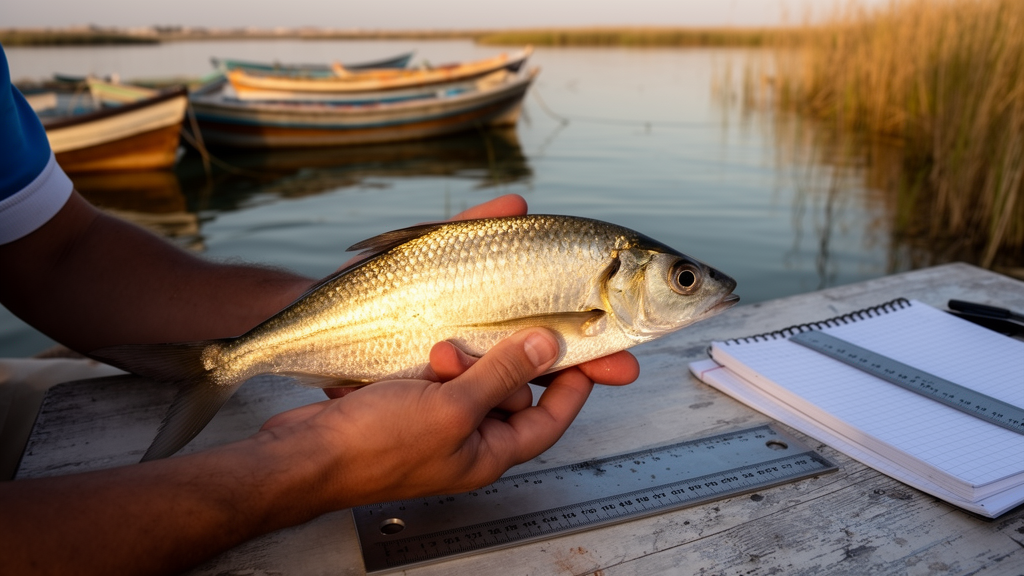
Reproductive and growth parameters of Chelon auratus (Actinopterygii, Mugiliformes, Mugilidae) in Bizerte Lagoon, Tunisia

Reproductive and growth parameters of Chelon auratus (Actinopterygii, Mugiliformes, Mugilidae) in Bizerte Lagoon, Tunisia

65
SHARES
587
VIEWS
Share on FacebookShare on Twitter
ADVERTISEMENT

A one-year field study of golden grey mullet, Chelon auratus, in Tunisia’s Bizerte Lagoon found an October–December reproductive period, slightly larger female maturity size, negative allometric growth and an observed age range of one to six years. The study characterized the lagoon population but did not establish long-term population trends.

Researchers collected 576 fish monthly from January through December 2022 at Menzel Abderrahmane harbor using a trammel net with 26–60 mm diamond mesh. They measured total length, total and eviscerated body weight, and gonad and liver weights, classified gonadal maturity, assessed sex ratio and condition, and examined scales from all 576 specimens for age estimation.

The sample comprised 290 females and 286 males, corresponding to approximately 1.01 females per male and an approximately balanced overall sex ratio. A chi-square test found no significant difference between the sexes (χ² = 1.25, degrees of freedom = 1, P > 0.05). Females predominated in January, April and November and among fish longer than 26 cm, except in the 32- and 33-cm length classes.

Logistic estimates placed total length at 50% maturity at 23.46 ± 0.2 cm for females and 22.5 ± 0.18 cm for males. Both sexes reached sexual maturity during their second year of life. Gonads began developing after August, and the gonadosomatic index peaked in October at 9.5 ± 0.7 for females and 5.64 ± 0.58 for males before declining in December, supporting a reproductive period from October through December.

Fecundity was measured in 45 ripe females caught in September, October and November. Absolute fecundity ranged from 115,000 to 500,000 oocytes, with a mean of 256,867 ± 98,134 oocytes and a 95% confidence interval of 220,000–293,700. Relative fecundity averaged 1,233 ± 143 eggs per gram of body weight, with a 95% confidence interval of 1,150–1,316 eggs per gram.

Length–weight relationships indicated negative allometric growth. The exponents were 2.6071 for females, 2.707 for males and 2.6875 for both sexes combined, each significantly below 3. Scale analysis suggested one growth ring per year, with the highest mean marginal increment in October. Fish sampled spanned one to six years, and most belonged to the three- and four-year classes; the maximum observed age was six years.

Observed and back-calculated growth curves were similar. For combined sexes, a von Bertalanffy model fitted to observed length-at-age data estimated asymptotic total length of 44.25 cm and a growth coefficient of 0.179 per year. Growth performance was similar between females and males, with indices of 2.55 and 2.53 cm per year, respectively, and the growth rate did not differ significantly between the sexes. Model-based theoretical longevity was estimated at 15.23 years for females and 14.89 years for males, rather than the six-year maximum observed in the sample.

The research was limited to one lagoon and one annual sampling period, so its observations and model estimates provide a local baseline rather than evidence of temporal change. The authors stated that broader spatial and temporal monitoring, combined with environmental and genetic data, would be needed for a more comprehensive assessment.

Subject of Research: Reproductive biology, age structure and growth of golden grey mullet in Bizerte Lagoon

Article Title: Reproductive and growth parameters of Chelon auratus ( Actinopterygii , Mugiliformes , Mugilidae ) in Bizerte Lagoon, Tunisia

Article References: Hajlaoui, W., Mili, S., Ennouri, R., Sessi, H., Mahmoudi, E., Hedfi, A., Ben Ali, M., & Missaoui, H. (2026). Reproductive and growth parameters of Chelon auratus (Actinopterygii, Mugiliformes, Mugilidae) in Bizerte Lagoon, Tunisia. Acta Ichthyologica et Piscatoria, 56, 63-75. https://doi.org/10.3897/aiep.56.175000

Image Credits: AI Generated

DOI: 10.3897/aiep.56.175000

Keywords: golden grey mullet, Chelon auratus, Bizerte Lagoon, fish reproduction, fish growth, maturity size, fecundity, age estimation, Tunisia, fisheries biology, Reproductive, growth

Cite Scienmag News

Beatrice Stafford. (October 21, 2026). One-year field study measures golden grey mullet reproduction and growth in Tunisia’s Bizerte Lagoon. Scienmag. https://scienmag.com/one-year-field-study-measures-golden-grey-mullet-reproduction-and-growth-in-tunisias-bizerte-lagoon/


Beatrice Stafford. "One-year field study measures golden grey mullet reproduction and growth in Tunisia’s Bizerte Lagoon." Scienmag, 21 October 2026, https://scienmag.com/one-year-field-study-measures-golden-grey-mullet-reproduction-and-growth-in-tunisias-bizerte-lagoon/. Accessed 21 October 2026.

Beatrice Stafford. "One-year field study measures golden grey mullet reproduction and growth in Tunisia’s Bizerte Lagoon." Scienmag. October 21, 2026. https://scienmag.com/one-year-field-study-measures-golden-grey-mullet-reproduction-and-growth-in-tunisias-bizerte-lagoon/

Tags: age estimationBizerte LagoonBizerte Lagoon fish populationChelon auratusChelon auratus growth in Tunisiafecundityfish age estimation using scalesfish growthfish growth patterns negative allometryfish population dynamics Tunisiafish reproductionfish reproductive period in North Africafish sex ratio analysis in lagoonfish sexual maturity sizefisheries biologygolden grey mulletgolden grey mullet reproduction studygrowthlength at maturity in grey mulletmaturity sizeone-year field fish study in Bizerte LagoonReproductiveseasonal fish reproductive cycleTunisia
Share26Tweet16
Previous Post

Phylogenetic analysis links Xylopia’s pantropical spread to dispersal and habitat shifts

Next Post

Taxonomic study identifies two new capitellid species from southern China

Related Posts

New Crab Spider Species Discovered on Extinct Volcano in Georgia
Science News

A new Psammitis species (Araneae, Thomisidae) from an extinct volcano in Georgia with reevaluation of the generic position of Xysticus marmoratus Thorell, 1875

October 21, 2026
Two New Species of Mud-Dwelling Marine Worms Discovered on China’s Southern Coast
Biology

Taxonomic study identifies two new capitellid species from southern China

October 21, 2026
Birds, islands and dry forests: how a tropical tree genus conquered the world’s Tropics
Earth Science

Phylogenetic analysis links Xylopia’s pantropical spread to dispersal and habitat shifts

October 21, 2026
One Map to Rule Europe’s Ecosystems: New Typology Blueprint
Science News

European survey finds varied ecosystem typologies support condition assessment but limit comparability

October 21, 2026
Heathers of the Cape: New Analysis Reveals Hundreds of Erica Species Face Extinction
Science News

Conservation gap analysis identifies gaps in protecting threatened Erica species

October 21, 2026
Research report: Engineering bench characterization and reciprocal cross-sensitivity of a sensor-integrated seated measurement platform
Technology and Engineering

Research report: Engineering bench characterization and reciprocal cross-sensitivity of a sensor-integrated seated measurement platform

October 21, 2026
Next Post
Two New Species of Mud-Dwelling Marine Worms Discovered on China’s Southern Coast

Taxonomic study identifies two new capitellid species from southern China

  • Mothers who receive childcare support from maternal grandparents show more optimized

    Mothers who receive childcare support from maternal grandparents show more parental warmth, finds NTU Singapore study

    27656 shares
    Share 11059 Tweet 6912
  • University of Seville Breaks 120-Year-Old Mystery, Revises a Key Einstein Concept

    1061 shares
    Share 424 Tweet 265
  • Bee body mass, pathogens and local climate influence heat tolerance

    682 shares
    Share 273 Tweet 171
  • Researchers record first-ever images and data of a shark experiencing a boat strike

    546 shares
    Share 218 Tweet 137
  • Groundbreaking Clinical Trial Reveals Lubiprostone Enhances Kidney Function

    531 shares
    Share 212 Tweet 133
Science

Embark on a thrilling journey of discovery with Scienmag.com—your ultimate source for cutting-edge breakthroughs. Immerse yourself in a world where curiosity knows no limits and tomorrow’s possibilities become today’s reality!

RECENT NEWS

  • A new Psammitis species (Araneae, Thomisidae) from an extinct volcano in Georgia with reevaluation of the generic position of Xysticus marmoratus Thorell, 1875
  • Taxonomic study identifies two new capitellid species from southern China
  • One-year field study measures golden grey mullet reproduction and growth in Tunisia’s Bizerte Lagoon
  • Phylogenetic analysis links Xylopia’s pantropical spread to dispersal and habitat shifts

Categories

  • Agriculture
  • Anthropology
  • Archaeology
  • Athmospheric
  • Biology
  • Biotechnology
  • Blog
  • Bussines
  • Cancer
  • Chemistry
  • Climate
  • Earth Science
  • Editorial Policy
  • Marine
  • Mathematics
  • Medicine
  • Pediatry
  • Policy
  • Psychology & Psychiatry
  • Science Education
  • Science News
  • Social Science
  • Space
  • Technology and Engineering

Subscribe to Blog via Email

Enter your email address to subscribe to this blog and receive notifications of new posts by email.

Join 5,150 other subscribers

© 2025 Scienmag - Science Magazine

Welcome Back!

Login to your account below

Forgotten Password?

Retrieve your password

Please enter your username or email address to reset your password.

Log In
No Result
View All Result
  • HOME
  • SCIENCE NEWS
  • CONTACT US

© 2025 Scienmag - Science Magazine

Discover more from Science

Subscribe now to keep reading and get access to the full archive.

Continue reading