


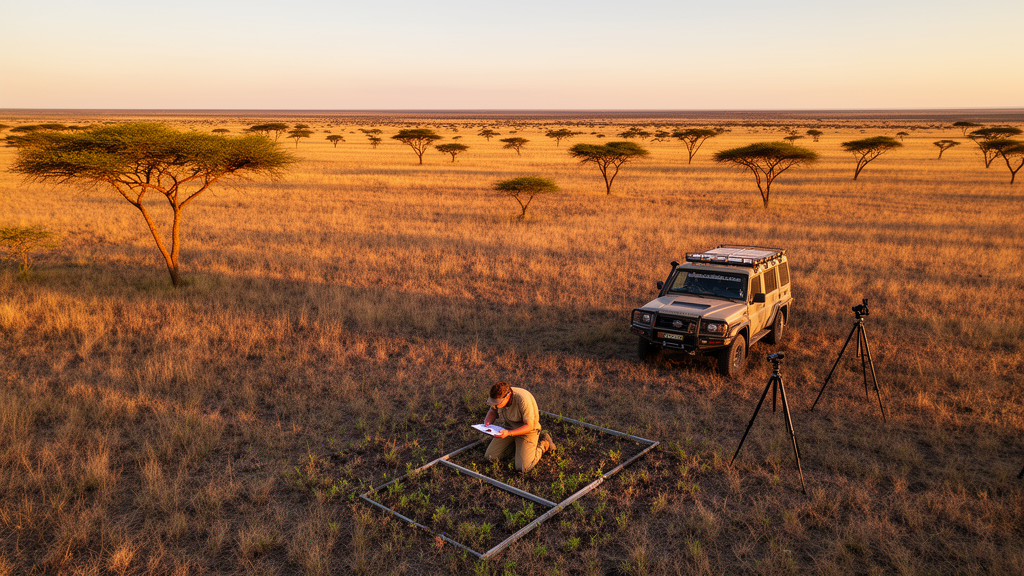
An editorial review of seven studies in a Special Collection on African vegetation finds that continental classifications remain coarse, comprehensive fine-scale surveys are uncommon and international databases contain relatively few vegetation plots from Africa.
The collection, launched in 2021 by Vegetation Classification and Survey and the African Section of the International Association for Vegetation Science, contains studies from Morocco, Benin, South Africa and Namibia. It therefore covers three of Africa’s major regions rather than the entire continent.
At the continental scale, available classifications are broad physiognomic systems. White’s 1983 classification recognized 16 natural vegetation types, while a remote-sensing-based system by Mayaux and colleagues in 2003 grouped vegetation into five main types. The review reports that comprehensive fine-scale overviews exist for relatively few countries or territories, including Morocco and South Africa, Lesotho and Eswatini, while many other studies address local areas or selected vegetation types.
African flora and vegetation data are less available and accessible than in Europe and the Americas, according to the review. It identifies data availability, language barriers, limited research funding and political instability as obstacles. African Union member states committed in 2006 to spend 1% of gross domestic product on research and development, but the continent’s funding reached 0.42% in 2019, compared with a global average of 1.7%.
Vegetation-plot records are particularly sparse in international databases. The review cites the working version of sPlot 4.0, which contains 45,202 plots from African countries out of 2,531,784 worldwide, or 1.8%, although Africa covers 22.5% of Earth’s ice-free surface. Thirty regional databases contributed data from 38 African countries, but some countries had no plots in sPlot. Namibia and Morocco had relatively good coverage, while South Africa’s National Vegetation Database contained more than 46,000 plot-based records but had not joined sPlot.
Two studies examined environmental gradients. In Namibia, Naftal and colleagues classified vegetation from 1,986 relevés into 12 units and used a Random Forest model to project distributions under 2080 climatic conditions. The model achieved 82% prediction accuracy and projected greater dominance of broad-leaved and degraded thornbush savannas, while mountain, dwarf-shrub and dry thornbush savanna units would decrease in area or disappear. These are model projections rather than observed changes.
In South Africa’s Tankwa Karoo National Park, Samuels and colleagues compared three vegetation types across elevations from 338 to 1,147 metres above sea level. Species composition and environmental variables distinguished the habitats, while slope and rockiness were associated with variation within vegetation types. In Benin’s Pendjari Biosphere Reserve, Assèdé and colleagues analysed 202 Braun-Blanquet relevés, identifying 249 species in 11 associations associated with a dryland-to-wetland moisture gradient.
The other studies examined traditional agroecosystems in Morocco, land-cover change on Beninese inselbergs and Karstveld vegetation in Namibia. Chakkour and colleagues recorded 209 species in 94 relevés across six Moroccan study areas. Ayeko and colleagues used Sentinel-2 and Spot-5 imagery at 10-metre resolution to assess land cover from 2003 to 2018, finding expansion of savanna, grassland, fields, fallow land and plantations alongside conversion of natural vegetation. Strohbach and Strohbach classified Namibian Karstveld from 889 relevés into four major types and formally described 17 new associations.
The authors recommend stronger cross-country collaboration, expanded plot sampling, improved databases, training and development of an African Vegetation Archive. They cite Europe’s long-term Vegetation Survey as an example of cooperation, while emphasizing that Africa’s scale, resource constraints and existing regional initiatives require a tailored approach. The review itself is explicitly incomplete and regionally biased, so the collection does not constitute a comprehensive assessment of African vegetation.
Subject of Research: Continental gaps and regional advances in African vegetation classification
Article Title: African vegetation studies: introduction to a Special Collection
Article References: Guuroh, R. T., Brown, L. R., Alvarez, M., Finckh, M., Schmiedel, U., Tsheboeng, G., & Dengler, J. (2024). African vegetation studies: introduction to a Special Collection. Vegetation Classification and Survey, 5, 279-288. https://doi.org/10.3897/vcs.143360
Image Credits: AI Generated
DOI: 10.3897/VCS.143360
Keywords: African vegetation, vegetation classification, vegetation plots, sPlot database, remote sensing, phytosociology, Namibia, South Africa, Benin, Morocco, African, vegetation
Cite Scienmag News
Gavin Prescott. (October 21, 2026). Review of seven studies finds African vegetation classifications remain uneven. Scienmag. https://scienmag.com/review-of-seven-studies-finds-african-vegetation-classifications-remain-uneven/
Gavin Prescott. "Review of seven studies finds African vegetation classifications remain uneven." Scienmag, 21 October 2026, https://scienmag.com/review-of-seven-studies-finds-african-vegetation-classifications-remain-uneven/. Accessed 21 October 2026.
Gavin Prescott. "Review of seven studies finds African vegetation classifications remain uneven." Scienmag. October 21, 2026. https://scienmag.com/review-of-seven-studies-finds-african-vegetation-classifications-remain-uneven/


