


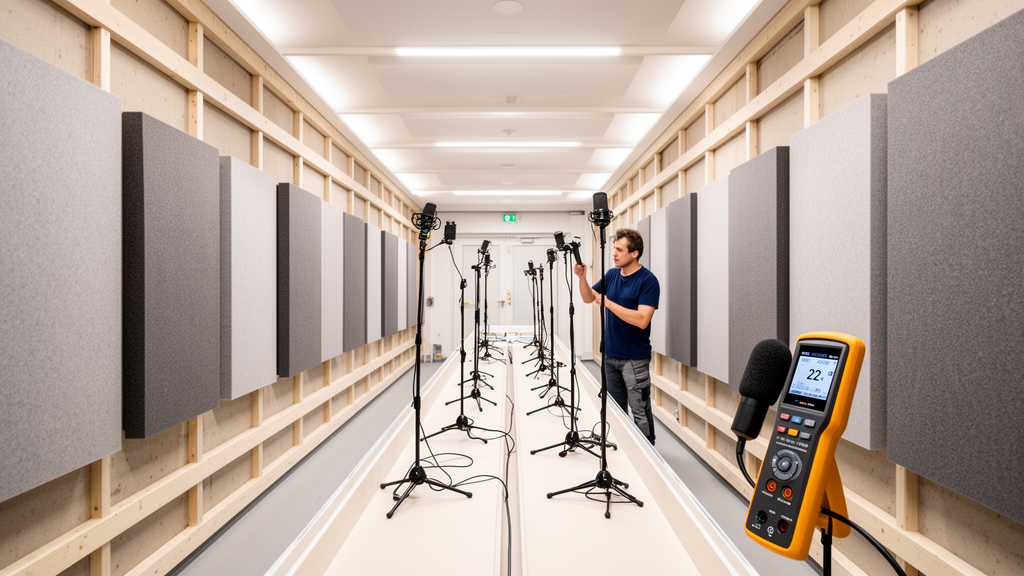
A controlled pilot physical-model experiment found that adding a protected acoustic retrofit lowered the mean indicated A-weighted sound level by 22.0 decibels in a laboratory model intended to represent the acoustic demands of Mina, Saudi Arabia, and comparable high-density pilgrimage corridors. Five paired observations produced a mean of 76.0 dBA in the unmodified configuration, designated C0, and 54.0 dBA after the retrofit, designated C1. The experiment took place on a retained pilot model in the Engineering Laboratories of the University rather than in the full-scale pilgrimage environment. The authors say the result should be interpreted as a controlled within-model comparison, not as standardized insertion loss, certified sound absorption or a performance estimate for Mina.
The study is presented as a Methods article describing an evidence-bounded procedure for developing and evaluating the retrofit. Its workflow integrates historical acoustic benchmarking, configuration-qualified material screening, architectural deployment modeling, a pilot physical corridor model, a controlled follow-up campaign and a staged validation framework. The authors identify the target environment as one combining large transient populations, public-address communication, mechanical services, transport interfaces and hard reflective construction surfaces. For the reported measurement campaign, the same model was tested before and after modification under a fixed arrangement, allowing the researchers to compare C0 and C1 while retaining the source position, receiver position, input signal and observation duration.
During each record, the source and receiver were fixed at S = (4.00, 10.50, 7.85) cm and R = (37.50, 10.50, 7.85) cm, respectively. Continuous broadband pink noise was used at a source setting of 70%, and a Meterk MK09 handheld A-weighted screening meter collected each reading over a 30-second observation interval. Pre- and post-series indication-verification checks produced readings of 94.0 and 94.1 dB. Three source-off background observations ranged from 43.2 to 43.4 dBA. Temperature remained between 24.0 and 24.2 °C, while relative humidity ranged from 42.8% to 43.2%. The minimum C1-to-background margin was 10.2 dB, and the researchers therefore applied no numerical background correction.
Across the five paired observations, C0 yielded a mean indicated level of 76.0 dBA with a standard deviation of 0.245 dB, while C1 yielded 54.0 dBA with a standard deviation of 0.255 dB. The mean paired difference was 22.0 dB, with a standard deviation of 0.274 dB and a standard error of 0.122 dB. An exploratory two-sided 95% Student’s t interval for the paired difference was 21.660–22.340 dB. These statistics describe the tested model, paired observations and screening procedure; they do not quantify the uncertainty expected from a full-scale installation or from future field trials. The MK09 also was not claimed to meet IEC 61672-1 Class 1 or Class 2 conformity, so the measurements are not presented as certified acoustic performance.
The work’s clearest demonstrated finding is therefore limited but measurable: under the specified laboratory conditions, the protected C1 configuration registered a 22.0 dB mean decrease in indicated A-weighted sound level relative to C0 in the retained pilot corridor model. The broader validation framework is intended to support further evaluation of the culturally inspired retrofit in other relevant conditions, but the supplied results do not establish how a full-scale system would perform. No conclusion about acoustic conditions across Mina’s pilgrimage routes, compliance with a formal field-measurement standard, or health-related outcomes can be drawn from this pilot comparison. At the time of the source article, the final formatted version was described as forthcoming in Frontiers in Built Environment, in its section on Sustainable Design and Construction.
Subject of Research: Pilot evaluation of an acoustic retrofit for high-density pilgrimage corridors
Article Title: Culturally inspired acoustic retrofit for high-density pilgrimage corridors: a pilot physical model study and reproducibility-oriented validation protocol
Article References: Laissy, M. Y., Rashed, H. F., Helal, K., & Alfadil, O. A. (2026). Culturally Inspired Acoustic Retrofit for High-Density Pilgrimage Corridors: A Pilot Physical-Model Study and Reproducibility-Oriented Validation Protocol. Frontiers in Built Environment, 12, 1959288. https://doi.org/10.3389/fbuil.2026.1959288
Image Credits: AI Generated
DOI: 10.3389/fbuil.2026.1959288
Keywords: acoustic retrofit, Mina, Hajj, pilgrimage corridors, sound levels, physical model, noise control, cultural heritage, acoustic validation, Culturally, inspired, acoustic
Cite Scienmag News
Violet Maxwell. (October 21, 2026). Pilot model shows 22 dB acoustic reduction after corridor retrofit. Scienmag. https://scienmag.com/pilot-model-shows-22-db-acoustic-reduction-after-corridor-retrofit/
Violet Maxwell. "Pilot model shows 22 dB acoustic reduction after corridor retrofit." Scienmag, 21 October 2026, https://scienmag.com/pilot-model-shows-22-db-acoustic-reduction-after-corridor-retrofit/. Accessed 21 October 2026.
Violet Maxwell. "Pilot model shows 22 dB acoustic reduction after corridor retrofit." Scienmag. October 21, 2026. https://scienmag.com/pilot-model-shows-22-db-acoustic-reduction-after-corridor-retrofit/


