

Wednesday, October 21, 2026
Science
No Result
View All Result
  • Login
  • HOME
  • SCIENCE NEWS
  • CONTACT US
  • HOME
  • SCIENCE NEWS
  • CONTACT US
No Result
View All Result
Scienmag
No Result
View All Result
Home Science News Biology

Captive grasshoppers show cross-subfamily male-male mating attempt

October 21, 2026
in Biology, Science News
Gavin Prescott
By Gavin Prescott Scienmag Editorial Profile - Ecology and Ecosystem Dynamics
Reading Time: 3 mins read
0
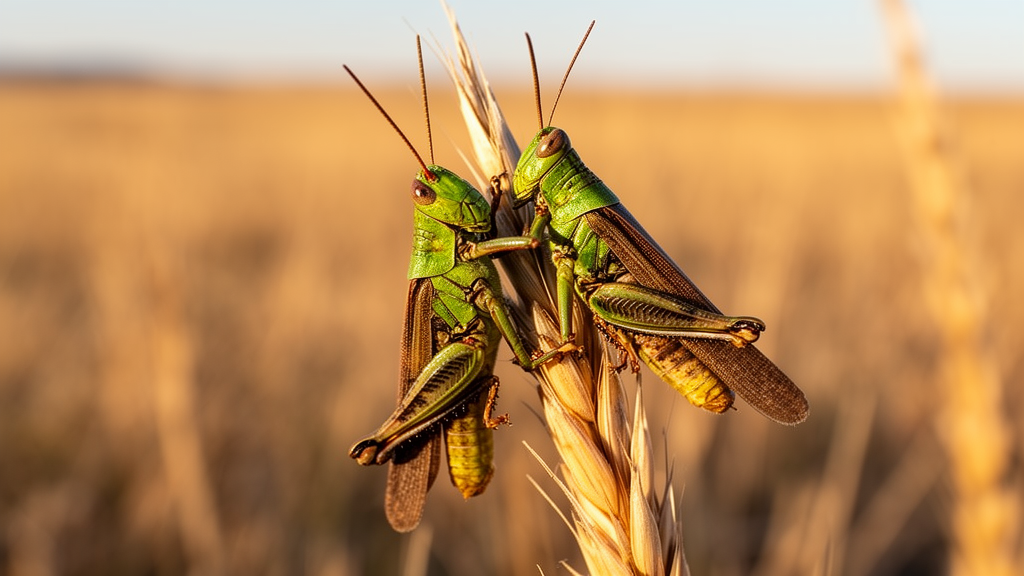
Grasshopper Males of Different Subfamilies Caught in Same-Sex Mating Attempt in Kazakhstan

Grasshopper Males of Different Subfamilies Caught in Same-Sex Mating Attempt in Kazakhstan

65
SHARES
587
VIEWS
Share on FacebookShare on Twitter
ADVERTISEMENT

A chance observation during a field collection in Kazakhstan documented a male Dociostaurus kraussi mounting a male Oedaleus decorus and connecting its cerci to the other male’s external genitalia. The two species belong to different subfamilies, making the captive observation a record of cross-subfamily male-male mating behavior in acridid grasshoppers.

The researchers captured Orthoptera on the morning of June 26, 2023, at a semi-desert locality in the northern foothills of the Dzungarian Alatau Mountains near Lake Alaqol, about 10 km south of Koktuma in Kazakhstan’s Jetisu Region. The site was at 45.7957°N, 81.6379°E and approximately 655 m above sea level. They transported about five to six live insects per container in seven containers for processing at camp.

One container held a male D. kraussi from Gomphocerinae, identified by field number SOH_1561, together with a male O. decorus from Oedipodinae, identified as SOH_1560. During an afternoon inspection, the D. kraussi male was found mounted on the O. decorus male, with its cerci connected to the mounted male’s genitalia. The position persisted into the evening.

Neither insect released its hold when the container was removed or when the pair was immersed in 80% ethanol for preservation. The researchers detected no resistance behavior from the mounted O. decorus male. They subsequently pinned and dried the specimens and produced a three-dimensional scan with a Disc3D insect scanner at the Leibniz Institute for the Analysis of Biodiversity Change in Hamburg.

The scan confirmed that the D. kraussi male’s cerci were connected to the O. decorus male’s external genitalia. It did not establish whether genital insertion occurred or whether sperm was transferred. The preserved specimens are held at the University of Zurich in Switzerland.

This was a chance observation under captivity rather than a controlled behavioral experiment. The researchers considered erroneous mate recognition to be the most likely explanation. Chemical mating barriers in most grasshopper species should make such an attempt extremely rare under natural conditions, while captivity and possible stress may have inhibited signals normally used to recognize mates.

Body-size similarity may also have contributed. Male O. decorus measure 18–31 mm, while female D. kraussi measure 19.3–31.5 mm. The observation cannot establish why the mounting occurred. D. kraussi is known to produce very simple calling songs and is described as having a wandering mating strategy, with both sexes moving around their territories; females are not known to answer the males’ calls. For O. decorus, no courtship behavior or acoustic communication had been demonstrated.

The authors also discussed reproductive interference as a possible, but unproven, alternative function. They noted that interspecific same-sex mating might interfere with a competing species’ reproduction, while the initiating male would bear the cost of being unable to pursue another reproductive opportunity at the same time. They suggested such behavior might be advantageous if the male had depleted its sperm or if few conspecific females were available, but the single observation does not test this hypothesis.

Because the event was observed only in captivity, the case cannot establish its natural frequency, adaptive significance, or whether copulation and sperm transfer occurred. The mounting and sustained genital contact may indicate that similar events can occur in nature, but no such event was directly observed in a natural setting.

Subject of Research: A single captive observation of cross-subfamily male-male mating behavior in two acridid grasshopper species.

Article Title: Observation of a cross-subfamily male-male mating attempt of grasshoppers in Kazakhstan ( Orthoptera , Acrididae )

Article References: Hawlitschek, O., Sevastianov, N., Pamin, J.-H., & Husemann, M. (2025). Observation of a cross-subfamily male-male mating attempt of grasshoppers in Kazakhstan (Orthoptera, Acrididae). Alpine Entomology, 9, 1-3. https://doi.org/10.3897/alpento.9.151006

Image Credits: AI Generated

DOI: 10.3897/alpento.9.151006

Keywords: grasshoppers, male-male behavior, mating attempt, Dociostaurus kraussi, Oedaleus decorus, Orthoptera, Acrididae, mate recognition, captive observation, Kazakhstan, Observation, cross-subfamily

Cite Scienmag News

Gavin Prescott. (October 21, 2026). Captive grasshoppers show cross-subfamily male-male mating attempt. Scienmag. https://scienmag.com/captive-grasshoppers-show-cross-subfamily-male-male-mating-attempt/

Gavin Prescott. "Captive grasshoppers show cross-subfamily male-male mating attempt." Scienmag, 21 October 2026, https://scienmag.com/captive-grasshoppers-show-cross-subfamily-male-male-mating-attempt/. Accessed 21 October 2026.

Gavin Prescott. "Captive grasshoppers show cross-subfamily male-male mating attempt." Scienmag. October 21, 2026. https://scienmag.com/captive-grasshoppers-show-cross-subfamily-male-male-mating-attempt/


Tags: Acrididaecaptive observationcaptive observation of orthopteran reproductive behaviorcross-species sexual interactions in insectscross-subfamilyCross-subfamily male-male mating behavior in grasshoppersDociostaurus kraussiDociostaurus kraussi and Oedaleus decorus matingfield study of Orthoptera in Dzungarian Alataugrasshopper mating attempt in semi-desert Kazakhstangrasshoppersinsect behavior observation during captivityinsect reproductive behavior in different subfamiliesKazakhstanmale-male behaviormale-male mounting behavior in Acrididaemate recognitionmating attemptobservationOedaleus decorusOrthopteraunusual mating behaviors in grasshoppers
Share26Tweet16
Previous Post

Controlled study finds heat and drought reduce germination in two restricted-range Mexican poplars

Next Post

Curated multi-marker analysis resolves fungal phylogeny and ecological patterns in two ophiostomatoid orders

Related Posts

Mixed-Methods Study Finds Two Markets in Turkish English-Medium Medical Education
Science Education

Mixed-Methods Study Finds Two Markets in Turkish English-Medium Medical Education

October 21, 2026
Young Erbil residents describe emotion suppression shaped by digital and cultural pressures
Psychology & Psychiatry

Young Erbil residents describe emotion suppression shaped by digital and cultural pressures

October 21, 2026
Fungal Family Tree Rebuilt From Thousands of Beetle Symbiont Sequences
Biology

Curated multi-marker analysis resolves fungal phylogeny and ecological patterns in two ophiostomatoid orders

October 21, 2026
Heat and Drought Threaten Germination of Two Endangered Mexican Poplars
Biology

Controlled study finds heat and drought reduce germination in two restricted-range Mexican poplars

October 21, 2026
AI and flexible investment model lifts simulated wastewater biorefinery value
Earth Science

AI and flexible investment model lifts simulated wastewater biorefinery value

October 21, 2026
Male Crickets Prefer Females Who Offer No Fertility Advantage
Science News

Field study finds no fertility or sire-count advantage for male-like chemical profiles in two field cricket species

October 21, 2026
Next Post
Fungal Family Tree Rebuilt From Thousands of Beetle Symbiont Sequences

Curated multi-marker analysis resolves fungal phylogeny and ecological patterns in two ophiostomatoid orders

  • Mothers who receive childcare support from maternal grandparents show more optimized

    Mothers who receive childcare support from maternal grandparents show more parental warmth, finds NTU Singapore study

    27656 shares
    Share 11059 Tweet 6912
  • University of Seville Breaks 120-Year-Old Mystery, Revises a Key Einstein Concept

    1061 shares
    Share 424 Tweet 265
  • Bee body mass, pathogens and local climate influence heat tolerance

    682 shares
    Share 273 Tweet 171
  • Researchers record first-ever images and data of a shark experiencing a boat strike

    546 shares
    Share 218 Tweet 137
  • Groundbreaking Clinical Trial Reveals Lubiprostone Enhances Kidney Function

    531 shares
    Share 212 Tweet 133
Science

Embark on a thrilling journey of discovery with Scienmag.com—your ultimate source for cutting-edge breakthroughs. Immerse yourself in a world where curiosity knows no limits and tomorrow’s possibilities become today’s reality!

RECENT NEWS

  • Mixed-Methods Study Finds Two Markets in Turkish English-Medium Medical Education
  • Young Erbil residents describe emotion suppression shaped by digital and cultural pressures
  • Curated multi-marker analysis resolves fungal phylogeny and ecological patterns in two ophiostomatoid orders
  • Captive grasshoppers show cross-subfamily male-male mating attempt

Categories

  • Agriculture
  • Anthropology
  • Archaeology
  • Athmospheric
  • Biology
  • Biotechnology
  • Blog
  • Bussines
  • Cancer
  • Chemistry
  • Climate
  • Earth Science
  • Editorial Policy
  • Marine
  • Mathematics
  • Medicine
  • Pediatry
  • Policy
  • Psychology & Psychiatry
  • Science Education
  • Science News
  • Social Science
  • Space
  • Technology and Engineering

Subscribe to Blog via Email

Enter your email address to subscribe to this blog and receive notifications of new posts by email.

Join 5,150 other subscribers

© 2025 Scienmag - Science Magazine

Welcome Back!

Login to your account below

Forgotten Password?

Retrieve your password

Please enter your username or email address to reset your password.

Log In
No Result
View All Result
  • HOME
  • SCIENCE NEWS
  • CONTACT US

© 2025 Scienmag - Science Magazine

Discover more from Science

Subscribe now to keep reading and get access to the full archive.

Continue reading