


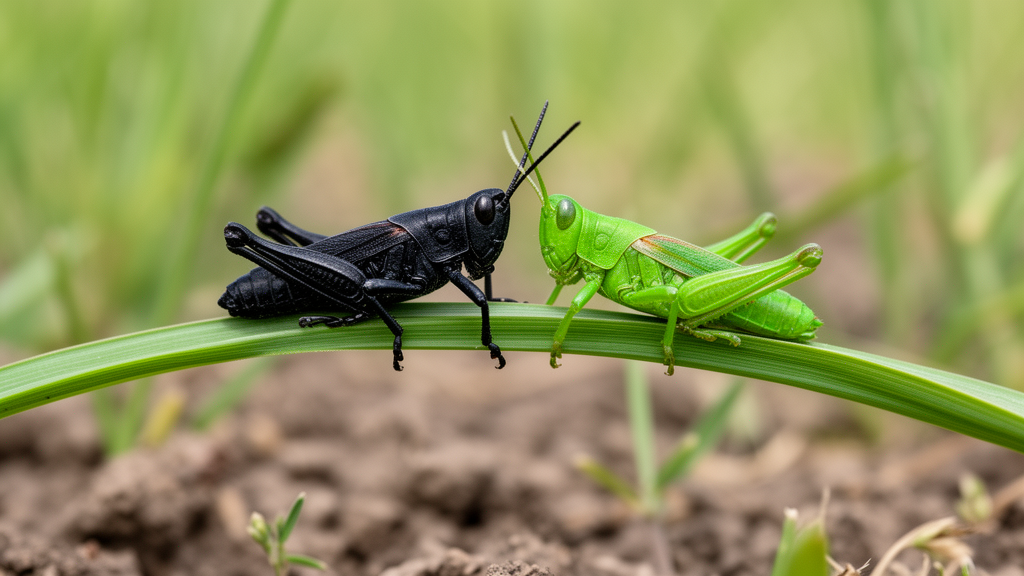
Laboratory and outdoor experiments on the Asian grasshopper Patanga japonica found that its nymphs develop different body colors under different environmental and hormonal conditions. Substrate color altered the distribution of green, whitish and patterned morphs; crowding and visual contact with other nymphs induced black patterns; high temperature suppressed much of that patterning; and injections of [His7]-corazonin induced conspicuous dark patterns in otherwise green, individually reared nymphs. The study concerned an acridid insect, and its findings do not establish the causes of color variation across all populations or environments.
The researchers combined a weekly field census in Tsukuba, Japan, with laboratory rearing, outdoor cages, controlled temperature treatments and hormone injections. During the 2021 field census, most nymphs were green, while yellow, brown, whitish and black-patterned individuals also occurred. Non-green morphs appeared more frequently later in the season: their proportion correlated positively with collection date (r = 0.93, N = 13, p < 0.001). The authors noted that the study area was a grassy site about 200 m long and 2 m wide, and that changes in surrounding plant color were a possible environmental correlate rather than a tested cause.
To test the influence of substrate color, the researchers reared newly hatched nymphs individually in transparent containers lined with yellow-green, white or black paper. The mean room temperature was 25.1°C, with a standard deviation of 5.3°C, from May 31 to August 15. The proportion of green nymphs was significantly higher in yellow-green containers than in white or black containers. Whitish nymphs appeared most often in white containers, while black spotting or patterning was more frequent in black containers. Reddish background coloration occurred in 17.8% of nymphs in black containers, compared with 4.3% in yellow-green and 2.7% in white containers. These findings support an effect of substrate color, but the experiment did not test interactions among substrate color, crowding and temperature.
Crowding produced a different response. Nymphs reared five per container developed black patterns after their molt to the second stadium, whereas some black patterning also occurred among solitary nymphs. Group-reared animals had a mean patterning grade that did not differ significantly among black, yellow-green and white containers, although the proportions in particular grades did differ, including fewer grade-5 individuals on the brightest substrate. The study therefore demonstrated density-dependent black patterning without establishing a single substrate effect for all measures of pattern severity.
Visual exposure was sufficient to induce some patterning. Individually housed nymphs could see five similarly aged nymphs in a white container through adjacent transparent lids but could not touch them. Compared with controls that saw an empty white container, visually exposed nymphs were less likely to remain in the lowest black-patterning grade. The result indicates that visual stimuli can contribute to patterning, although it does not exclude chemical cues or other aspects of the setup. The authors also observed that crowded P. japonica nymphs were comparatively inactive and did not frequently touch or kick one another.
Outdoor cages revealed seasonal variation in the intensity of black patterning. Among cohorts hatching in June, July and August 2021, the proportion in the darkest grade rose from 0% to 19.0% and 57.2%, respectively, while mean grades rose from 2.6 to 3.7 and 4.5. A September-hatching cohort reared outdoors in 2022 included 67.7% in the darkest grade, with a mean grade of 4.6 among 31 scored individuals. Average temperature across the full development period did not track this increase, but temperatures during the latter half of nymphal development declined with later hatching dates.
A controlled temperature comparison provided direct evidence that 34°C suppresses much of the thoracic black patterning. Third-stadium nymphs that had been reared outdoors were divided between a cage maintained at 34°C and an outdoor control cage. The outdoor animals were strongly melanized, with most in grades 4 or 5, whereas most of the animals held at 34°C had bright yellow backgrounds and only limited black patterning, chiefly on the lateral pronotum. Melanization remained in the posterior head, abdominal midline and legs. The study tested a high-temperature treatment at one temperature and developmental stage, so it does not establish a general temperature-response curve across the species’ full life cycle.
Injections of [His7]-corazonin, a neuropeptide associated with color control in other acridids, induced dark patterning in P. japonica. Green nymphs receiving 1 nmol either once or three times during the fourth stadium developed yellow backgrounds and black patterns at the penultimate instar; by the last instar, all six individuals receiving a single injection were in grade 4 or 5, while all six oil-injected controls remained in grade 1. In a preliminary test, four nymphs injected with 1 nmol at 34°C all reached grade 5. These results support corazonin’s involvement in inducing the pattern, but they do not by themselves establish whether heat changes corazonin secretion, local tissue sensitivity, or another regulatory step.
Adult coloration was more uniform than that of the nymphs. Most field adults had brown bodies, dark markings beneath the compound eyes, brownish forewings and horizontal white stripes, providing a cryptic appearance against leaf litter. Some adults had orange regions or lacked pronotum markings, and one old male collected in July 2021 was nearly black except for its legs and abdomen. Hindwings were unpigmented before winter and reddish after overwintering in both sexes. The authors said that this change might be related to sexual maturation, as reported for a related species, but the mechanism was not tested. Overall, the experiments identify separate effects of substrate color, density, visual cues, temperature and corazonin on P. japonica body-color polyphenism, while leaving broader ecological significance and the molecular basis of yellow coloration unresolved.
Subject of Research: Environmental and hormonal control of body-color polyphenism in the grasshopper Patanga japonica
Article Title: Environmental and hormonal control of body-color polyphenism in Patanga japonica ( Orthoptera , Acrididae ): Effects of substrate color, crowding, temperature and [His 7 ]-corazonin injection
Article References: Tanaka, S., & Kayukawa, T. (2024). Environmental and hormonal control of body-color polyphenism in Patanga japonica (Orthoptera, Acrididae): Effects of substrate color, crowding, temperature and [His7]-corazonin injection. Journal of Orthoptera Research, 33(1), 1-12. https://doi.org/10.3897/jor.33.98133
Image Credits: AI Generated
DOI: 10.3897/jor.33.98133
Keywords: Patanga japonica, grasshopper, body-color polyphenism, homochromy, crowding, visual cues, temperature, corazonin, melanization, Orthoptera, Environmental, hormonal
Cite Scienmag News
Gavin Prescott. (October 21, 2026). Laboratory and field experiments link substrate color, crowding, temperature and corazonin to body-color variation in the grasshopper Patanga japonica. Scienmag. https://scienmag.com/laboratory-and-field-experiments-link-substrate-color-crowding-temperature-and-corazonin-to-body-color-variation-in-the-grasshopper-patanga-japonica/
Gavin Prescott. "Laboratory and field experiments link substrate color, crowding, temperature and corazonin to body-color variation in the grasshopper Patanga japonica." Scienmag, 21 October 2026, https://scienmag.com/laboratory-and-field-experiments-link-substrate-color-crowding-temperature-and-corazonin-to-body-color-variation-in-the-grasshopper-patanga-japonica/. Accessed 21 October 2026.
Gavin Prescott. "Laboratory and field experiments link substrate color, crowding, temperature and corazonin to body-color variation in the grasshopper Patanga japonica." Scienmag. October 21, 2026. https://scienmag.com/laboratory-and-field-experiments-link-substrate-color-crowding-temperature-and-corazonin-to-body-color-variation-in-the-grasshopper-patanga-japonica/


