


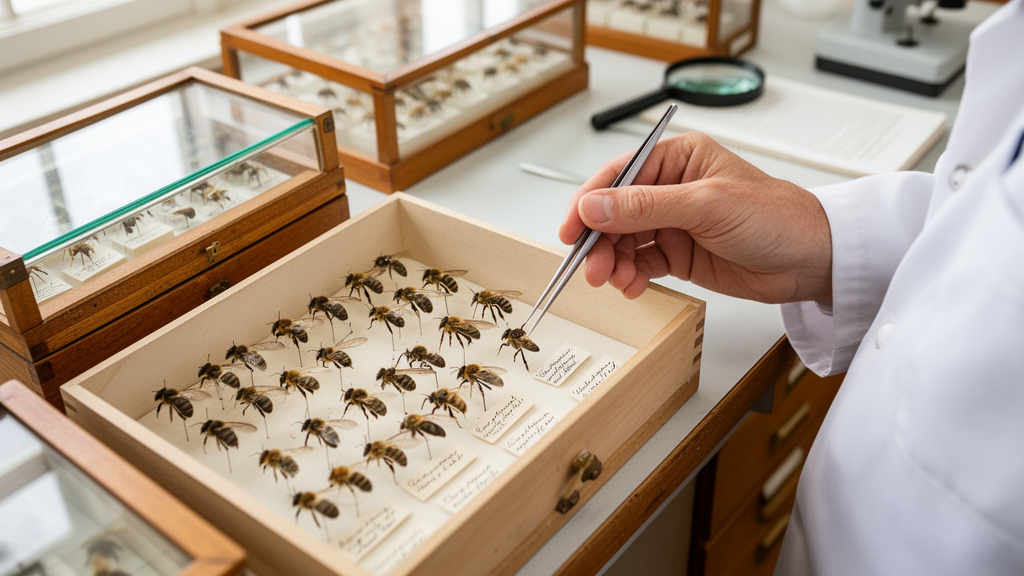
A taxonomic and data-curation study of 13,374 historical bee specimens from Portugal has identified 14 species not previously documented in the country and helped raise the known richness of continental Portuguese bee fauna to 736 species. The material is held by the Science Museum of the University of Coimbra. Researchers catalogued, identified and georeferenced the Portuguese specimens, then created a Global Biodiversity Information Facility dataset linking collection records to earlier taxonomic publications where possible.
Most of the new national records came from historical material, including a specimen collected in 1876 and others gathered during the mid-20th century. The study also removed or excluded 19 species from the continental checklist after evaluating misidentifications, taxonomic synonyms and records unsupported by Portuguese specimens. The researchers examined every available bee specimen in the museum collection confirmed to have been collected in Portugal.
Of the 13,374 specimens included, all but 61 were determined to species level through stereomicroscopic examination, comparison with reference material and appropriate dichotomous identification keys. Another 3,136 specimens were examined separately but excluded from the primary dataset because their geographic origin was unknown or they did not belong to Portuguese Anthophila. Eighty-six specimens in difficult or taxonomically active groups were reviewed by specialist taxonomists working on Andrena, Lasioglossum, Halictus, Eucera, Nomada, Coelioxys, Bombus and Hylaeus.
Label data were entered between May 2022 and August 2023, after which the specimens were indexed, moved into new boxes and taxonomically revised between October 2023 and May 2024. The updated national list also drew on 10 specimens from six other Portuguese and international collections. The museum collection represents all six bee families found in Portugal and 45 of the 55 recorded genera, or 82% of generic diversity.
It contains 464 of the 736 species in the updated continental checklist, representing 63% of species-level diversity, with an average of 29 specimens per represented species. The most abundant species include Andrena flavipes, with 691 specimens, Halictus scabiosae with 658, Lasioglossum malachurum with 575, Anthophora plumipes with 557 and Panurgus perezi with 399. Coverage is uneven among genera: only 10% of the Portuguese Tetralonia species and 47% of the Hoplitis species are represented.
Rare, habitat-specialised and parasitic genera are particularly sparse, while historical handling that led to missing locality labels and the mixing of Portuguese and foreign material prevented some specimens from contributing to faunal checklists. Collection dates extend from a confirmed specimen collected in 1876 to 1990. The 1961–1970 decade is the most heavily represented, with 7,411 records, followed by 1951–1960 with 2,286 and 1876–1910 with 2,015.
The last interval spans 34 years because most specimens in the so-called Old Collection lack exact years, although information from the principal collector establishes that they were gathered before 1911. Sampling is much thinner in 1971–1980, with 48 records, 1931–1940, with five, and 1911–1920, with one. Every month is represented, although most captures occurred from March through August.
The specimens cover all 18 administrative districts and both Portuguese archipelagos, but their geography reflects where collectors lived and travelled. Coimbra accounts for 5,104 records, followed by Porto with 1,681, Lisbon with 1,503, Faro with 1,354 and Viseu with 923. Vila Real has one record, Madeira eight, the Azores 21 and Bragança 37.
Among the 14 additions to Portugal, a male Andrena rotundata collected at Praia da Areia Branca on Portugal’s central coast in 1969 was described by the authors as a surprising discovery. It represents the first confirmed record of the species in continental Europe; the other known European populations were reported from Sardinia and Sicily. Andrena ferox, a species associated with oak forests, was documented from Buçaco, Ponte da Portela and Santo Estêvão, expanding its known Iberian range.
Five Lasioglossum intermedium specimens from Lisbon, Coimbra and Amarante indicated a substantial westward expansion within the Iberian Peninsula, while a male Sphecodes pinguiculus collected near Matosinhos added another northern record. The revision also uncovered the first Portuguese records of Amegilla ochroleuca and Anthophora canescens. Historical specimens showed that some of these bees had already been identified in the museum but their records had remained unpublished.
A female and male Anthophora pubescens collected in Gondesende, Bragança, in 2022 represented a new northern record. A Bombus ruderarius pair dated 1978 and four Nomada species—N. flavopicta, N. pectoralis, N. connectens and N. flavilabris—entered the Portuguese list from specimens gathered between 1967 and 2019. A 2020 male Thyreus picaron from Ponte da Barca added another species not previously reported nationally.
These records expanded the total continental bee fauna from 712 species in the most recent preceding assessment to 736. The authors did not treat the revised list as a complete measure of Portuguese bee diversity: a further 10 species found on the islands are not present on the mainland, and the museum collection itself lacks entire genera and many species within represented genera. The updated list also required 19 removals or exclusions.
Several changes followed taxonomic revisions, including replacement of Eucera punctatissima with Eucera confinis after examination of type material and continued exclusion of Thyreus scutellaris because Portuguese records reflected an older application of the name. Hylaeus purpurissatus was set aside pending clarification within the Hylaeus incongruus group, while Halictus consobrinus was removed because females in that subgenus are essentially unidentifiable and the species had already been excluded from Iberia. Halictus patellatus remains unconfirmed because no male specimen from Portugal was available, and Sphecodes algeriensis was not accepted at species level while its status remains under revision.
The list also replaced Megachile parietina with Megachile baetica and consolidated two older Pyrosmia names under Osmia leucopyga. Other exclusions, including Anthophora punctilabris, Eucera oraniensis and several Sphecodes species, lacked published evidence of Portuguese occurrence. Collection sites were georeferenced using label toponyms, current maps, Portuguese toponym databases and information from Manuel Assunção Diniz, a major collector and former curator whose records dominate the collection.
Coordinate precision varied, most commonly ranging from 10 metres to 2.5 kilometres. Representative males and females were photographed where available for newly added species, and type material was imaged alongside its labels. The revision located six type specimens in the Portuguese subset and three in international reference material, covering six species.
These included the holotype and a paratype of Colletes dinizi and paratypes of three Nomada species. A male Anthophora romandii from 1842 was classified only as a possible syntype because its provenance could not be established. The researchers caution that the enlarged historical dataset cannot yet support inferences about population decline or other temporal trends.
Specimens were not collected through a standardised protocol, and the collection generally lacks abundance data, habitat observations, visited flowers and pollen-load information. The earliest material includes broad, partly undated intervals, while collection locations often reflect the holiday destinations, residences and travel routes of private collectors rather than systematic coverage of the country. The authors linked the work to broader European efforts to strengthen pollinator monitoring and taxonomic capacity in Portugal, including the ARCADE project, while noting that inland districts such as Beja, Évora, Portalegre, Santarém, Guarda, Bragança, Vila Real and Viana do Castelo remain sparsely represented.
Despite these limitations, the study shows that neglected museum material can add verified species records, recover historical distribution and phenological observations, and preserve type specimens needed for future bee taxonomy.
Subject of Research: Taxonomic revision and digitization of historical Portuguese bee specimens
Article Title: New data from the historical bee collection ( Hymenoptera , Anthophila ) of the Science Museum of the University of Coimbra and additional faunistic updates for Portugal
Article References: Gaspar, H., Flaminio, S., Soares, A., Rufino, C., Loureiro, J., Castro, S., & Wood, T. J. (2025). New data from the historical bee collection (Hymenoptera, Anthophila) of the Science Museum of the University of Coimbra and additional faunistic updates for Portugal. Journal of Hymenoptera Research, 98, 165-194. https://doi.org/10.3897/jhr.98.142965
Image Credits: AI Generated
Keywords: Portuguese bees, museum collections, taxonomic revision, faunal checklist, Hymenoptera, Anthophila, species records, GBIF dataset, collection digitization, biodiversity data, historical specimens, data
Cite Scienmag News
Margaret Porter. (October 21, 2026). Historical Portuguese bee collection adds 14 national records. Scienmag. https://scienmag.com/historical-portuguese-bee-collection-adds-14-national-records/
Margaret Porter. "Historical Portuguese bee collection adds 14 national records." Scienmag, 21 October 2026, https://scienmag.com/historical-portuguese-bee-collection-adds-14-national-records/. Accessed 21 October 2026.
Margaret Porter. "Historical Portuguese bee collection adds 14 national records." Scienmag. October 21, 2026. https://scienmag.com/historical-portuguese-bee-collection-adds-14-national-records/


