

Wednesday, October 21, 2026
Science
No Result
View All Result
  • Login
  • HOME
  • SCIENCE NEWS
  • CONTACT US
  • HOME
  • SCIENCE NEWS
  • CONTACT US
No Result
View All Result
Scienmag
No Result
View All Result
Home Science News Science Education

Interactive 360 video linked to early self-rated cardiology understanding

October 21, 2026
in Science Education
Courtney Benton
By Courtney Benton Scienmag Editorial Profile - Science and Technology Policy
Reading Time: 3 mins read
0
Interactive 360 video linked to early self-rated cardiology understanding

Interactive 360 video linked to early self-rated cardiology understanding

65
SHARES
587
VIEWS
Share on FacebookShare on Twitter
ADVERTISEMENT

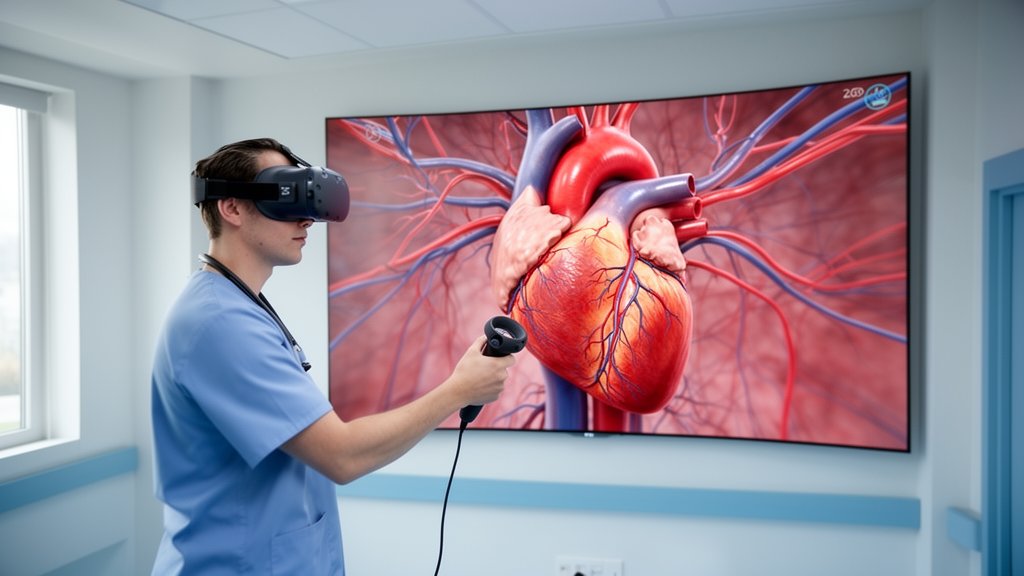
An interactive 360-degree video module was associated with higher immediate self-rated understanding of catheterization-laboratory education than observation in an actual catheterization laboratory, according to a retrospective, non-randomized, two-period crossover study involving fifth-year medical students. Among 51 students who completed both learning sessions and all assessments, a mixed-effects model estimated a 0.44-point higher post-session understanding score after the interactive module than after laboratory observation, adjusted for baseline score and study period. The estimate was based on a five-point scale and had a 95% confidence interval of 0.22 to 0.66, with p less than 0.001. The result concerns students’ own ratings of understanding rather than independently measured knowledge or clinical performance.

The researchers assigned 88 fifth-year medical students to one of two sequences according to their cardiology clerkship schedules. One group received the interactive 360 video before observing a catheterization laboratory, while the other observed the laboratory first and then completed the video module. Each student was therefore intended to experience both approaches, but allocation was not randomized. The design allowed the investigators to compare the approaches within participants while accounting for baseline understanding and the period in which each session occurred. Because sequence was determined by clerkship scheduling and the study was retrospective, the findings are associational rather than a controlled estimate of a causal teaching effect.

The module used 360-degree recordings made in an actual catheterization laboratory. Its functions included pointer-based object identification, playback synchronized with a headset, and real-time monitoring of learners’ gaze. These features differentiated it from passive 360-degree observation, although the study did not test which individual technical function, if any, was responsible for the observed difference. Self-rated understanding was measured at baseline, after the first session, and after the second session using the mean of 10 items, each rated from 1 to 5.

Baseline scores were comparable between the two sequences: 2.70 plus or minus 0.56 for the video-first group and 2.52 plus or minus 0.83 for the laboratory-first group, with p equal to 0.37. The largest separation occurred after the first session. Students assigned to interactive video first reported a mean understanding score of 4.34 plus or minus 0.58, whereas those assigned to catheterization-laboratory observation first averaged 3.41 plus or minus 0.92; the difference was reported as p less than 0.001. The interactive-video session was associated with significant score increases in either sequence. By contrast, the catheterization-laboratory session produced a significant increase only when it was delivered first.

After both sessions, the groups’ reported scores converged: 4.45 plus or minus 0.53 for the video-first sequence and 4.41 plus or minus 0.60 for the laboratory-first sequence, with p equal to 0.80. The investigators concluded that the interactive module was associated with greater early gains in self-rated understanding and proposed that similar modules might complement catheterization-laboratory observation in supporting preparation and consolidation. The evidence is limited to the study’s retrospective, non-randomized design and its use of self-reported understanding. It does not establish that the module improved objectively tested knowledge, procedural competence or patient outcomes, and it does not show that the two approaches differed after both had been completed.

Subject of Research: Effects of interactive 360 video and catheterization-laboratory observation on medical students’ self-rated cardiology understanding

Article Title: Interactive 360 video for catheterization-laboratory education in undergraduate cardiology clerkship: a retrospective two-period crossover study

Article References: Tanimoto, T., Takahata, M., Hirano, T., Kashiwagi, M., Sasaki, Y., Mori, M., Nakatsugawa, Y., Mizumoto, K., Tanaka, A., & Murata, K.-Y. (2026). Interactive 360 video for catheterization-laboratory education in undergraduate cardiology clerkship: a retrospective two-period crossover study. BMC Medical Education. https://doi.org/10.1186/s12909-026-10396-3

Image Credits: AI Generated

DOI: 10.1186/s12909-026-10396-3

Keywords: medical education, 360-degree video, cardiology clerkship, catheterization laboratory, fifth-year medical students, self-rated understanding, retrospective crossover study, immersive learning, Interactive, video, catheterization-laboratory, education

Cite Scienmag News

Courtney Benton. (October 21, 2026). Interactive 360 video linked to early self-rated cardiology understanding. Scienmag. https://scienmag.com/interactive-360-video-linked-to-early-self-rated-cardiology-understanding/

Courtney Benton. "Interactive 360 video linked to early self-rated cardiology understanding." Scienmag, 21 October 2026, https://scienmag.com/interactive-360-video-linked-to-early-self-rated-cardiology-understanding/. Accessed 21 October 2026.

Courtney Benton. "Interactive 360 video linked to early self-rated cardiology understanding." Scienmag. October 21, 2026. https://scienmag.com/interactive-360-video-linked-to-early-self-rated-cardiology-understanding/


Tags: 360-degree videocardiology clerkshipcatheterization laboratorycatheterization laboratory teaching methodscomparison of observational and interactive learning approachesEducationeffect of virtual simulation on self-perceived understandingfifth-year medical studentsimmersive learningimmersive learning in cardiologyimpact of interactive videos on medical knowledgeinteractiveinteractive 360-degree cardiology trainingMedical Educationmedical education technologymedical student education assessmentmultimedia learning tools for cardiologynon-randomized crossover study in medical educationretrospective crossover studyself-rated medical student understandingself-rated understandingVideovirtual reality in medical training
Share26Tweet16
Previous Post

INFORMS Names 12 Leaders as 2026 Operations Research Fellows

Next Post

Weakly supervised framework improves TFT-LCD defect detection in industrial study

Related Posts

Cohen standard setting closely matches Angoff in medical school exams
Science Education

Cohen standard setting closely matches Angoff in medical school exams

October 21, 2026
Rural Lesotho’s inclusive schools face resource and travel barriers
Science Education

Rural Lesotho’s inclusive schools face resource and travel barriers

October 21, 2026
Research report: Effects of a web-based serious game on postpartum hemorrhage management knowledge, self-efficacy, and self-regulated learning: a randomized controlled trial among nursing students in western Türkiye
Science Education

Research report: Effects of a web-based serious game on postpartum hemorrhage management knowledge, self-efficacy, and self-regulated learning: a randomized controlled trial among nursing students in western Türkiye

October 21, 2026
A component model and indicators of supervisory leadership for primary school administrators in Northeastern Thailand
Science Education

A component model and indicators of supervisory leadership for primary school administrators in Northeastern Thailand

October 21, 2026
How Are Midwifery Curricula Really Built? A Landmark Review Finds Almost No Evidence
Science Education

Curriculum development in midwifery education: a systematic literature review

October 20, 2026
Indonesian eco-enzyme education review finds project learning outpaces evidence
Science Education

Indonesian eco-enzyme education review finds project learning outpaces evidence

October 20, 2026
Next Post
Weakly supervised framework improves TFT-LCD defect detection in industrial study

Weakly supervised framework improves TFT-LCD defect detection in industrial study

  • Mothers who receive childcare support from maternal grandparents show more optimized

    Mothers who receive childcare support from maternal grandparents show more parental warmth, finds NTU Singapore study

    27656 shares
    Share 11059 Tweet 6912
  • University of Seville Breaks 120-Year-Old Mystery, Revises a Key Einstein Concept

    1061 shares
    Share 424 Tweet 265
  • Bee body mass, pathogens and local climate influence heat tolerance

    682 shares
    Share 273 Tweet 171
  • Researchers record first-ever images and data of a shark experiencing a boat strike

    546 shares
    Share 218 Tweet 137
  • Groundbreaking Clinical Trial Reveals Lubiprostone Enhances Kidney Function

    531 shares
    Share 212 Tweet 133
Science

Embark on a thrilling journey of discovery with Scienmag.com—your ultimate source for cutting-edge breakthroughs. Immerse yourself in a world where curiosity knows no limits and tomorrow’s possibilities become today’s reality!

RECENT NEWS

  • Weakly supervised framework improves TFT-LCD defect detection in industrial study
  • Interactive 360 video linked to early self-rated cardiology understanding
  • INFORMS Names 12 Leaders as 2026 Operations Research Fellows
  • Medical chatbots resist unnecessary tests, but waver where doctors disagree

Categories

  • Agriculture
  • Anthropology
  • Archaeology
  • Athmospheric
  • Biology
  • Biotechnology
  • Blog
  • Bussines
  • Cancer
  • Chemistry
  • Climate
  • Earth Science
  • Editorial Policy
  • Marine
  • Mathematics
  • Medicine
  • Pediatry
  • Policy
  • Psychology & Psychiatry
  • Science Education
  • Science News
  • Social Science
  • Space
  • Technology and Engineering

Subscribe to Blog via Email

Enter your email address to subscribe to this blog and receive notifications of new posts by email.

Join 5,150 other subscribers

© 2025 Scienmag - Science Magazine

Welcome Back!

Login to your account below

Forgotten Password?

Retrieve your password

Please enter your username or email address to reset your password.

Log In
No Result
View All Result
  • HOME
  • SCIENCE NEWS
  • CONTACT US

© 2025 Scienmag - Science Magazine

Discover more from Science

Subscribe now to keep reading and get access to the full archive.

Continue reading