


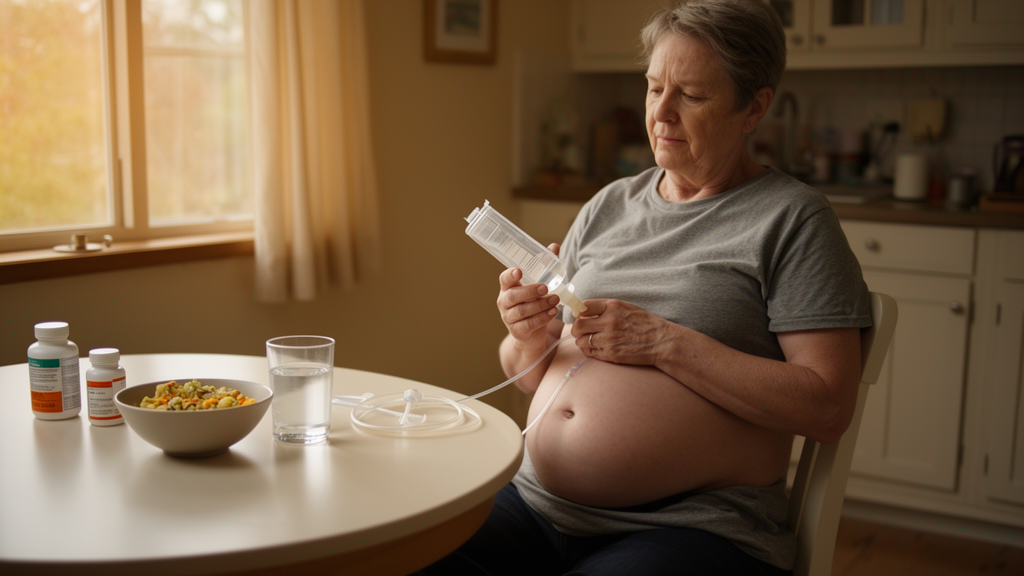
Patients who remained dependent on a feeding tube for 12 months after definitive chemoradiotherapy for locally advanced head and neck cancer had about twice the subsequent hazard of death as those who had become tube-independent, even after adjustment for baseline function, tumor and nodal stage, smoking history and age. The finding came from a retrospective, single-center cohort of 204 adults, rather than a randomized trial, and requires prospective, multicenter validation before it can establish that prolonged tube use itself causes shorter survival. The same study identified smoking exposure, patients’ baseline functional status and radiation dose to the middle pharyngeal constrictor as factors associated with the speed of recovery.
The analysis included consecutive patients treated at the McGill University Health Centre in Montreal from January 2015 through December 2022. Eligibility required curative-intent radiotherapy to 70 Gy with concurrent systemic therapy, a prophylactic percutaneous endoscopic gastrostomy or radiologically inserted gastrostomy placed either before treatment or within the first week of radiotherapy, and complete clinical, dosimetric and follow-up information. Patients receiving palliative treatment, without prophylactic tube placement, or with synchronous distant metastases were excluded. Of 213 eligible patients, nine were removed from the time-to-independence analysis because their records listed tube removal after the date of death, a logical inconsistency that investigators could not resolve. The resulting cohort had a median age of 64 years; 77% were male, 65% had an oropharyngeal primary tumor, 54% had T3–T4 disease and 80% had nodal involvement.
All patients received intensity-modulated radiotherapy or volumetric-modulated arc therapy with concurrent platinum-based chemotherapy, or cetuximab in selected cases. The radiation plans specified 70 Gy to high-risk target volumes, 63 Gy to intermediate-risk volumes and 56 Gy to low-risk volumes, delivered in 33–35 fractions. Investigators extracted mean and maximum doses to organs at risk, including the oral cavity, lips, mandible, parotid glands, larynx and the superior, middle and inferior pharyngeal constrictors. Gastrostomy removal was not governed by a written institutional protocol, but followed a consistent dietitian-led practice: removal was requested once a patient was eating and drinking exclusively by mouth and body weight had remained stable for four weeks.
Among the 204 patients analyzed, 199 had a documented feeding-tube removal and five died before achieving independence. Because death prevents the recovery event from occurring, investigators treated it as a competing risk. They used Kaplan–Meier estimates and multivariable cause-specific Cox regression to model the continuous time from the start of radiotherapy to tube removal, while also fitting a Fine–Gray subdistribution-hazard model as a sensitivity analysis. For overall survival, the researchers used landmark analyses at three, six and 12 months. Patients alive at each landmark were classified by their tube status at that point, and survival from the landmark onward was compared between groups. This approach was intended to avoid immortal-time bias, which can arise when survival is compared using a tube-status category defined only after patients have remained alive long enough to reach that category.
Smoking history was the strongest independent clinical predictor of time to independence. In the main cause-specific model, ever-smokers reached tube independence more slowly than never-smokers, with a hazard ratio of 0.60, a 95% confidence interval of 0.42–0.84 and a p-value of 0.004. Higher baseline Karnofsky Performance Status was associated with faster independence, with a hazard ratio of 1.02 per point, a 95% confidence interval of 1.01–1.04 and a p-value of 0.006. The continuous time-to-event model also identified mean radiation dose to the middle pharyngeal constrictor: each additional Gy was associated with a 2% lower rate of reaching independence, corresponding to a hazard ratio of 0.98 per Gy, a 95% confidence interval of 0.96–1.00 and a p-value of 0.048. Mean oral-cavity dose showed a similar but nonsignificant trend in the primary model, with a hazard ratio of 0.98 per Gy, a 95% confidence interval of 0.95–1.00 and a p-value of 0.067. Doses to the superior constrictor, lips and mandible were not significant.
The Fine–Gray sensitivity model produced consistent effect sizes and statistically significant associations for smoking history, middle-constrictor dose and oral-cavity dose, with p-values of 0.010, 0.011 and 0.019, respectively. A separate six-month analysis gave a less definitive statistical picture. Of 188 patients with gastrostomies who survived beyond six months and had complete predictor data, 49, or 26.1%, remained tube-dependent. In multivariable logistic regression, baseline performance status was the only clearly significant predictor: each additional Karnofsky point was associated with slightly lower odds of persistent dependence at six months, with an odds ratio of 0.96, a 95% confidence interval of 0.92–1.00 and a p-value of 0.037. Smoking history, middle-constrictor dose and oral-cavity dose pointed in the same directions as in the time-to-event analysis but were not significant in this smaller model, which had approximately seven events per predictor.
The landmark survival analysis showed that the timing of persistent dependence mattered. At three months, 106 of 200 patients with complete covariate data were still dependent, but the unadjusted difference in subsequent survival did not reach conventional statistical significance: the hazard ratio for death was 1.71, with a 95% confidence interval of 0.98–3.00 and a p-value of 0.059. At six months, 51 of 194 patients remained dependent. Their subsequent survival was worse, with an unadjusted hazard ratio of 1.78, a 95% confidence interval of 1.01–3.13 and a p-value of 0.048. At 12 months, 27 of 186 patients were still dependent, and the unadjusted hazard ratio for death was 2.53, with a 95% confidence interval of 1.30–4.91 and a p-value of 0.006. These estimates compare the hazard of death after each landmark, not a directly measured probability of dying within a specified period.
Adjustment altered the early results but not the one-year association. After accounting for baseline Karnofsky Performance Status, T classification, N classification, smoking history and age, the three-month hazard ratio was 1.35, with a 95% confidence interval of 0.76–2.42 and a p-value of 0.305. The six-month estimate was similarly attenuated and nonsignificant, with an adjusted hazard ratio of 1.48, a 95% confidence interval of 0.81–2.70 and a p-value of 0.199. At 12 months, however, the adjusted hazard ratio was 2.20, with a 95% confidence interval of 1.05–4.58 and a p-value of 0.036. The pattern suggests that early tube dependence largely reflected baseline illness severity and functional status, while dependence persisting to one year marked a smaller group whose survival difference was not fully explained by the measured factors. The one-year estimate remains imprecise because only 27 patients were still dependent; its events-per-variable ratio was 7.3, below the conventional threshold of about 10.
The observational design cannot determine whether continued tube dependence contributes directly to mortality, and several unmeasured or incompletely measured features could affect the findings. Speech-language pathology referral was left to the treating clinician rather than standardized, and the dataset did not record prophylactic swallowing exercises, rehabilitation intensity or patient compliance. Differences in access to or engagement with swallowing therapy could therefore contribute to the observed associations with smoking and radiation dose. Local, regional and distant recurrence data were also unavailable, leaving open the possibility that persistent or recurrent disease both prolonged tube dependence and independently reduced survival. Other potentially important variables included alcohol intake, sarcopenia and more detailed smoking exposure, such as pack-years and the interval since cessation. The findings may also not generalize beyond patients receiving a uniform prophylactic-gastrostomy protocol at one institution to settings using reactive tube placement, surgery-based treatment or different radiotherapy regimens.
The study identifies potential targets for further investigation without demonstrating that changing them will improve survival. Smoking history and dose to the middle pharyngeal constrictor were independently associated with slower recovery, while the oral-cavity estimate was weaker but directionally consistent. The investigators did not derive a clinical dose threshold from the cohort, and the data do not establish that a particular radiation constraint would shorten tube use. Similarly, the survival analysis identifies one-year dependence as a prognostic marker but does not show that ending tube use earlier would change outcomes. The authors argue for prospective, externally validated studies that also capture swallowing-rehabilitation intensity, recurrence, patient-reported swallowing outcomes and detailed dosimetry, allowing testing of structured smoking-cessation support and dysphagia-optimized radiotherapy planning as potential ways to reduce prolonged feeding-tube dependence.
Subject of Research: Clinical and dosimetric predictors of feeding-tube independence and survival in locally advanced head and neck cancer
Article Title: Predictors of time to feeding-tube independence in locally advanced head and neck cancer
Article References: Salman, S., Heppell, N., Salman, N. D., Shirron, N., Joseph, A., Tsien, C., & Shenouda, G. (2026). Predictors of time to feeding-tube independence in locally advanced head and neck cancer. Frontiers in Oncology, 16, Article 1956034. https://doi.org/10.3389/fonc.2026.1956034
Image Credits: AI Generated
DOI: 10.3389/fonc.2026.1956034
Keywords: head and neck cancer, feeding-tube independence, chemoradiotherapy, dysphagia, gastrostomy, overall survival, smoking history, radiation dosimetry, pharyngeal constrictors, retrospective cohort, Predictors, time
Cite Scienmag News
Nathaniel Bowman. (October 21, 2026). Year-long feeding-tube dependence linked to poorer survival after head-neck cancer treatment. Scienmag. https://scienmag.com/year-long-feeding-tube-dependence-linked-to-poorer-survival-after-head-neck-cancer-treatment/
Nathaniel Bowman. "Year-long feeding-tube dependence linked to poorer survival after head-neck cancer treatment." Scienmag, 21 October 2026, https://scienmag.com/year-long-feeding-tube-dependence-linked-to-poorer-survival-after-head-neck-cancer-treatment/. Accessed 21 October 2026.
Nathaniel Bowman. "Year-long feeding-tube dependence linked to poorer survival after head-neck cancer treatment." Scienmag. October 21, 2026. https://scienmag.com/year-long-feeding-tube-dependence-linked-to-poorer-survival-after-head-neck-cancer-treatment/


