

Wednesday, October 21, 2026
Science
No Result
View All Result
  • Login
  • HOME
  • SCIENCE NEWS
  • CONTACT US
  • HOME
  • SCIENCE NEWS
  • CONTACT US
No Result
View All Result
Scienmag
No Result
View All Result
Home Science News Medicine

Spectral CT signals distinguish antisynthetase-related lung disease in retrospective study

October 21, 2026
in Medicine
Ophelia Keating
By Ophelia Keating Scienmag Editorial Profile - Health Services Research
Reading Time: 3 mins read
0
Spectral CT signals distinguish antisynthetase-related lung disease in retrospective study

Spectral CT signals distinguish antisynthetase-related lung disease in retrospective study

65
SHARES
587
VIEWS
Share on FacebookShare on Twitter
ADVERTISEMENT

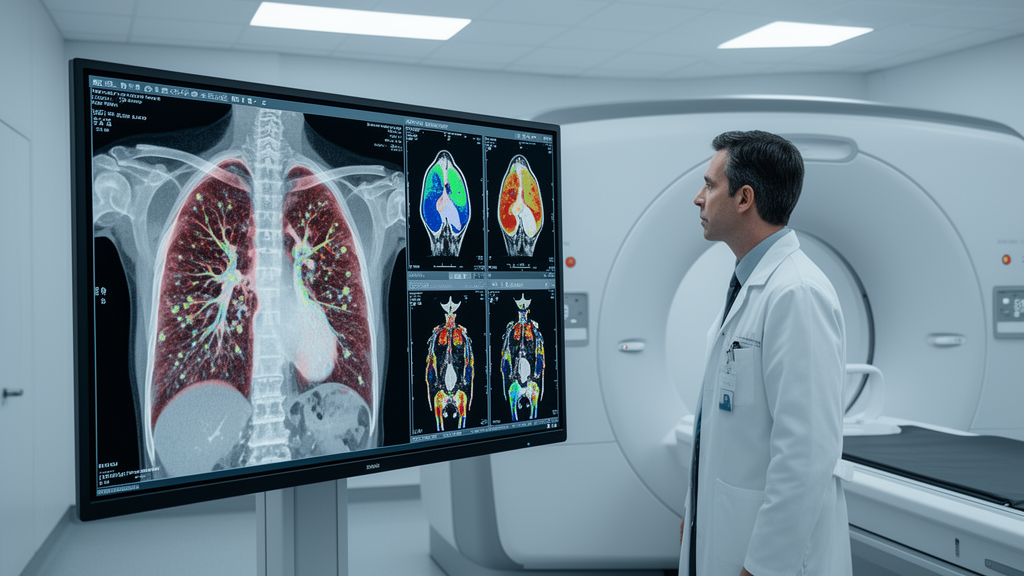
A retrospective quantitative imaging study of 165 patients found that dual-layer spectral computed tomography supplied measurable information that helped distinguish interstitial lung disease associated with antisynthetase syndrome (ASS-ILD) from disease associated with polymyositis or dermatomyositis (PM/DM-ILD). Right-lower-lobe volume performed best among the evaluated spectral CT parameters, producing an area under the receiver operating characteristic curve of 0.727, with 79.2% sensitivity and 58% specificity. The findings indicate potential complementary diagnostic value, although the study does not establish spectral CT as a standalone test.

The cohort comprised 69 patients with ASS-ILD and 96 patients with PM/DM-ILD, all of whom underwent both spectral CT and conventional high-resolution computed tomography (HRCT). Researchers quantified four types of measurements in each lung lobe: lung volume; 70 keV monoenergetic CT number, abbreviated MCTN; effective atomic number, or Zeff; and electron density, expressed as a percentage of water density. The groups were compared overall and within subgroups matched by radiological pattern or imaging feature, including nonspecific interstitial pneumonia and ground-glass opacity.

A Bonferroni correction was used for multiple testing, with an adjusted significance threshold of p < 0.00625. Across the full comparison, the ASS-ILD group had significantly smaller right- and left-lower-lobe volumes and higher MCTN and electron-density values than the PM/DM-ILD group; all adjusted p values were below 0.05. Volume differences were also observed when the analysis was restricted to patients whose HRCT scans showed nonspecific interstitial pneumonia.

In that subgroup, right-lower-lobe volume in ASS-ILD was 374.79 cm³, with an interquartile range of 291.08 to 619.35 cm³, compared with 596.22 ± 193.33 cm³ in PM/DM-ILD. Left-lower-lobe volume was 364.13 cm³, with an interquartile range of 255.83 to 567.04 cm³, in the ASS-ILD group, versus 563.74 ± 189.98 cm³ in the PM/DM-ILD group. Both raw comparisons produced p values below 0.001.

Quantitative differences also appeared when the researchers selected patients with ground-glass opacity. In that subgroup, left-lower-lobe electron density in ASS-ILD was 29.7% of water density, with an interquartile range of 24.1 to 43.8, compared with 25.3% and an interquartile range of 20.05 to 32.78 in PM/DM-ILD. The corresponding left-lower-lobe MCTN was −706.3 Hounsfield units, with an interquartile range of −763.15 to −562.5, in ASS-ILD, versus −749.7 Hounsfield units and an interquartile range of −802.98 to −678.33 in PM/DM-ILD.

Each ground-glass-opacity comparison had a raw p value of 0.003. These subgroup results show that the measured differences were detectable even when conventional HRCT patterns or signs were similar. Right-lower-lobe volume offered the strongest discrimination among the dual-layer spectral CT parameters evaluated, but its sensitivity of 79.2% and specificity of 58% mean that the measurement alone would not classify every patient correctly.

The study therefore characterizes spectral CT as an adjunct rather than a replacement for conventional HRCT, clinical assessment and serological testing. Within the reported population, however, quantitative lower-lobe differences distinguished ASS-ILD from PM/DM-ILD and demonstrate how spectral CT can add information beyond conventional imaging appearances.

Subject of Research: Diagnostic value of quantitative dual-layer spectral CT for distinguishing ASS-ILD from PM/DM-ILD

Article Title: A quantitative study: investigating the diagnostic value of using dual-layer spectral computed tomography in differentiating idiopathic inflammatory myopathy-associated interstitial lung disease

Article References: Xie, S., Wang, S., Zhang, Z., Liang, Y., Yu, J., Qi, R., Tan, C., Liu, H., Zhang, X., Liao, W., Zhao, L., Zhang, T., & Zhang, L. (2026). A quantitative study: investigating the diagnostic value of using dual-layer spectral computed tomography in differentiating idiopathic inflammatory myopathy-associated interstitial lung disease. BMC Medical Imaging. https://doi.org/10.1186/s12880-026-02960-6

Image Credits: AI Generated

DOI: 10.1186/s12880-026-02960-6

Keywords: spectral CT, antisynthetase syndrome, interstitial lung disease, polymyositis, dermatomyositis, quantitative imaging, lung volume, high-resolution CT, diagnostic accuracy, quantitative, investigating, diagnostic

Cite Scienmag News

Ophelia Keating. (October 21, 2026). Spectral CT signals distinguish antisynthetase-related lung disease in retrospective study. Scienmag. https://scienmag.com/spectral-ct-signals-distinguish-antisynthetase-related-lung-disease-in-retrospective-study/


Ophelia Keating. "Spectral CT signals distinguish antisynthetase-related lung disease in retrospective study." Scienmag, 21 October 2026, https://scienmag.com/spectral-ct-signals-distinguish-antisynthetase-related-lung-disease-in-retrospective-study/. Accessed 21 October 2026.

Ophelia Keating. "Spectral CT signals distinguish antisynthetase-related lung disease in retrospective study." Scienmag. October 21, 2026. https://scienmag.com/spectral-ct-signals-distinguish-antisynthetase-related-lung-disease-in-retrospective-study/

Tags: antisynthetase syndromedermatomyositisDiagnosticdiagnostic accuracydiagnostic markers for antisynthetase syndrome-related lung involvementdifferentiation of interstitial lung disease using spectral imagingdual-layer spectral CT imaging for ILDhigh-resolution CTinterstitial lung diseaseInvestigatinglung volumelung volume and electron density measurements in ILDpolymyositisQuantitativequantitative imagingquantitative lung imaging parameters in ASS-ILDradiological features of ASS-ILD and PM/retrospective imaging study of lung diseasessensitivity and specificity of spectral CT parametersspectral CTSpectral CT in antisynthetase syndrome lung diseasespectral CT vs HRCT in diagnosis of interstitial lung diseases
Share26Tweet16
Previous Post

Research report: Pediatric HIV reservoir in early ART: distinct immunobiology and its implications for HIV cure

Next Post

Interpretable machine learning predicts Victorian zonal crash counts

Related Posts

Pilot ultrasound session modestly reduces schizophrenia delusions
Medicine

Pilot ultrasound session modestly reduces schizophrenia delusions

October 21, 2026
Type 2 diabetes adults favor larger, personal physical activity incentives
Medicine

Type 2 diabetes adults favor larger, personal physical activity incentives

October 21, 2026
Brain-Computer Interfaces Show Promise for Rebuilding Mind and Daily Life After Stroke
Medicine

Brain-computer interface training shows preliminary cognitive and daily-living benefits after stroke

October 21, 2026
Antihistamine clue reveals hidden regulator of cellular stress secretion
Medicine

Cell study links histamine H1 receptor to regulation of stress-induced ER protein secretion

October 21, 2026
Receptive Language Emerges as the Central Hub in a New Network Model of Autism Vulnerability
Medicine

Cross-sectional network analysis links receptive language to a provisional autism vulnerability model

October 21, 2026
Inside the ambitious evidence registry rethinking brain injury rehabilitation
Medicine

Post-acute traumatic brain injury recovery: architecture of an illustrative curated evidence registry

October 21, 2026
Next Post
Interpretable machine learning predicts Victorian zonal crash counts

Interpretable machine learning predicts Victorian zonal crash counts

  • Mothers who receive childcare support from maternal grandparents show more optimized

    Mothers who receive childcare support from maternal grandparents show more parental warmth, finds NTU Singapore study

    27656 shares
    Share 11059 Tweet 6912
  • University of Seville Breaks 120-Year-Old Mystery, Revises a Key Einstein Concept

    1061 shares
    Share 424 Tweet 265
  • Bee body mass, pathogens and local climate influence heat tolerance

    682 shares
    Share 273 Tweet 171
  • Researchers record first-ever images and data of a shark experiencing a boat strike

    546 shares
    Share 218 Tweet 137
  • Groundbreaking Clinical Trial Reveals Lubiprostone Enhances Kidney Function

    531 shares
    Share 212 Tweet 133
Science

Embark on a thrilling journey of discovery with Scienmag.com—your ultimate source for cutting-edge breakthroughs. Immerse yourself in a world where curiosity knows no limits and tomorrow’s possibilities become today’s reality!

RECENT NEWS

  • Interpretable machine learning predicts Victorian zonal crash counts
  • Spectral CT signals distinguish antisynthetase-related lung disease in retrospective study
  • Research report: Pediatric HIV reservoir in early ART: distinct immunobiology and its implications for HIV cure
  • Research report: Effects of a web-based serious game on postpartum hemorrhage management knowledge, self-efficacy, and self-regulated learning: a randomized controlled trial among nursing students in western Türkiye

Categories

  • Agriculture
  • Anthropology
  • Archaeology
  • Athmospheric
  • Biology
  • Biotechnology
  • Blog
  • Bussines
  • Cancer
  • Chemistry
  • Climate
  • Earth Science
  • Editorial Policy
  • Marine
  • Mathematics
  • Medicine
  • Pediatry
  • Policy
  • Psychology & Psychiatry
  • Science Education
  • Science News
  • Social Science
  • Space
  • Technology and Engineering

Subscribe to Blog via Email

Enter your email address to subscribe to this blog and receive notifications of new posts by email.

Join 5,150 other subscribers

© 2025 Scienmag - Science Magazine

Welcome Back!

Login to your account below

Forgotten Password?

Retrieve your password

Please enter your username or email address to reset your password.

Log In
No Result
View All Result
  • HOME
  • SCIENCE NEWS
  • CONTACT US

© 2025 Scienmag - Science Magazine

Discover more from Science

Subscribe now to keep reading and get access to the full archive.

Continue reading