


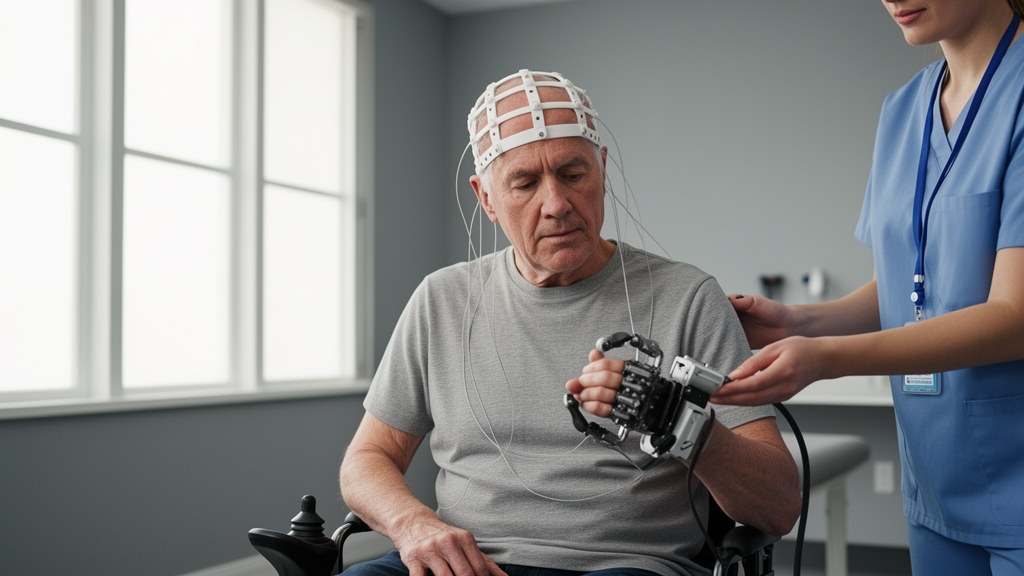
A systematic review and meta-analysis of 11 randomized controlled trials involving 559 patients with stroke found that brain-computer interface (BCI) training performed better than conventional rehabilitation for cognitive function and activities of daily living (ADL). The pooled estimates favored BCI for cognition, with a standardized mean difference (SMD) of 0.634 (95% confidence interval, 0.214 to 1.055; p = 0.003), and for ADL, with an SMD of 1.198 (95% CI, 0.079 to 2.316; p = 0.036). However, the certainty of evidence was low for cognition and very low for ADL.
The review, published in Frontiers in Neurology in 2026, was conducted by Zijie Luo, Lei Yu, Meiling Wu and Xuan Gong. The authors followed PRISMA guidelines and retrospectively registered the protocol with PROSPERO on July 17, 2026, under identifier CRD420261453809. Searches covered PubMed, Web of Science, Google Scholar, CNKI and Wanfang Data from their inception through March 2026. The initial search identified 935 publications; after duplicate removal, 416 records underwent title and abstract screening and 124 full texts were assessed.
Eleven randomized controlled trials met the inclusion criteria. Six reported only nonmotor outcomes, three reported only ADL, and two reported both. Seven studies were conducted in China, two in Russia, one in Iran and one in Portugal. Participant ages ranged from 37 to 86 years. The interventions included several EEG-based BCI approaches, such as motor imagery, motor imagery with virtual reality, P300-based neurofeedback, BCI-controlled pedaling, and BCI-triggered functional electrical stimulation. Training ranged from two to seven sessions per week and from 10 to 180 days.
For the principal cognitive analysis, eight studies with 330 participants were pooled. Cognitive outcomes were measured using the Montreal Cognitive Assessment, Symbol Digit Modalities Test and Loewenstein Occupational Therapy Cognitive Assessment, so the researchers used SMDs to combine results across instruments. Heterogeneity was moderate to substantial at I² = 66.3%, with p = 0.004. Leave-one-out sensitivity analysis did not materially change the direction or statistical significance of the pooled estimate. Excluding the largest-weighted study, which used computer-assisted cognitive training rather than a conventional EEG-based BCI, reduced the pooled SMD to 0.50 (95% CI, 0.15 to 0.84) while preserving the direction and significance of the result.
Five studies with 317 participants contributed data to the ADL analysis. The pooled effect favored BCI training, but heterogeneity was very high at I² = 94.5%, with p < 0.0001, and the 95% confidence interval was wide. Four studies used the modified Barthel Index to assess functional independence, while one used the WHOQOL-BREF, which measures health-related quality of life. Because the available studies could not be analyzed separately, the authors said the pooled estimate should be interpreted primarily as an effect on ADL rather than as a general measure of quality of life. The GRADE certainty for this outcome was very low because of performance bias, serious inconsistency and imprecision.
Exploratory subgroup analyses for cognition did not find significant differences between groups defined by region, sample size, stroke type, intervention intensity or intervention duration; all between-group p values exceeded 0.05. For ADL, the first-stroke and non-first-stroke subgroups differed significantly (p = 0.0008). The estimated effect was larger for first-stroke patients, at SMD 2.37 (95% CI, 1.63 to 3.10), than for patients with a non-first stroke, at SMD 0.35 (95% CI, -0.58 to 1.27). The authors identified first-episode status as a possible effect modifier, but the subgroup included only two studies and does not establish a reliable treatment-selection rule.
Risk of bias was assessed with the Cochrane Risk of Bias 2 tool, and certainty of evidence with GRADE. Most studies were judged to have an overall low risk of bias, but most had a high risk of performance bias because participants and rehabilitation personnel could not be blinded to BCI treatment. Funnel plots, Begg’s tests and Egger’s regression analyses did not detect significant publication bias for either outcome. The authors cautioned that these tests have limited power with fewer than 10 studies, so they cannot definitively exclude publication bias. The low certainty assigned to cognition reflected performance bias and substantial unexplained heterogeneity.
The review has several limitations. Only eight studies contributed cognitive data and five contributed ADL data, which may affect the stability of pooled results. The studies used different cognitive instruments, and there were too few studies for reliable meta-regression, for which a minimum of 10 studies is generally recommended. Most primary reports also lacked sufficient technical detail about signal acquisition, feature extraction and classification algorithms, limiting comparisons among BCI systems. One included trial used RehaCom rather than a conventional EEG-based BCI; excluding it in sensitivity analysis left the principal cognitive finding intact.
The protocol was registered retrospectively, and none of the subgroup analyses had been prespecified, so those findings are hypothesis-generating rather than confirmatory. The quantitative synthesis focused on cognition because too few studies reported other nonmotor domains. The authors stated that current evidence is insufficient to recommend BCI for emotion or speech rehabilitation. They concluded that BCI training shows preliminary promise for cognition and ADL after stroke, but that larger, standardized and longer-term randomized trials are needed to establish its clinical value and identify the patients most likely to benefit.
Subject of Research: Brain-computer interface training for cognitive function and activities of daily living after stroke
Article Title: The application of brain-computer interface on cognitive function and activities of daily living in stroke patients: a systematic review and meta-analysis
Article References: Luo, Z., Yu, L., Wu, M., & Gong, X. (2026). The application of brain-computer interface on cognitive function and activities of daily living in stroke patients: a systematic review and meta-analysis. Frontiers in Neurology, 17, Article 1862193. https://doi.org/10.3389/fneur.2026.1862193
Image Credits: AI Generated
DOI: 10.3389/fneur.2026.1862193
Keywords: stroke rehabilitation, brain-computer interface, cognitive function, activities of daily living, systematic review, meta-analysis, randomized controlled trials, evidence certainty, application, brain-computer, interface, cognitive
Cite Scienmag News
Cassandra Pierce. (October 21, 2026). Brain-computer interface training shows preliminary cognitive and daily-living benefits after stroke. Scienmag. https://scienmag.com/brain-computer-interface-training-shows-preliminary-cognitive-and-daily-living-benefits-after-stroke/
Cassandra Pierce. "Brain-computer interface training shows preliminary cognitive and daily-living benefits after stroke." Scienmag, 21 October 2026, https://scienmag.com/brain-computer-interface-training-shows-preliminary-cognitive-and-daily-living-benefits-after-stroke/. Accessed 21 October 2026.
Cassandra Pierce. "Brain-computer interface training shows preliminary cognitive and daily-living benefits after stroke." Scienmag. October 21, 2026. https://scienmag.com/brain-computer-interface-training-shows-preliminary-cognitive-and-daily-living-benefits-after-stroke/


