


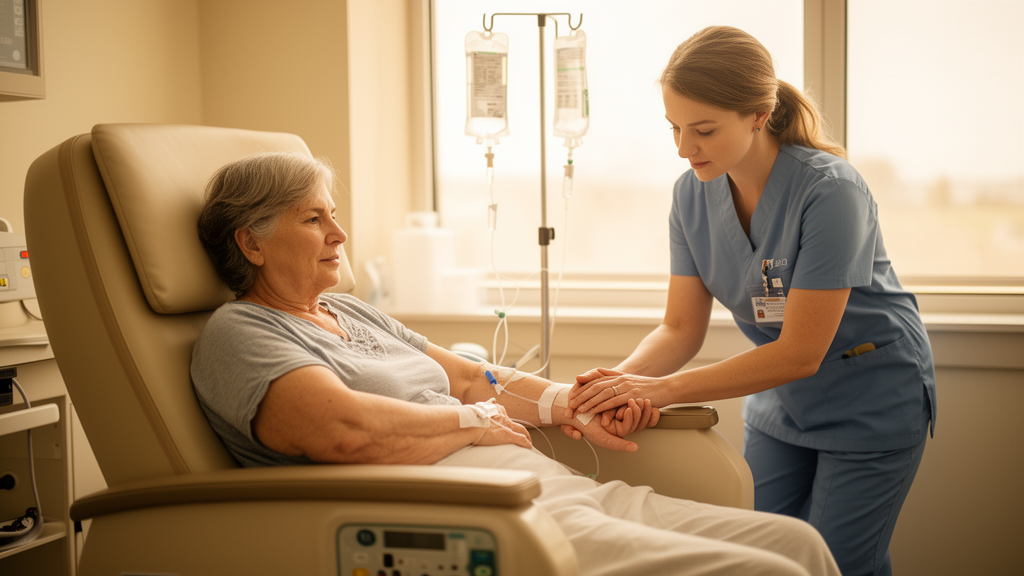
A retrospective pilot study at City of Hope’s Lennar Foundation Cancer Center found that patients receiving hand and/or foot massage during chemotherapy infusion reported lower symptom scores immediately afterward. The uncontrolled analysis included 313 patients and 652 massage sessions, with the largest model-estimated pre–post changes observed for neuropathy, tiredness, wellbeing concerns and anxiety. Because there was no comparison group, the findings show an association with massage rather than establishing that massage caused the improvements.
The pilot clinical service was conducted over 12 months in 2023–2024. Patients undergoing chemotherapy were offered complimentary 15- to 20-minute effleurage massages from a licensed massage therapist. The technique used long, gentle, gliding strokes without deep pressure, and patients could choose massage of the hands, feet or both. The program was designed to assess whether massage could be delivered without interrupting clinical care and to examine changes in patient-reported symptoms during infusion.
Participants completed a modified Edmonton Symptom Assessment System immediately before and directly after each massage. Symptoms were rated from 0 to 10 and included nausea, pain, tiredness, anxiety, depression, shortness of breath, neuropathy and wellbeing concerns. The study also recorded demographic characteristics, cancer type and stage, chemotherapy regimen and the number of massage sessions per patient. These assessments were collected during routine clinical care and analyzed retrospectively as part of a quality-improvement initiative.
Most participants were female (73.5%), the median age was 62, and patients self-identified as White (56.5%), Asian (18.5%) or Hispanic or Latino (10.5%). Hematologic cancers were the most common diagnosis (27.5%), followed by gastrointestinal cancers (19.5%), breast cancer (19.2%) and gynecologic cancers (16.3%). Stage IV disease was documented for 30.7% of the cohort, while 29.7% had unknown stage. Participants received a median of two sessions, with a range of one to 24; 74% chose combined hand and foot massage, while 13% chose hand massage and 13% chose foot massage.
Mixed-effects linear regression models accounted for repeated measurements within individuals and included time, massage type, the interaction between time and massage type, age and gender. Each symptom was modeled separately, with restricted maximum likelihood and the Kenward–Roger method. The time effect was significant for every evaluated symptom, with F-statistics ranging from 25.73 for nausea to 128.84 for neuropathy and all p-values below 0.001. Estimated mean pre–post changes were 1.46 points for neuropathy, 1.21 for tiredness, 1.20 for wellbeing concerns, 1.19 for anxiety, 0.87 for pain, 0.59 for depression, 0.50 for nausea and 0.45 for shortness of breath.
Baseline symptom burden was also substantial across the cohort. Tiredness was reported by 82.8% of patients and had a mean score of 3.78, while neuropathy was reported by 65.2% and had a mean of 3.22. Wellbeing concerns were reported by 77.9%, with a mean score of 3.24, and anxiety was reported by 59.3%, with a mean of 2.34. The immediate pre–post estimates therefore occurred in a population experiencing frequent symptoms during treatment, although the study did not include a no-massage control group for comparison.
There was no statistically significant interaction between time and massage type for any symptom, indicating that the models did not detect different pre–post change patterns among hand, foot and combination massage. Post hoc slice tests nevertheless produced differing estimates by modality. For example, foot massage was associated with estimated changes of 1.65 points for neuropathy, 1.46 for tiredness and 1.15 for pain, compared with 1.17, 1.06 and 0.49 points, respectively, for hand massage. These modality-specific results were presented descriptively and do not establish that one type of massage was superior.
No adverse events or complications attributed to massage were reported during the program. A separate survey of infusion nurses was completed by 22 of 28 nurses who received the questionnaire. Respondents rated the perceived effect on patient stress at 4.9 out of 5 and improvement in overall patient symptom burden at 4.4 out of 5. They also rated the effect on their own stress or burden at 4.4 and unanimously selected 1, meaning no disruption to nursing tasks. These survey findings describe staff perceptions and were not controlled measures of clinical benefit.
The study has several limitations. It was retrospective, prospective in its collection of observational data, and conducted at one cancer center with one massage therapist, limiting generalizability. The absence of a control group prevents clear attribution of pre–post improvements to massage, while the immediate assessments did not establish whether benefits persisted. Post-session surveys were collected by either massage therapists or nurses, which the authors noted could introduce response bias. The findings support the feasibility and acceptability of the service and show associations between massage sessions and lower immediate symptom scores, but randomized studies with longer follow-up are needed to evaluate efficacy, optimal treatment parameters and longer-term effects.
Subject of Research: Retrospective pilot study of massage during chemotherapy infusion and patient-reported symptom burden
Article Title: A pilot study of the impact of massage therapy on symptom burden during infusion in patients with cancer
Article References: DiCristofano, C., Razavi, M., Tran, P. H., Ku, S., Fisher, A., Kim, E., Rose, J., Hedgpeth, N., Fertal, J., & Lee, R. T. (2026). A pilot study of the impact of massage therapy on symptom burden during infusion in patients with cancer. Frontiers in Oncology, 16, Article 1943581. https://doi.org/10.3389/fonc.2026.1943581
Image Credits: AI Generated
DOI: 10.3389/fonc.2026.1943581
Keywords: massage therapy, chemotherapy infusion, cancer care, symptom burden, neuropathy, tiredness, anxiety, wellbeing, retrospective study, pilot, impact, massage
Cite Scienmag News
Nathaniel Bowman. (October 21, 2026). A pilot study of the impact of massage therapy on symptom burden during infusion in patients with cancer. Scienmag. https://scienmag.com/a-pilot-study-of-the-impact-of-massage-therapy-on-symptom-burden-during-infusion-in-patients-with-cancer/
Nathaniel Bowman. "A pilot study of the impact of massage therapy on symptom burden during infusion in patients with cancer." Scienmag, 21 October 2026, https://scienmag.com/a-pilot-study-of-the-impact-of-massage-therapy-on-symptom-burden-during-infusion-in-patients-with-cancer/. Accessed 21 October 2026.
Nathaniel Bowman. "A pilot study of the impact of massage therapy on symptom burden during infusion in patients with cancer." Scienmag. October 21, 2026. https://scienmag.com/a-pilot-study-of-the-impact-of-massage-therapy-on-symptom-burden-during-infusion-in-patients-with-cancer/


